If you are in the exciting early stages of designing a light filled extension, you are probably imagining wide glazed doors opening onto a sun drenched terrace. It is the perfect indoor outdoor lifestyle for your family. That vision is beautiful, but there is one crucial detail that is often overlooked. It can dramatically affect how comfortable and usable that space becomes.
Before you go any further, here is what you absolutely need to know.
Key Takeaways
- The best time to plan for an awning is during the architectural design stage, ideally at RIBA Stage 2. This is when structural decisions are being made and drawings are first developed.
- Single storey extensions require special attention because the parapet wall above the doors is often too narrow to support the forces generated by an awning. These forces include dead weight, wind uplift and torsion, and they must be safely anchored.
- To ensure proper rain runoff, the awning must be installed at a pitch of around 14 to 15 degrees. This requires careful height calculations to avoid creating a head height hazard.
- The awning must also be mounted high enough to clear open bi fold doors. If this is not considered, the doors may clash with the awning when opened, creating both a safety issue and a usability problem.
- Waiting until later in the build often leads to visible brackets, compromised aesthetics and costly retrofits.
The Common Misunderstanding: Awnings as a Finishing Touch
Many people think of an awning as something you add at the end of a project, like garden furniture or outdoor lighting. It is easy to assume that it is a decorative item chosen once the build is complete.
In reality, an awning is a structural element. It must be planned and designed into the building from the beginning. The difference between planning for one and retrofitting one is significant.
Why Single Storey Extensions Require Special Planning
On a double storey house, there is usually plenty of structure above the doors to support the forces generated by an awning. The weight bearing capacity is there and fixings can be anchored securely.
On a single storey extension, the situation is very different. The parapet wall above the glazed doors is often narrow and lacks the strength needed to anchor the awning safely. This is especially true for wider awnings with long projections.
Awnings create substantial forces. The dead weight alone can be over one hundred kilograms. Wind uplift can generate retracting forces of more than three hundred kilograms per bracket. These loads must be distributed correctly and the structure must be designed to handle them.
The Lintel Solution: Planning for Load and Height
To support an awning safely on a single storey extension, the lintel above the doors must be carefully specified. This is not just about holding up the wall. It is about managing the static load of the awning, the dynamic forces when it is extended in wind and the precise placement of fixing points.
In many cases, a steel I beam lintel is the right solution. It provides the strength needed to anchor the awning securely. However, because the lintel is set back from the outer wall, steel sections are needed to make the structural connection to the awning brackets at the correct height.
As mentioned earlier, mounting height is crucial. It affects the pitch required for rain runoff, the clearance above head height and the ability to open bi fold doors safely beneath the awning.
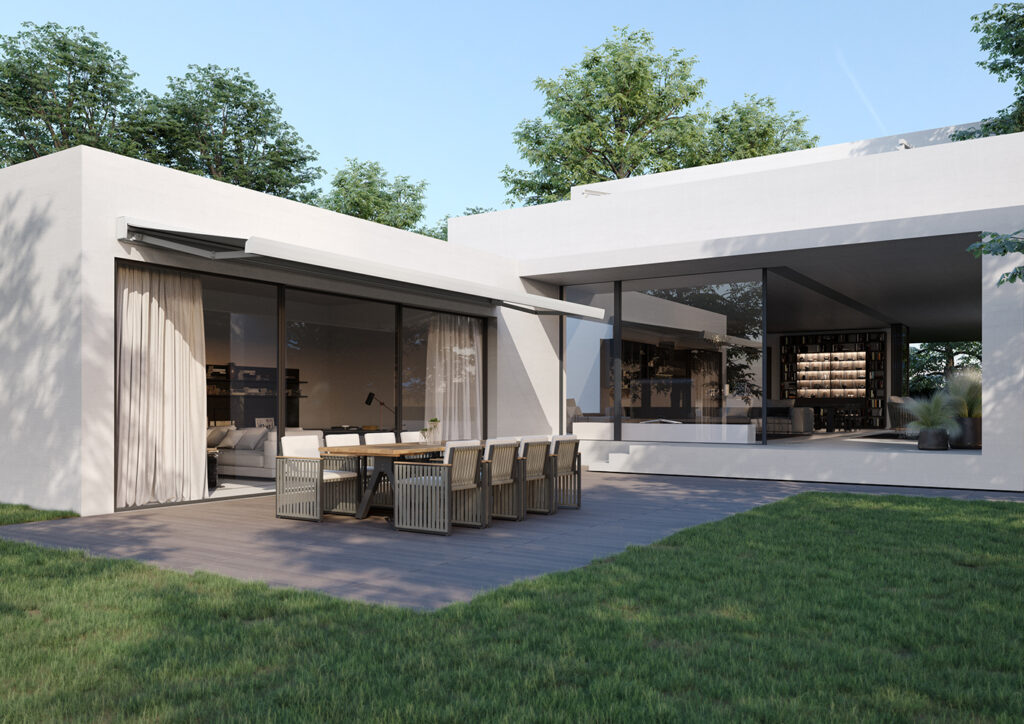
A Real Example: Planning Ahead to Protect the Dream
We recently worked with an architect and structural engineer on a South West facing extension. The homeowner, Michelle, had the foresight to plan for a seven metre wide awning with a two point six metre projection, even though it was not in the budget yet.
Here is what they did right.
- They specified an I beam lintel that could handle both the weight of the awning and the wind forces.
- The retracting force was calculated at 370kg per bracket, based on a wind pressure of 70N per square metre.
- We designed five custom Z shaped galvanised steel sections to bolt between the flanges of the I beam and rise through the cavity wall.
- These brackets were positioned at the correct height and spacing, ready for future installation.
Michelle’s extension is ready for an awning at any time. There will be no structural surprises and no visible metalwork. Just smart planning.
Answering Your Toughest Questions
“My architect has not mentioned this. Should I be concerned” Not necessarily. Architects manage hundreds of details and shading is not always top of mind. This is your opportunity to collaborate. You can ask questions like, how can we make sure this glazed space stays comfortable all year round, or could we plan for an awning now even if we install it later.
Is it really worth the extra cost and planning upfront Yes. The cost of designing in structural support is small compared to the disruption and expense of retrofitting later. It protects your investment and ensures long term comfort.
The Way Forward: A Simple Plan for Success
At WindowTreat, we believe in proactive shading design. Here is your action plan.
- Start the conversation early. Raise the awning topic during RIBA Stage 2 when structural drawings are being developed.
- Think about the forces involved and how they will be supported.
- Plan for the future. Even if you delay installation, make sure the structure is ready.
- Speak to a specialist. A quick chat with a shading expert can reveal options you may not have considered.
Protecting Your Dream From the Start
Planning for an awning is not just another item on your checklist. It is the key to making your glazed extension liveable, comfortable and beautiful for years to come.
Your vision is achievable. By moving the conversation about shading to the beginning of your project, you ensure that your dream is never compromised.
If you are thinking about an awning, the key is to act early. Call our specialists on 01256 345580 for a friendly chat about how to integrate shading seamlessly and preserve your dream design from the start. You can also book an appointment online right now.