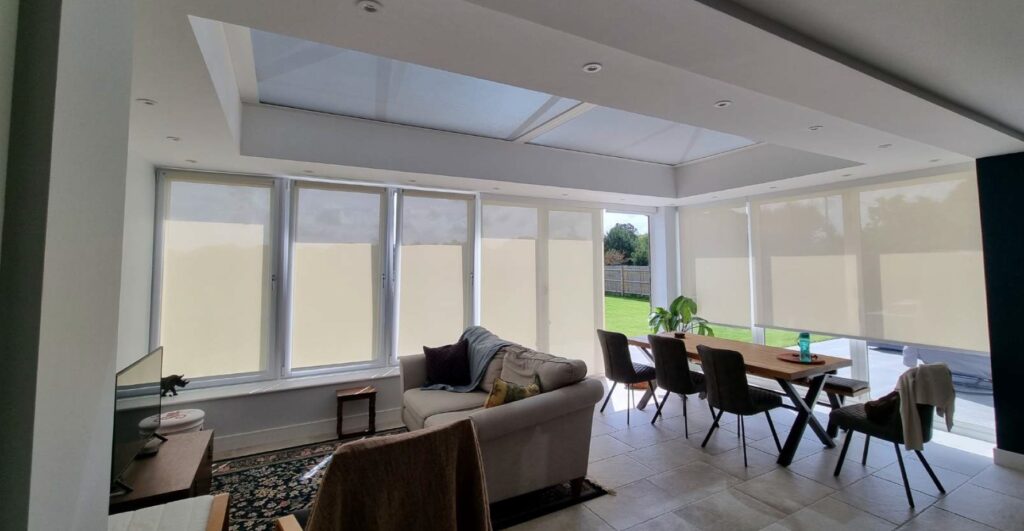
Spending thousands on motorised shading for your extension, only to discover it won’t talk to your smart home system – that’s not a hypothetical worry. It happens.
Most shading companies won’t mention it until after you’ve committed. And very few will explain how electric blinds, electric awnings, and concealed systems all connect to the same smart ecosystem – or where window film fits alongside them.
This guide covers the full picture. We explain exactly which smart home platforms work with specialist electric blinds and awnings, which need extra hardware, what the whole setup genuinely costs, and how concealed Blindspace® systems take the experience to another level entirely.
We’ll also flag one important compatibility limitation that most companies in our industry avoid mentioning altogether.
Our goal is to give you the full picture so you can make the right decision, even if that means you don’t choose us.
Key Insights from This Guide:
- Smart electric blinds and awnings need a hub to connect to your home – the motor alone cannot talk to Wi-Fi
- Amazon Alexa and Google Home integrate natively, but Apple HomeKit has a significant limitation that most suppliers ignore
- The real value of smart shading isn’t voice commands: it’s automated scenarios that manage heat, privacy, security, and wind protection without you lifting a finger
- The same Somfy TaHoma hub controls your interior blinds and your exterior awnings – one ecosystem, indoors and out
- Concealed Blindspace® systems combined with smart automation create invisible intelligence – shading that appears from nowhere, does its job, and vanishes
- 3M window film works alongside smart automation as a passive complement – handling UV and heat rejection around the clock while your automated blinds and awnings handle the rest
- Hub and integration costs are modest (£175–£600), but must be budgeted upfront
- Smart automation is genuinely life-changing for large glazed extensions, and genuinely unnecessary for a small spare bedroom window
Smart Home Compatibility at a Glance
| Platform | Native Integration? | Extra Hardware Needed? | Typical Extra Cost |
| Amazon Alexa | Yes, via TaHoma hub | TaHoma Switch only | ~£175–£199 |
| Google Home | Yes, via TaHoma hub | TaHoma Switch only | ~£175–£199 |
| Apple HomeKit | No (with standard motors) | Bond Bridge Pro + Homebridge | ~£380–£440+ |
| Control4 / Crestron | Yes, with gateway | URTSI or Bond Bridge Pro | £300–£600+ |
| Loxone / KNX | Possible, complex | RS485 gateway or relay | £200–£500+ |
This applies to both electric blinds and electric awnings using Somfy motors. Detailed explanations of each platform below.
Why Trust This Guide?
At WindowTreat, we specialise in solving the complex comfort challenges created by large architectural glazing – inside and out. Our team lives with this technology daily; our own specialist, Chris, runs automated blinds in his own home. We use Somfy motors and the Zigbee protocol because we believe in robust, two-way communication that genuinely enhances how you live. We install electric awnings on the same smart platform, and we integrate Blindspace® concealment systems that make the technology invisible. We’re also honest about what doesn’t work, including the limitations we’ll flag below.
What We Cover in This Guide:
- How smart shading connects to your home – the hub, the protocol, and the ecosystem
- What works out of the box, and what needs extra steps
- Making it simple – scenes, schedules, and sensors
- Electric awnings – the outdoor side of the same smart ecosystem
- Concealed systems – when smart automation meets Blindspace®
- Where 3M window film fits alongside smart automation
- Planning smart integration from day one vs adding it later
- Who smart automation is, and isn’t, for
- Frequently asked questions
- Your next step
- Smart blinds and automation articles
How Smart Shading Connects to Your Home
In our experience fitting smart blinds and awnings across hundreds of projects, the single biggest misunderstanding is this: the motor inside your blind or awning cannot connect directly to Wi-Fi. It uses radio frequency, not internet protocol.
That means you need a bridge – a small hub that translates your smart home commands into signals the motor understands.
Think of it like a translator sitting between two people who speak different languages. Without the translator, nothing happens.
This applies equally to interior electric blinds and exterior electric awnings. The same hub speaks to both.
The Hub Is Not Optional
The standard solution is the Somfy TaHoma Switch. It’s a compact box that plugs into your broadband router.
It controls up to 40 channels – blinds, awnings, and sensors combined – and integrates with Zigbee devices. The cost is approximately £175–£199.
There is a cheaper alternative called the Somfy Connectivity Kit at around £70. However, it’s significantly limited.
| Feature | TaHoma Switch (~£199) | Connectivity Kit (~£70) |
| Device limit | 40 channels | 20 channels |
| Sun/wind/temperature sensors | Yes | No |
| Advanced scene scheduling | Yes | Limited |
| Voice assistant integration | Full | Basic |
| Suitable for large extensions | Yes | Rarely |
| Controls awnings and blinds | Yes | Blinds only (limited) |
The Connectivity Kit cannot connect to sun, wind, or temperature sensors. For a glazed extension where automated heat management is the whole point – or for an awning where wind protection is essential – this is a serious limitation.
We wouldn’t recommend it for the kind of architectural spaces we typically work with.
The Zigbee Advantage
The motor technology itself is evolving rapidly. Somfy is transitioning from one-way radio control to the Zigbee protocol, which creates a mesh network in your home.
Each motor communicates with the next, strengthening the signal. More importantly, Zigbee enables two-way communication.
This means your system can confirm the blind actually moved. It can report battery levels and position.
With older one-way motors, your app might show “closed” when the blind is actually stuck open. That defeats the purpose of a security automation like holiday mode.
What Works Out of the Box, And What Needs Extra Steps
Having helped homeowners integrate blinds and awnings with every major smart home platform, we can tell you the experience varies enormously depending on your ecosystem.
Here’s the honest breakdown.
Amazon Alexa and Google Home: Straightforward
Both platforms integrate natively through the TaHoma hub. Setup takes minutes.
You say “Alexa, close the kitchen blinds” and it happens. You can add blinds and awnings to routines, grouping them with lights and other devices.
Google Home works the same way. Voice commands are reliable and responsive.
These two platforms don’t require the motor to report its exact position back. They simply send the command, and the blind or awning executes it.
Apple HomeKit: The Honest Limitation
This is the part most blind companies avoid mentioning. We believe you deserve to know before you commit.
Standard Somfy motors are not natively compatible with Apple HomeKit.
Apple requires two-way communication for certification. The motor must confirm its exact position – something older radio-only motors cannot do.
If you buy specialist electric blinds and a TaHoma hub expecting them to appear in your Apple Home app, they won’t.
There are workarounds. A Bond Bridge Pro combined with Homebridge software can bridge the gap. But it requires technical confidence, and costs an additional £380–£440.
For an Apple-only household, this is a genuine consideration. If you aren’t willing to use a workaround, voice-controlled blinds through Siri simply won’t work out of the box.
We’d rather tell you this now than have you discover it after spending £5,000 on a system.
Professional Home Automation: Control4, Crestron, Loxone
If you have a whole-house system, integration is fully possible. It just requires the right gateway.
Control4 works well through a Somfy URTSI interface or the Bond Bridge Pro. Your integrator maps the blind and awning channels to your touchscreens and scenes.
Loxone and KNX require RS485 gateways or relay extensions. These translate wired automation commands into radio signals for the blinds. KNX weather stations can also trigger awning retraction based on wind and rain – a particularly useful feature for exposed outdoor shading.
The typical programming cost for professional integration is £300–£600, depending on complexity. Budget for this upfront.
Making It Simple – Scenes, Schedules, and Sensors
In our experience, the real value of smart shading has nothing to do with voice commands. One of our specialists, Chris, puts it perfectly:
“I don’t press a button. I don’t even think about it.”
Chris has automated electric blinds in his own home. They close approximately 15 minutes before dusk for privacy. They open again in the morning for natural light.
They’re also connected to a sun sensor. If the room gets too warm while he’s out, the blinds close automatically. He comes home hours later to a comfortable room.
That’s the shift. Smart shading isn’t about convenience. It’s about proactive comfort management that works while you’re living your life – inside and out.
Scenarios That Change How You Use Your Home
Pre-programmed “scenarios” are where the real lifestyle value sits. Here are the ones our clients use most – across blinds, awnings, and concealed systems.
| Scenario | What Happens | Why It Matters |
| Cinema Mode | Blackout blinds close, lights dim | Instant home cinema at the touch of a button |
| Holiday Mode | Blinds and lights follow a two-week cycle | Creates implied occupancy, a genuine security deterrent |
| Morning Sun | Blinds open gradually with sunrise | Wake naturally, not to a jarring alarm |
| Comfort Mode | Sun sensor triggers blinds when room overheats | Your extension stays comfortable even when you’re away |
| Dusk Privacy | All blinds close automatically at sunset | No more remembering to close every blind manually |
| Wind Guard | Wind sensor automatically retracts the awning | Protects your awning from storm damage – even when you’re not home |
| Patio Shade | Sun sensor deploys the awning when it gets hot | Your outdoor space is shaded and ready before you step outside |
| Reveal Mode | Concealed Blindspace® blinds retract into their pocket | The architecture takes centre stage – no visible hardware anywhere |
One client’s holiday mode blinds actually helped catch a burglar attempting a break-in. The automated cycle of blinds and lights made the house look occupied.
The system went further. At dusk, the blinds came down and the landing light went on. Later, the bathroom light switched on. Then the bedroom light, behind the already-closed blind.
It created a convincing illusion of someone moving through their evening routine.
A Real Family, A Real Problem Solved
We worked with a family in Cirencester who had rescued Cooper, a Border Collie cross. He loved their new extension but caused problems at night.
Cooper barked constantly at his own reflection in the dark glass. The family’s sleep was ruined.
We installed automated blinds on both the roof lantern and sliding doors. A dusk-automation programme closes all the blinds as evening arrives, eliminating the reflections.
A sun sensor also closes the blinds when the room gets too hot, keeping Cooper safe when the family is out.
The result was a cooler home, better sleep, and a happy dog. It’s a perfect example of how smart electric blinds solve problems you never expected, going far beyond simple remote control.
Electric Awnings – The Outdoor Side of the Same Smart Ecosystem
Here’s something most companies won’t tell you: if you’re investing in smart blinds for your extension, there’s a good chance you should be thinking about your outdoor space at the same time.
WindowTreat’s electric awnings use the same Somfy motors and connect to the same TaHoma hub as your interior blinds. One hub, one app, one ecosystem – controlling both your indoor comfort and your outdoor shading.
That means the awning above your patio and the roof lantern blind inside your kitchen extension can be managed from the same phone screen, respond to the same sensors, and be included in the same automated scenarios.
Wind Sensor Automation – The Feature That Pays for Itself
The single most valuable smart feature for an electric awning isn’t voice control or scheduling. It’s the wind sensor.
A small vibration sensor sits on the front bar of the awning. When wind speed picks up beyond a set threshold, the awning retracts automatically – even if you’re out for the day, asleep, or on holiday.
Without this, a sudden gust can cause serious damage. We’ve seen awnings from other suppliers wrecked because the homeowner simply wasn’t there to press a button. With sensor automation, it doesn’t matter. The system protects itself.
Sun-Triggered Deployment
On the other end, a sun sensor can deploy your awning automatically when the temperature on your patio or terrace reaches a set level. You come home from work to find your outdoor space already shaded and comfortable – ready for an evening outside.
Combined with the wind guard, this creates a fully autonomous outdoor shading system. The awning deploys for sun, retracts for wind, and you don’t think about it.
How Awning Automation Differs from Blind Automation
The core technology is the same – Somfy motor, TaHoma hub, sensor triggers. But the priorities differ. With interior blinds, the primary drivers are heat management, privacy, and light control. With awnings, it’s wind protection and sun shading.
The awning’s wind sensor is not optional in the way a blind’s sun sensor might be. If you’re investing in a premium electric awning, automated wind retraction is essential for protecting your investment.
Concealed Systems – When Smart Automation Meets Blindspace®
The most impressive results happen when smart automation combines with complete architectural concealment. This is where WindowTreat’s approach genuinely differs from what you’ll find elsewhere.
Blindspace® is a precision-engineered concealment system. The blind mechanism – motor, barrel, fabric – recess completely into a pocket built into your ceiling or wall. When the blind is retracted, there’s nothing visible. No cassette, no bracket, no hardware. Just a hairline gap in the ceiling.
Now combine that with smart automation, and something rather special happens.
Invisible Intelligence
A concealed blind that responds to a sun sensor doesn’t just manage your comfort – it does so without ever revealing itself as a piece of technology. The blind descends from what appears to be a seamless ceiling, manages the heat or privacy, then retracts and disappears again.
You don’t see it arrive. You don’t see it leave. Your space simply adapts.
This is what we mean by invisible intelligence. The architecture stays pure. The glazing stays uncluttered. And the comfort management happens in the background, driven by sensors and schedules rather than switches and remotes.
For homeowners who’ve invested heavily in the aesthetic of their extension – the clean lines, the minimalist finish, the uninterrupted views – this combination of Blindspace® concealment and smart automation preserves everything they set out to achieve.
James’s Garage – Concealment and Smart Control in Action
We worked with James, a passionate classic car collector, who needed to protect his prized vehicles from UV damage. His bespoke garage featured two roof lanterns and wide bifold doors.
We integrated smart blackout blinds for both the roof and the doors. The key was concealing them in Blindspace® boxes, colour-matched to the window frames.
At the touch of a button, James can either showcase his collection in full view or completely shield it. When retracted, the blinds are completely invisible.
That’s the “wow factor” beyond basic functionality. The cars and the architecture are the focus, not the technology.
Planning Concealment for Smart Automation
There’s an important planning consideration here. Blindspace® systems must be integrated during the build – ideally before first-fix, certainly before plasterboarding. The structural void that houses the blind needs to be designed in from the start.
If you’re planning smart automation and you want concealment, the conversation needs to happen early. Retrofitting a Blindspace® pocket into a finished ceiling is invasive and costly. But specifying it during the design phase? That’s straightforward, and the result is transformative.
This connects directly to our S.H.A.D.E. principle – the idea that shading should be designed into architecture from day one. Concealed smart automation is the ultimate expression of that principle.
Where 3M Window Film Fits Alongside Smart Automation
3M window film is a passive, permanent product applied directly to your glass. It has no motorisation and no smart home integration capability. It sits outside the smart automation ecosystem entirely.
But that doesn’t mean it’s irrelevant to this conversation. In fact, it’s often a critical companion to it.
Here’s how the two work together. Window film handles the constant, around-the-clock challenges – UV protection that prevents your furnishings from fading, baseline heat rejection that reduces solar gain through the glass itself, and daytime privacy on certain films. It works whether you’re home or away, whether the power is on or off, whether your Wi-Fi is up or down. It never needs a command.
Your smart blinds and awnings then handle the variable, responsive challenges – closing for privacy at dusk, deploying shade when the sun hits a threshold, creating blackout for cinema mode, simulating occupancy while you’re on holiday.
One of our most effective solutions combines 3M film on the glass with automated electric blinds above it. The film takes the edge off the heat all day. The blinds respond intelligently when conditions change. Together, they create a “belt and braces” approach that neither product achieves alone.
If you’re considering smart automation for a space that also suffers from significant solar heat gain or UV exposure, it’s worth discussing window film as part of the overall solution. It won’t appear in your TaHoma app, but it will be working quietly alongside everything that does.
Planning Smart Integration from Day One vs Adding It Later
Having seen hundreds of projects, we know that timing determines outcome when it comes to smart shading.
This connects directly to our S.H.A.D.E. principle – the idea that shading should be designed into architecture from day one. Smart integration is no different.
The First-Fix Advantage
If you’re still in the building phase, smart integration is straightforward. Your electrician runs a dedicated power supply to each blind location during first-fix wiring.
This costs a fraction of what it would later. A fused spur installed during the build might cost £70–£120. Retrofitting one into a finished wall could be £150–£300 or more.
Hardwired motors are also more powerful and reliable than battery alternatives. For large, heavy blinds on a roof lantern, mains power is always the preferred choice.
The same principle applies to awning installations. Running power to the mounting point during the build is far simpler and cheaper than retrofitting it later.
And if you want Blindspace® concealment, first-fix is not just preferable – it’s essential. The structural pocket must be built in before plastering.
It’s Never Too Late, But Earlier Is Better
Even if your build is finished, smart automation is still very achievable. Battery and solar-powered motors avoid the need for disruptive wiring.
A couple in Dorset, Duone and Simon, had an existing garden room that was unbearable in summer. We retrofitted a performance blind system years after the original build, and it transformed the space completely.
The automation side was added through the TaHoma hub, connected wirelessly. No chasing into walls. No replastering.
Earlier is cheaper and cleaner. But later is absolutely possible.
Who Smart Automation Is, And Isn’t, For
We’d rather lose your business than set you up to fail. So here’s our honest assessment.
Smart shading automation is a genuinely worthwhile investment if:
- You have a large glazed extension with south or west-facing glass that overheats
- You already use Amazon Alexa, Google Home, or a professional automation system
- You’re in the planning or early build stages and can integrate wiring from the start
- You value the idea of your home managing comfort, privacy, and security without daily intervention
- You have bifold doors, sliding doors, or roof lanterns that are difficult to reach manually
- You’re investing in an electric awning and want it protected from wind damage automatically
- You want the cleanest possible finish – concealed Blindspace® systems combined with automated control
Smart shading automation is NOT for you if:
- You’re an Apple-only household and won’t consider workarounds for HomeKit – you’ll be frustrated
- You prefer to avoid home technology and the idea of a hub and app feels like a burden
- Your budget is extremely tight – the smart features add £175–£600 on top of the blind cost, and that money might be better spent on a higher-performance fabric
- You have small, standard windows in a spare bedroom – a simple blind does the job, and smart automation is genuinely overkill
- You want precise percentage positioning (“open to 42%”) – current technology works best with open, close, and a preset favourite position
If your main frustration is an unusable, overheating extension, the performance fabric matters more than the smart features. Get the fabric right first. Smart automation is the layer that makes a great blind even better.
But don’t pay a premium for intelligence if you just need a window covering.
Frequently Asked Questions About Smart Shading Automation
How much does the smart home hub cost? The Somfy TaHoma Switch costs approximately £175–£199. The budget Connectivity Kit is around £70 but lacks sensor compatibility, which limits automated heat management for blinds and wind protection for awnings. For large extensions, the TaHoma is the right choice.
Can the same hub control blinds and awnings? Yes. The Somfy TaHoma Switch controls up to 40 channels across both interior blinds and exterior awnings. One hub, one app, one ecosystem. If you’re planning both, there’s no need for separate systems.
Can I add smart features to existing electric blinds? If your existing blinds use Somfy motors, a TaHoma hub can often connect to them. This works provided the motors are compatible with the hub’s protocol. It’s always worth checking with a specialist before purchasing.
What happens if my internet goes down? Your blinds and awnings will continue to work via their original remote control. The TaHoma hub relies on an internet connection for voice commands and app control, so those features pause during an outage. Pre-set schedules stored locally on the hub may still run, depending on the model. Crucially, wind sensor retraction for awnings works independently of your internet connection.
How does a sun sensor work? A small wireless sensor is placed outside, typically on a south-facing wall. When sunlight intensity exceeds a set threshold, it tells the hub to close specific blinds or deploy an awning. When the sun moves or clouds arrive, the blinds reopen or the awning retracts. It’s automatic, and the running cost is negligible.
How does a wind sensor protect an awning? A vibration sensor mounted on the awning’s front bar detects movement caused by wind. When it exceeds the set threshold, the awning retracts automatically. This happens whether you’re home or not, protecting your investment from storm damage around the clock.
What does it cost to run smart electric blinds? Almost nothing. A mains-powered motor running daily costs approximately 18 pence per year in electricity. Ten blinds use less power annually than a single dishwasher cycle.
Can I integrate smart blinds with Control4 or Loxone? Yes, with the right gateway hardware. Control4 typically uses a Somfy URTSI or Bond Bridge Pro. Loxone requires an RS485 extension. Budget £300–£600 for professional programming and setup.
Will the technology become obsolete quickly? The Zigbee protocol used in newer Somfy motors is an open, widely adopted standard. It’s the same protocol used by Philips Hue, IKEA smart home, and many other systems. Obsolescence risk is low because the protocol itself is not proprietary.
Do smart blinds work with voice commands? Yes, through Amazon Alexa or Google Home via the TaHoma hub. You can say “Alexa, close the living room blinds” and it works immediately. Apple Siri does not work natively with standard Somfy motors.
Can Blindspace® concealed blinds be automated? Absolutely. Blindspace® is a concealment system, not a motor system. The blind inside a Blindspace® pocket uses the same Somfy motor and connects to the same TaHoma hub as any other electric blind. The difference is purely visual – the blind disappears completely when retracted.
Does 3M window film work with smart home systems? No. Window film is a passive product with no motorisation or connectivity. It works constantly, with no commands needed. Many of our clients combine film with smart blinds – the film manages baseline heat and UV protection, while the automated blinds handle variable conditions like privacy, glare, and temperature spikes.
Your Next Step
If you’re planning an extension with large glazing, or you have one that’s already too hot to enjoy, the best time to discuss smart integration is right now.
Not because we want to sell you something. Because the decisions you make at this stage determine what’s possible later – whether that’s concealed Blindspace® pockets that need to be built in, awning power supplies that are easier to run during construction, or simply choosing the right hub before you commit to a smart home platform.
A quick conversation helps us understand your space, your smart home setup, and whether automation genuinely makes sense for your situation. Sometimes the honest answer is that it doesn’t.
We’d rather tell you that upfront.
Book a free virtual consultation – it’s a relaxed video call where we look at your space together and explore the possibilities. No pressure. No obligation.
Or call our specialists directly on 01256 345580 to discuss smart integration for your project.
Smart Blinds and Automation Articles
The Full Picture: Pros, Cons, and Real-World Experience
- Smart electric blinds – the real pros and cons – An honest look at the genuine drawbacks and real lifestyle benefits. Covers cost, reliability concerns, and how scenarios like cinema mode and holiday mode actually work in practice.
Smart Integration Deep Dives
Detailed guides on Zigbee integration, specific automation scenarios, and professional system compatibility are coming soon.
Electric Awning Automation
Guides covering wind sensor setup, sun-triggered deployment, and how to automate your outdoor shading alongside your interior blinds are coming soon.
Concealed Systems and Smart Control
Articles exploring how Blindspace® concealment combines with smart automation for the ultimate invisible shading experience are coming soon.
Window Film and Smart Blinds – The Combined Approach
A guide to combining passive 3M window film with active smart shading for comprehensive glazing comfort is coming soon.