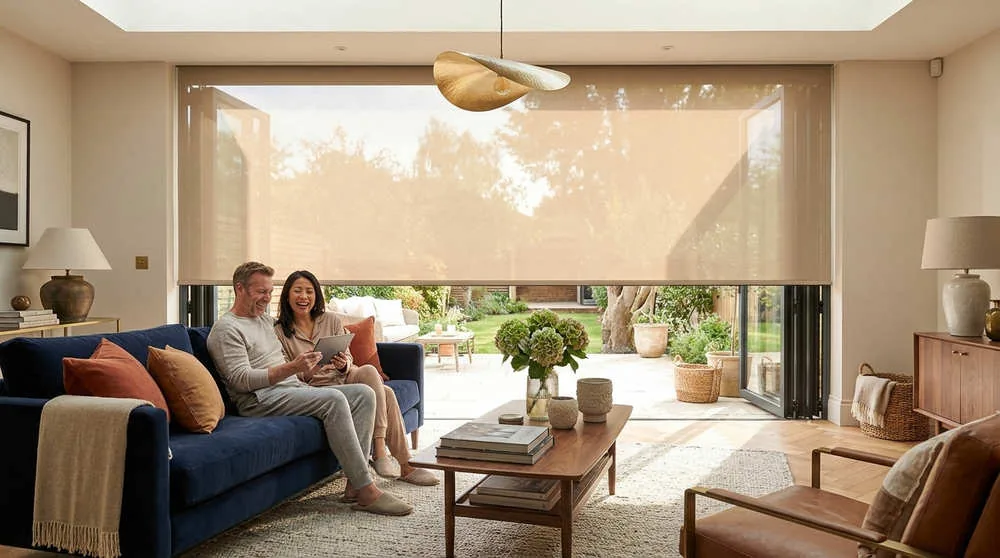
We talk to homeowners every day, and so many conversations start the same way.
You’re planning a beautiful, light-filled extension, dreaming of that seamless connection to the garden and visualising family breakfasts in a kitchen flooded with sunlight.
It’s an exciting, aspirational vision, but without careful planning, the reality can be starkly different, an unusable greenhouse by 11 am or glare so intense you can’t watch TV.
To help you protect that dream, here are the key things to understand.
Key Takeaways
- Shading is architecture, not an accessory: Treat shading as a core design element from day one to ensure your space is usable.
- Protect your dream: Early planning prevents common issues like overheating, glare, and lost views.
- The S.H.A.D.E. framework: Use our five pillars, Shading Design, Human-Centred, Architectural Intent, Directing Light, Environmental Performance, to guide your project.
- Invest now to save later: While upfront planning requires more time and coordination, it safeguards your long-term investment and comfort.
The problem isn’t the glass. The problem is that the control for the glass was treated as an afterthought.
Think of it like commissioning a high-performance sports car but forgetting to design any brakes. It’s a powerful, beautiful machine, but without control, it’s unusable and compromised. We see this all the time.
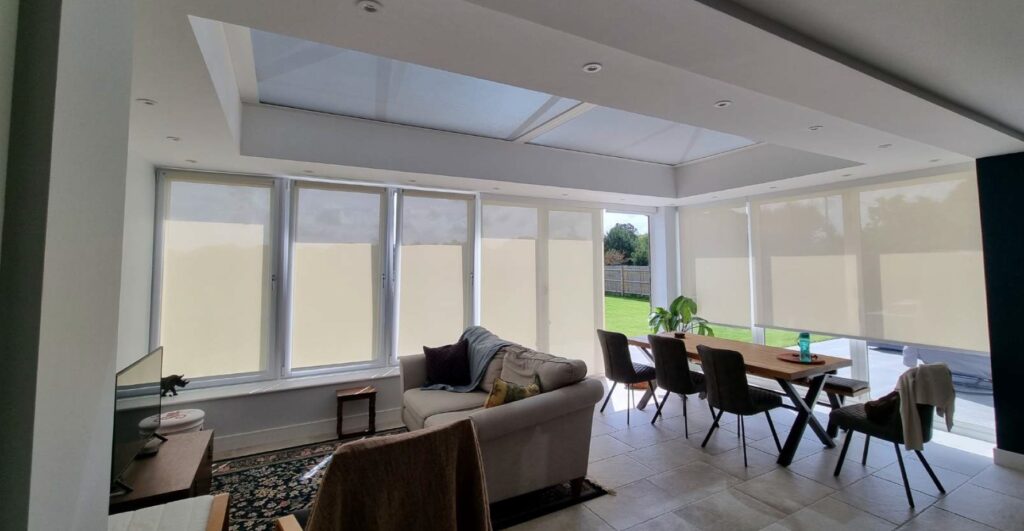
Nigel came to us many years ago, just after completing what he believed was his dream extension. The design was striking. Wide bi-fold doors wrapped around two elevations, opening onto uninterrupted countryside views. Neither Nigel nor his architect wanted anything that might interrupt those beautifully framed sightlines. To bring in even more daylight, they added a large roof lantern.
You can probably guess what happened next.
As spring arrived, the very features that looked so impressive on paper became the source of daily frustration. The generous glazing that once felt uplifting turned harsh and overpowering. Heat built quickly, glare flooded the room, and the space became unusable long before summer had even begun.
We were able to help. We retrofitted shading for both the roof lantern and the bi-fold doors, restoring comfort and making the room functional again. But I will never forget Nigel’s disappointment. He felt let down, almost as if the architect had misled him, because the clean lines he loved were no longer as pure as they could have been. With a little foresight and the right advice during the design stage, the entire system could have been integrated seamlessly. At this point, myself and by brother Steve (founders of WindowTreat) began working on the S.H.A.D.E principle
Nigel’s experience is a reminder that the problem is rarely the glass. The real issue is treating the control of the glass as an afterthought.
What is the S.H.A.D.E. Principle?
At its heart, the S.H.A.D.E. principle is a simple but profound idea: Shading is part of architecture, not an accessory.
It’s a framework for thinking about and integrating shading right from the very beginning of the design process, just as you would the glazing itself.
When you treat shading as an essential component, you move from “bolting on” a fix later to designing in comfort, performance, and aesthetic integrity from the start.
This is the only way to guarantee your new space lives up to the vision, in comfort, in performance, and in usability. It’s a better way to build with glass.
Of course, we must be transparent: adopting this rigorous approach requires a greater investment in upfront planning, time, and coordination with your architect and build team compared to a simple retrofit.
It demands more thought at the start of your project when you are juggling many decisions. However, this initial effort is the necessary step to protect the much larger long-term investment you are making in your home, ensuring the space you build is one you can actually enjoy every day.
The S.H.A.D.E. principle for homeowners is built on five key pillars:
S – Shading Deserves to Be Designed
If light is the raw material, shading is the control. It’s as essential as the glazing it complements.
Without it, light overwhelms, views are lost behind constantly drawn blinds, and the architecture disappears. When designed in early, shading holds the line and keeps the light where it belongs. This isn’t optional; it’s architectural responsibility.
H – Human-Centred Design
Architecture serves people. Unfiltered light can interfere with focus, disrupt sleep, and rob a space of calm.
S.H.A.D.E. protects the way you live by filtering glare, preserving the view, and balancing brightness. It supports your wellbeing, visual, thermal, and emotional. It’s the key to how you can enjoy your extension in every season.
A – Architectural Intent
Every detail in your design has a purpose. But when shading is left too late, that detail is diluted by visible headboxes and retrofit solutions.
S.H.A.D.E. ensures your design intent makes it to the final build. Blinds become invisible when not in use, hidden in architectural pockets. This is the ultimate expression of minimalism, and you can explore the options in our honest comparison of concealed vs. surface-mounted blinds.
D – Direct the Light
Glazing is an opportunity, but without control, it becomes a liability. This is where so many projects fail experientially. You pay for every square metre, but can only use some of it.
S.H.A.D.E. gives you control over how light enters and behaves, ensuring glazing and shading work together. This lets you manage heat and glare properly, so you don’t feel like you’re in a goldfish bowl at night.
E – Environmental Performance
Sustainability lives in the details. A building that works with its climate cuts solar gain in summer and retains warmth in winter, reducing the load on your heating and cooling systems.
This improves your home’s energy performance, supports regulatory compliance, and delivers thermal comfort you’ll feel every single day. This is why choosing the right blind fabric to handle heat and glare is so critical.
The Result of S.H.A.D.E.: An Uncompromising Vision
When you plan using the S.H.A.D.E. principle, the result is transformative.
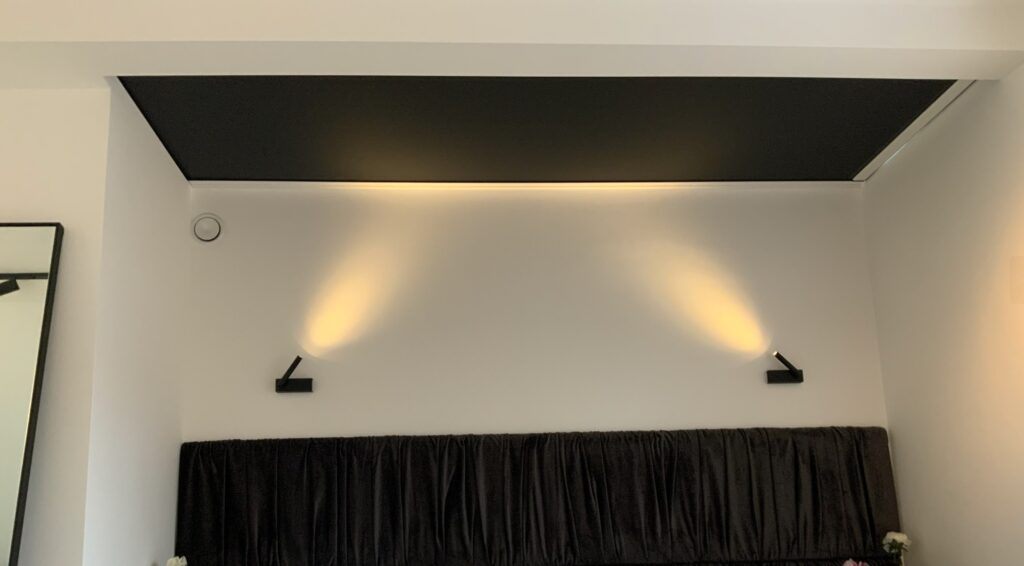
We worked on a fascinating project with an architect, Pavla, and a structural engineer, Piers, who were designing their own dream home in Fulham. A key feature of their master bedroom was a large flat roof light, designed specifically so they could stargaze from their bed.
The challenge was twofold: they needed total blackout for sleep, but the solution had to be completely invisible to preserve the star-gazing experience. This is the S.H.A.D.E. principle in action.
By working with them from the design stage, we integrated our blackout roof blind solution directly into the wall structure. The blind emerges from a hidden recess, provides flawless blackout, and then retracts to become completely invisible, revealing the sky.
It’s a beautifully executed, remote-controlled system that elegantly appears when needed and vanishes completely when not. It’s the perfect example of achieving an uncompromising architectural vision.
Watch Pavla & Piers Dream Skylight Blind In Action
If you’re a homeowner just starting to plan your build, you can read more in our detailed guide:
A Guide for Architects: Integrating S.H.A.D.E. into Your Design Process
For our architect and design partners, S.H.A.D.E. is a framework for ensuring total client satisfaction. We know your goal is to deliver a design that is not only aesthetically stunning but also highly functional.
However, shading is often overlooked or underspecified, leading to post-completion client complaints about comfort that can reflect poorly on the design.
By integrating the S.H.A.D.E. framework into your process (e.g., at RIBA Stage 1-3), you protect your architectural intent and deliver a space that performs flawlessly. This approach ensures compliance with regulations like Part O (overheating) and contributes to positive EPC and BREEAM outcomes.
We have created a dedicated technical guide on applying this framework in a professional context.
- What is S.H.A.D.E.? (Explained for Architects)
- What Common Glazing and Shading Mistakes Do Architects Make?
Moving from Afterthought to Architecture
The single most important decision you can make to guarantee the long-term comfort and usability of your new space is to plan for shading from the beginning. It’s the difference between a room that looks beautiful and a room that feels beautiful to live in.
If your architect didn’t plan for blinds, find out if it’s too late to get the minimalist look you wanted.
You can also learn about what to look for when choosing a specialist electric blind company and get an overview of how much electric blinds really cost in our honest UK guide.
Planning early is key to seamlessly integrating comfort and control into your design. Call us on 01256 345580 to find out more, or message WindowTreat for an initial chat and a video session to explore the possibilities for your space.