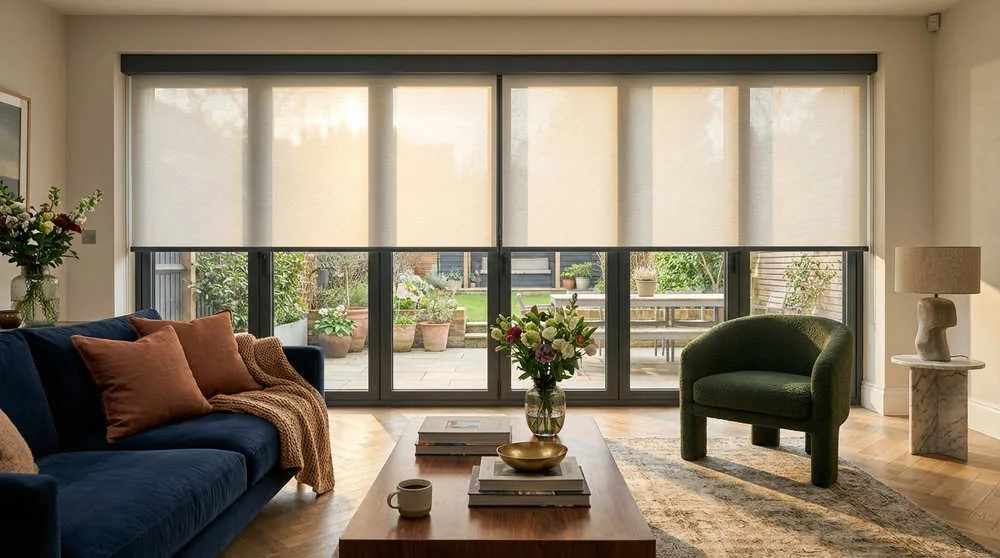
Are you standing in your beautiful new glass extension, wondering why the room you invested so much in has become uncomfortably hot, unbearably bright, or feels like a goldfish bowl at night?
Perhaps you are worried about the cost, the mess of installation, or making a choice you will regret. You are in exactly the right place. The reality is that large expanses of glass require active management. Without it, your dream space can quickly feel like a liability rather than an asset.
This guide walks you through everything you need to know before investing a single pound. We cover realistic pricing and why some systems cost so much more. We explore common problems that catch homeowners out, including how to integrate specialist window film or external electric awnings. We also provide honest comparisons between your options and, crucially, who these solutions are not the right fit for.
By the end, you will have the knowledge to make a confident decision that protects the dream you have built. Our goal is to educate you so you can make the best decision, even if that means you do not buy from us.
6 Critical Mistakes That Add £3,000+ to Your Project Costs
- The biggest mistake is leaving shading until the build is complete. This locks you out of the most elegant solutions like Blindspace, which must be designed into the structure early.
- Realistic pricing for quality systems often ranges from £3,800 to £5,500 per window. Understanding this prevents budget shocks later in the project.
- The buy twice trap is a common frustration. Cheaper systems often fail within 12 months, forcing you to pay again for the quality you should have started with.
- Your architect likely did not plan for this. It is not your fault, but acting as doctors for glass, we can still help you find a cure.
- A single blind forces daily compromises. You often end up losing your view entirely just to stop the heat.
- Ignoring external solutions like electric awnings or window film. Sometimes the best way to handle heat is to stop it before it even touches the glass surface.
What Do We Mean by Specialist Glass Management?
We are talking about motorised shading systems and performance treatments specifically engineered for modern architectural glazing. This includes roof lanterns, bifold doors, and large sliding glass walls that define contemporary UK homes.
Unlike standard window blinds, these systems handle large spans and horizontal orientations while maintaining a minimalist aesthetic. We often use a combination of high-performance fabrics, robust motors, and architectural concealment like Blindspace to ensure your blinds disappear when they are not needed. For certain projects, we might even recommend specialist window film to block UV rays or an electric awning to intercept the sun before it enters the room.
Standard high street blinds simply will not work for your glass extension. You need a specialist solution that respects the integrity of your architecture.
Why Your Dream Space Becomes Unusable
You have likely invested over £100,000 into a stunning extension. The architect sold you the dream of light-filled spaces and a seamless connection to the garden. But now you are living in it, and the reality is often quite different.
The Greenhouse Effect
On sunny days, your beautiful kitchen becomes unbearably hot. Homeowners tell us they have had to wear sunglasses indoors just to eat lunch at the table. The glass is doing its job by letting light in, but the heat gets trapped with nowhere to go. It is like a performance sports car with no brakes. It looks powerful, but without control, the experience is compromised.
The Goldfish Bowl Effect
When the sun goes down and the lights come on, the physics reverse. Your windows become mirrors from the inside and a brightly lit stage for anyone outside. Privacy disappears instantly, and the room can feel cold and exposed.
The Fading Problem
Natural light is beautiful, but it contains agents of destruction. UV rays can cause irreversible damage to your Scandinavian wooden floors, expensive furniture, and artwork. This is where specialist window film can act as a permanent shield. It protects your interior without changing the clear look of your glass.
Understanding the Four Pillars of Comfort
To achieve a perfectly comfortable home, we look at four primary tools. Each has a specific role to play depending on your architecture and lifestyle.
1. Electric Blinds: The Versatile All-Rounder
Electric blinds provide on-demand control for heat, glare, and privacy. They are the most common solution for roof lanterns and bifold doors. By using high-performance metallised fabrics, they can reflect up to 80 percent of solar heat while still allowing you to see through to your garden. This prevents the room from feeling like a dark box during the day.
2. Electric Awnings: The External Shield
Internal blinds are excellent, but they let the heat through the glass before they start working. External electric awnings, such as The Artemis, intercept the sun before it even touches the window. This is the most effective way to manage extreme heat in south-facing extensions.
We helped Helen and Michael in Peckham with this exact challenge. They had a beautiful kitchen that became a furnace in the summer. Internal blinds helped slightly with glare, but the room remained too hot to enjoy. By installing an external roof blind, we stopped the heat at the source. Even during the peak of summer, their kitchen stayed comfortably cool while remaining bright and airy.
3. Blindspace: The Art of Concealment
If you want a minimalist look where the blinds are only visible when they are closed, Blindspace is the answer. These precision aluminium profiles are installed during the build to create a hidden pocket in the ceiling. When the blinds are up, they vanish completely. This preserves the architectural vision without compromise.
We worked with Pavla, an architect, and Piers, a structural engineer, who designed their own home in Fulham. A key feature was a large roof window above their bed. A visible blind box would have ruined the clean lines of their ceiling. By planning for Blindspace concealment from the very beginning, their blackout blind remains entirely hidden until it is needed. This allows them to enjoy an uninterrupted view of the stars from their bed while ensuring a pitch-black environment for sleep.
4. Window Film: Invisible Protection
Window film is a fantastic option for gables or large glass walls where you want constant protection without any physical barriers. Modern 3M films are virtually invisible but can block 99 percent of damaging UV rays. This is the best way to protect your furniture and flooring from fading while keeping your views completely clear throughout the day.
Honest Pricing: What Quality Systems Actually Cost
Quality electric blinds for architectural glazing are a significant investment. You are likely to see quotes ranging from £3,000 to £17,000 depending on size and complexity. Many homeowners are shocked that a specialist blind can cost as much as the roof lantern itself. However, the price reflects specialist engineering. A standard blind hangs with gravity. A roof lantern blind fights gravity every day, requiring zip-tensioning to prevent sagging like a sack of potatoes.
We worked with a client, Phil, who chose a cheaper alternative to our recommended system. He wanted to tailor his cloth after a long, expensive build. Within six months, he called us back because the cheaper blind sagged terribly. Worse, the room was still too hot because the budget fabric did nothing to manage heat. He ended up buying twice. He paid for the cheap system that failed, then for the quality solution he initially considered. The lifetime cost of quality is almost always lower than repeatedly replacing inferior systems.
Smart Home Integration: Beyond the Remote
You might wonder if automated blinds are just a gadget. The reality is they provide intelligent control that manual blinds cannot match. Chris, one of our specialists, lives with this technology every day and explains the benefit perfectly.
I have two electric blinds in my own home. They close automatically about 15 minutes before dusk for privacy and then open again in the morning. I get the benefit of natural light when it is there and privacy in the evening without having to think about it. They are also connected to a sun sensor. If the room starts to get too hot while I am out, the blinds will close by themselves. I can come back three hours later and find the room is comfortable because the system has been working for me while I have been away. It moves the system from being a simple mechanical blind to an intelligent part of my home comfort.
Who Are These Specialist Solutions NOT Right For?
We believe in radical transparency. Our systems are likely not the right fit if:
- You have small, standard-sized windows. Our engineering is designed for large architectural glass and would be overkill for a standard bedroom.
- Your absolute priority is the lowest possible upfront price. High-street options will always be cheaper initially, even if they lack the performance and longevity of a specialist system.
- You are looking for a DIY project. Our installations require professional measurement and coordination with multiple trades.
- You are not facing any heat or glare issues. If your room is comfortable as it is, you may not need this level of performance.
Your Next Steps: From Overwhelmed to Empowered
The investment in quality shading is about protecting the much larger investment you have made in your home. It ensures your space remains comfortable, usable, and true to your vision for years to come. Planning early is the key to successfully integrating comfort and control into your design.
Call us on 01256 345580 or book an appointment.
All Articles in This Guide
Understanding the Foundation
What is S.H.A.D.E.? (explained for homeowners) The guiding philosophy that treats shading as integral to architecture, not a decorative afterthought. This is essential reading for anyone planning a glass extension.
What is S.H.A.D.E.? (explained for architects) How the S.H.A.D.E. framework integrates with RIBA stages and building regulations for those working with design professionals.
Critical Timing Decisions
When is the right time to plan electric blinds for my extension? The single most important decision for achieving minimalist results. We explain why RIBA Stage 2 is the point of no return for concealment.
What common glazing and shading mistakes do architects make? Empowering you to have a confident conversation with your design team by highlighting the three oversights we see repeatedly.
Making Your Space Work Year-Round
How do I enjoy my extension with large glass expanses in every season? Moving from a position of compromise to one of control. We discuss managing heat in summer, warmth in winter, and privacy at night.