If you’ve invested in a beautiful glass extension, you know the dream: a light-filled space connecting home and garden. But you may also know the nightmare: on a sunny day, that dream room becomes an unusable “greenhouse.”
We often speak to homeowners who are understandably frustrated because their new kitchen is “boiling” or “like an oven,” with intense glare making it impossible to relax. They’re looking for a real solution.
The answer lies in understanding one key difference: do you want to manage heat that’s already inside, or stop it before it ever gets in? This is the crucial distinction between internal blinds and external shading.
Understanding this difference is the key to solving the problem for good. Here’s what you need to know.
Key Takeaways
- External shading stops over 90% of solar heat before it enters your home, making it the most effective solution for severe overheating.
- Internal blinds manage heat that is already inside, acting like a radiator. They are best for privacy, glare, and for heat only fabrics with high solar reflectance (Rs%) will be effective.
- External shading is a large investment and changes your home’s exterior, while internal blinds can be completely concealed and are better for all year round protection.
- The right choice depends on your primary goal: choose external for extreme heat and internal for an all year round solution.
Stopping Heat vs. Managing It
So, what’s happening in your room? The reality is, it’s a simple matter of physics. When sunlight hits your glass, it passes through and its energy is absorbed by the surfaces inside your room such as your floor, your sofa, your kitchen island worktop. This energy is then re-radiated as heat, and it’s trapped. The glass that let the light in is very good at keeping that long-wave heat in.
Many people’s first instinct is to install an internal blind. But here’s the problem: by the time the sun hits an internal blind, the heat is already inside your living space.
The blind fabric itself can absorb the heat and essentially turns into a large, flat radiator, still releasing that heat into your room. It manages the light and glare, but it’s fighting a losing battle against the heat if it does not have the ability to reflect the heat back through the glazing system.
So, what’s the alternative? You stop the heat before it ever hits the glass.
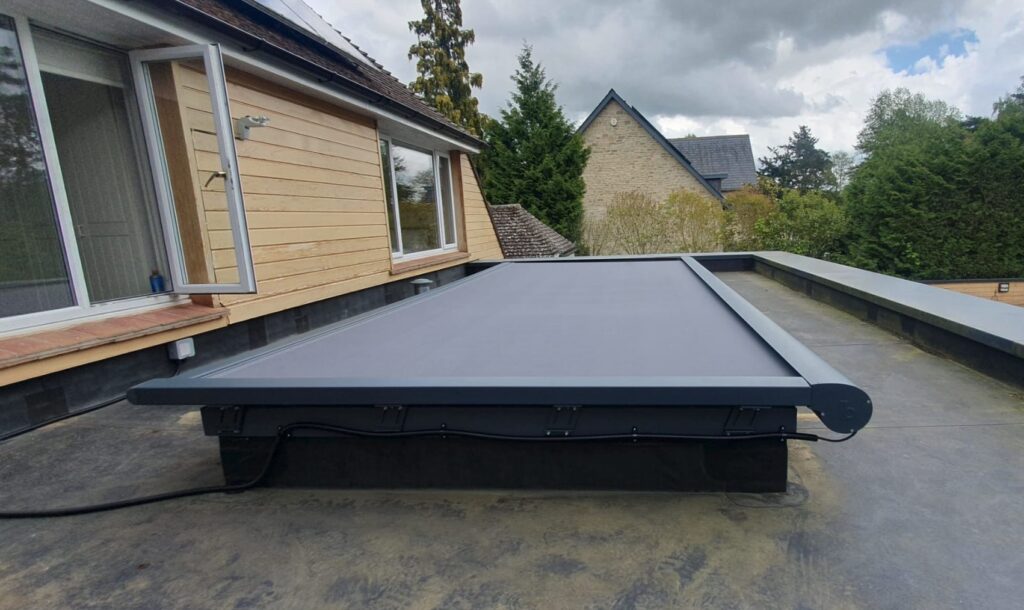
This is the fundamental principle of external shading. By blocking the sun’s energy from the outside, you prevent the heat passing through your glass, stopping the greenhouse effect at its source. The high heat rejection is achieved as the fabric can reflect and absorb the heat without trapping it within your home.
I’ve seen this again and again on architecturally designed homes. Large glazed areas without consideration for heat management. Fortunately we can generally find solutions that will dramatically transform the liveability of your designed space. Your vision of glazed space does not have to create unmanaged solar heat gain.
Inside vs. Outside Shading: A Head-to-Head Comparison
Choosing between an internal and external solution isn’t just about aesthetics; it’s a critical performance decision. External blinds are, without question, the champions of heat control, capable of blocking over 90% of solar heat. Internal blinds are managing heat that’s already in.
However, internal blinds often win on aesthetics, especially with modern concealed systems where the blind completely disappears into the ceiling. An external blind, by contrast, becomes a new, visible element of your home’s architecture albeit not always seen when looking out.
This performance difference can be a difference in investment. Because they are engineered to withstand weather and require more robust mechanisms, external solutions are a financial commitment compared to cheaper internal solutions.
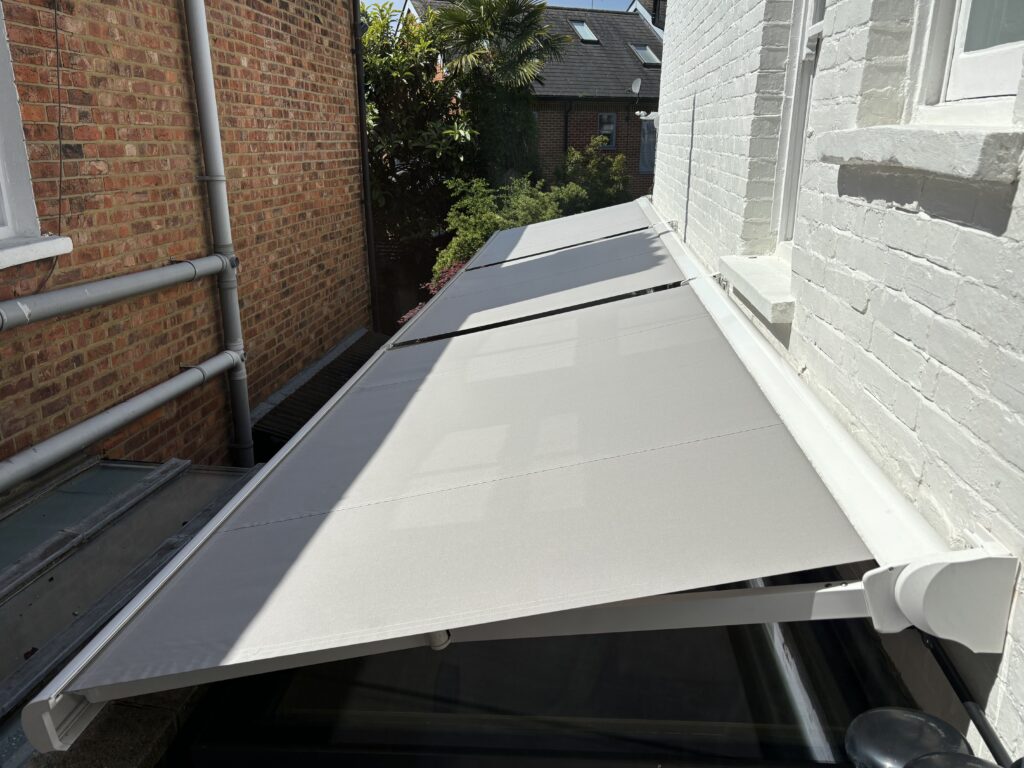
Read Our Full Comparison: Inside vs outside shading – which makes more sense for your space?
When Does an External Blind Make Sense?
An external blind is an engineering-led solution for a significant heat problem. We find it’s the perfect choice when your room is south or west-facing, as these elevations get the most intense sun.
It’s also ideal if you have very large expanses of glass, like large sliding doors where the sheer volume of glass makes heat gain extreme.
If heat control is your number one priority and you want the most effective, no-compromise solution, external shading is the definitive answer. It’s what allows you to truly enjoy your glass extension in every season.
A perfect example is a project we did for Helen and Michael in Peckham, London. Their architect had designed a stunning kitchen with extensive side and roof glazing. It was beautiful, but during sunny spells, the room became “unbearably hot” and unusable.
After looking at all the options, they realised the only way to truly solve the problem was to stop the heat at its source. We installed an external roof blind that blocks over 90% of the heat. The transformation was immediate. Their kitchen remained bright but became comfortably cool, allowing them to finally use the space exactly as they had envisioned.
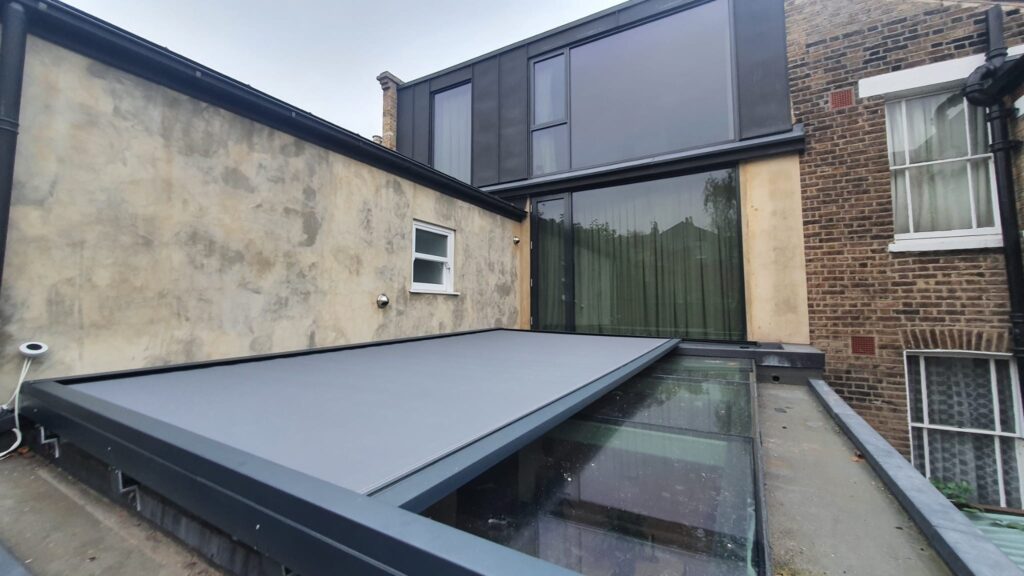
An external roof blind, like this one installed for a client in Peckham, blocks intense heat and glare at the source, transforming an “unbearably hot” kitchen into a comfortable living space
When is an Internal Blind the Smarter Choice?
As specialists, our job is to help you find the right solution, not just the most expensive one. An external blind isn’t always necessary and if your looking for an all year round solution then internal blinds are the better option.
If your main goal is privacy, especially tackling that “goldfish bowl” feeling at night, a high-quality internal blind is the perfect and most cost-effective solution. Read more about solving the “goldfish bowl” effect.
The same goes for needing blackout. For a bedroom or a kitchen media snug, an internal blackout blind is the ideal choice for light control.
Aesthetics can also be the deciding factor. If you are most concerned with achieving a specific interior look or want the total invisibility of a concealed blind system, an internal solution is often the best fit. This is a core part of our S.H.A.D.E. planning framework, which involves matching the solution to the true purpose of the space.
However be sure to discuss with true experts on how internal blind fabrics perform when coupled with modern glazing systems.
Finally, budget is often a key driver. But you’ll often find that both Premium internal blinds and External blind systems are both a considered investment so its crucial that you understand your needs and what will deliver you the best results for your home comfort.
Choosing the Right Tool for the Job
Ultimately, the best shading solution is the one that solves your biggest problem. It’s not about which blind is “best,” but which one is the right tool for your specific home.
If your main issue is managing glare or creating privacy, a high-performance internal blind is an excellent choice.
But if your problem is extreme, relentless heat that makes your room unusable, an external blind is the single most effective solution you can choose. It is the definitive answer to the greenhouse effect, giving you back the comfortable, usable space you invested in.
Getting the right solution for your specific heat problem is key to reclaiming your space and keeping that ‘dream’ alive. To get a specialist assessment and find out which solution is right for you, our team is here to help.
Call us on 01256 345580 for a friendly chat about your options, or book an appointment for an initial chat and a video session to explore the possibilities for your space.