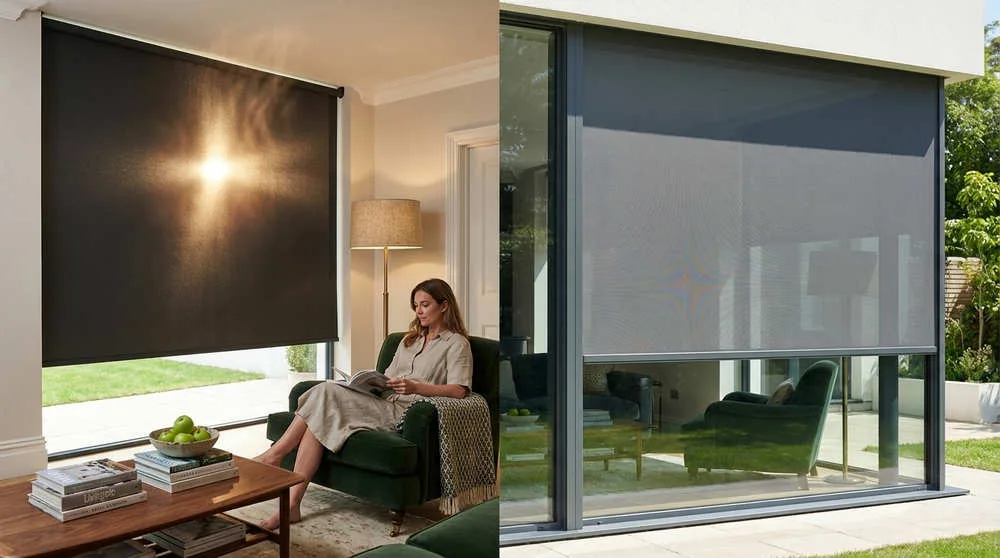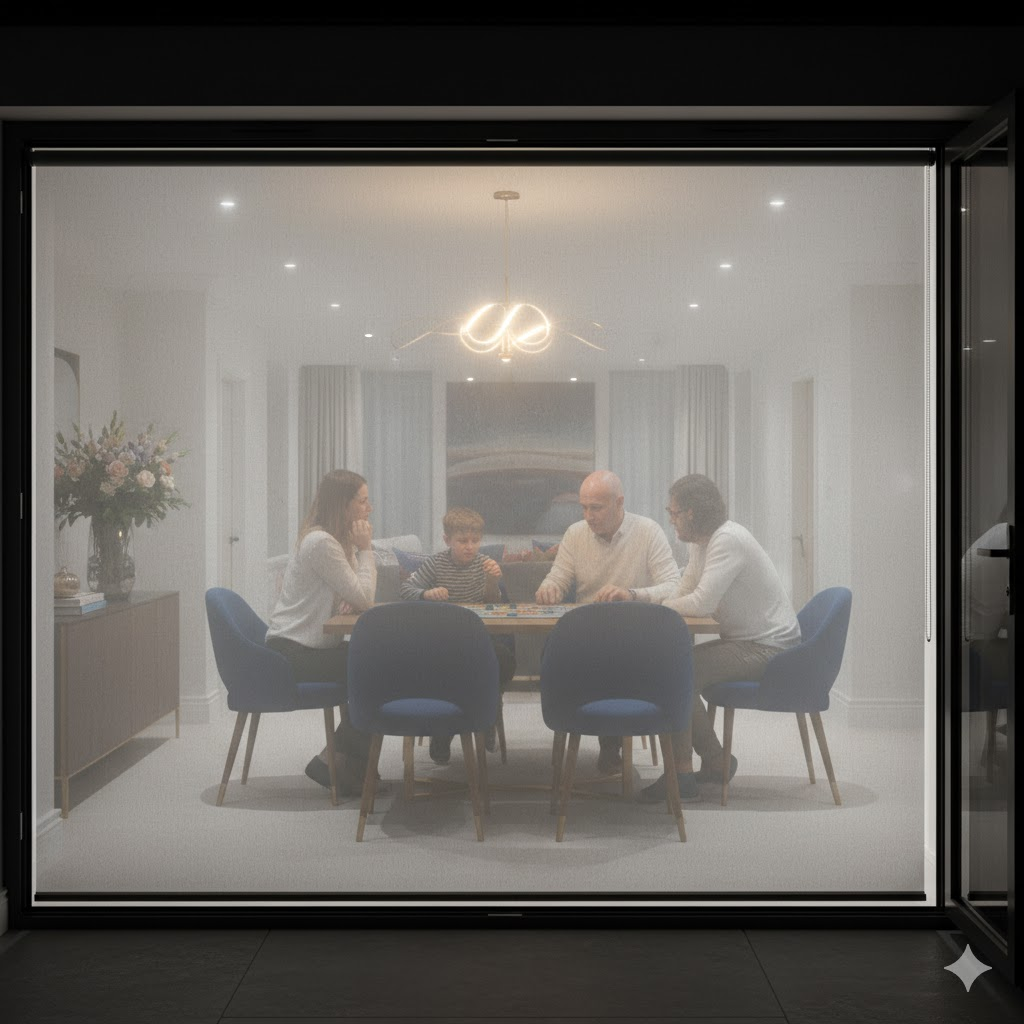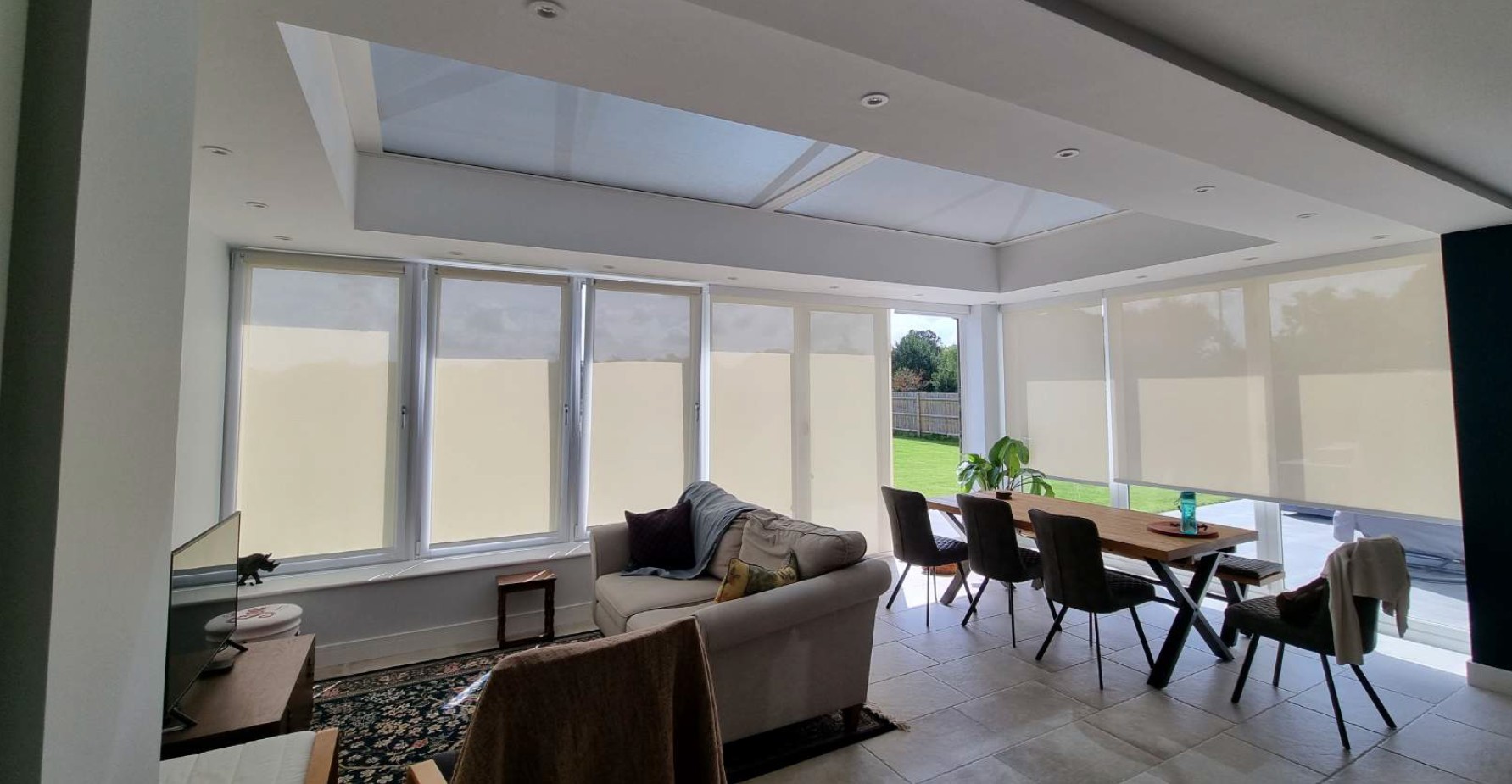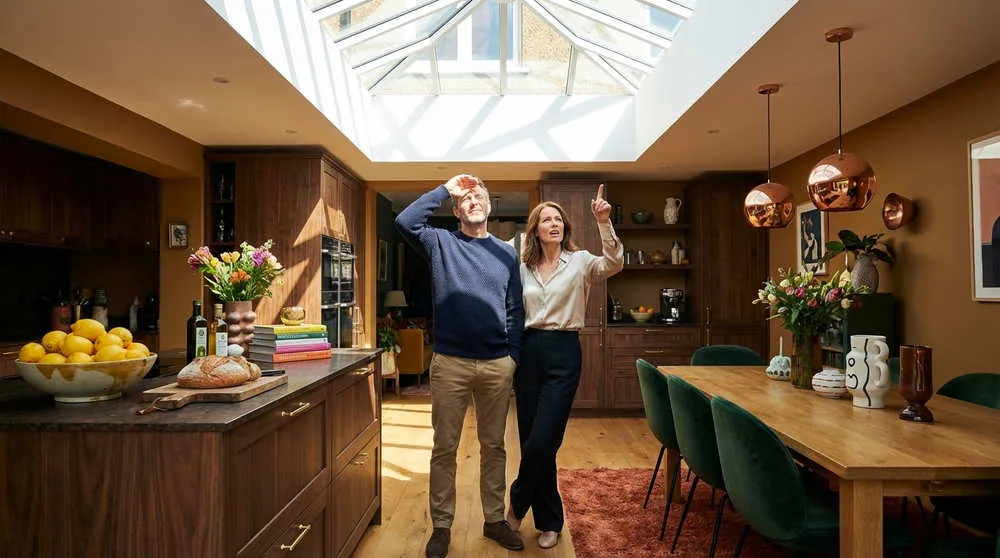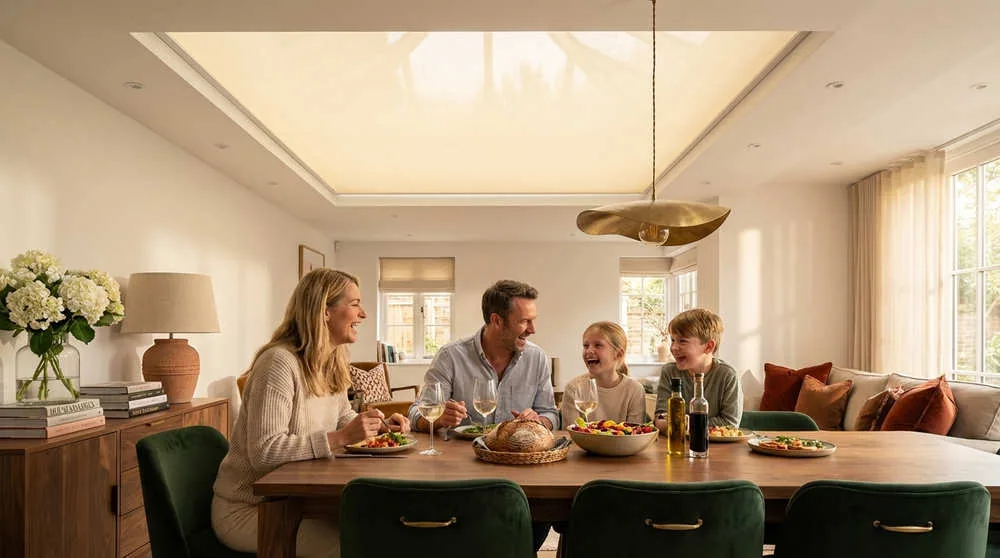








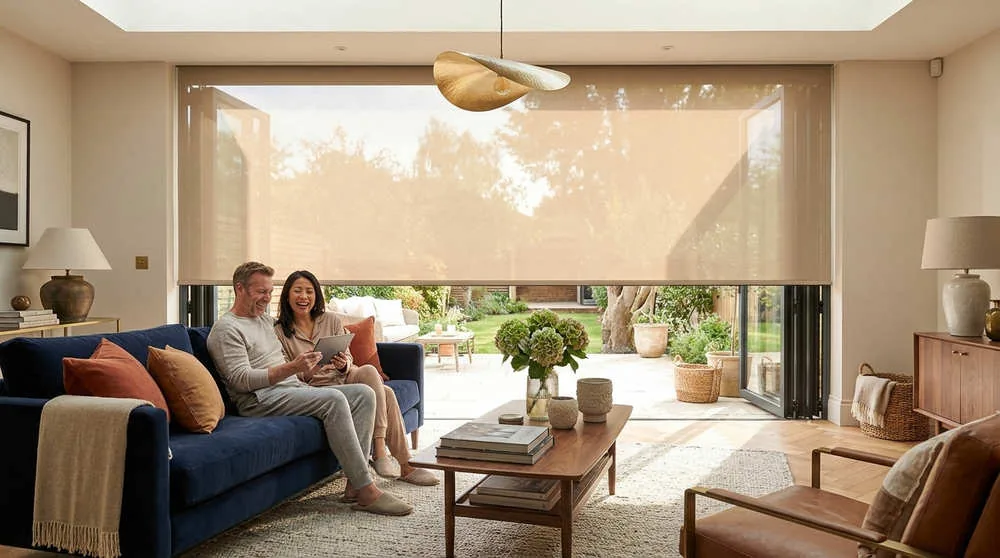
Your glass extension was supposed to be the best room in your house. Instead, for much of the year it’s the most uncomfortable – too hot in summer, blinding by day, and after dark you’re living in a goldfish bowl.
If that sounds familiar, this guide was written for you.
Here you’ll find the real science of heat control across every solution type – external shading, window film, and electric blinds – with honest performance data, clear comparisons, and a practical path to reclaiming your room. Including the “goldfish bowl” effect nobody warns you about.
Our goal is to educate you so you can make the best decision. Even if that means you don’t choose us.
Key Insights from This Guide:
- External shading blocks over 90% of solar heat before it reaches your glass – roughly three times more effective than any internal solution
- 3M window film permanently upgrades the glass itself, rejecting up to 97% of infrared heat and 99.9% of UV – with nothing visible and nothing to operate
- For internal blinds, the fabric’s Solar Reflectance (Rs) value is the single most important number for heat control, not the colour or brand. Metallised fabrics solve both heat and glare at once
- A dual blind system eliminates the daily choice between your view and your comfort
- The most effective approach often combines two or more solutions – what we call the “belt and braces” strategy
Quick Reference: Solution Comparison at a Glance
| Solution | How It Works | Heat Rejection | Glare Control | Privacy | Best For |
| Electric Awning (External) | Intercepts sun before it reaches the glass | Excellent (90%+) | Good | None | South-facing roof lanterns, maximum heat control |
| 3M Window Film | Permanently upgrades the glass performance | Very Good (up to 97% IR) | Moderate | Daytime only | Fixed glazing, UV protection, invisible solution |
| Metallised Blind Fabric (Internal) | Reflects heat from inside, adjustable | Good (up to 85% Rs) | Good | Full (with room-darkening layer) | Adjustable control, night-time privacy |
| Dual Blind System (Internal) | Two fabrics in one housing – screen + room-darkening | Good (up to 85% Rs) | Excellent | Full | Complete control without daily compromise |
Detailed breakdowns and honest comparisons for each below.
What Do We Mean by “Managing Heat, Glare and Privacy”?
It’s the challenge of making a room with large amounts of glass comfortable to live in – controlling intense solar heat in summer, cutting blinding glare during the day, and ensuring privacy at night – all without sacrificing the light and views the glass was designed to provide.
There’s no single product that solves every aspect perfectly. But with the right combination of approaches, you can have it all.
Why Trust This Guide?
At WindowTreat, we specialise in solving comfort problems caused by large glazing. We act as “doctors for glass,” diagnosing heat and light issues using measurable data, not guesswork. We’re Trading Standards Approved through Buy With Confidence, SafeContractor accredited, and every solution we recommend is backed by performance science. This means you’re protected if something goes wrong, and our recommendations are independently verified, not just sales talk.
We’re also one of very few companies in the UK that offer external awnings, 3M window film, and electric blinds as an integrated service. Most companies sell one or the other. We diagnose the problem first, then recommend the right combination – which sometimes means a single product, and sometimes means two or three working together.
What We Cover in This Guide:
- Why your extension became a greenhouse – and it’s not the glass’s fault
- Three ways to control heat – outside the glass, on the glass, and inside the room
- Stopping heat before it reaches the glass – electric awnings and external shading
- Upgrading the glass itself – 3M window film
- Managing heat and light inside the room – electric blind fabrics
- The “goldfish bowl” problem and the no-compromise solution
- One blind or two? Why a dual system changes everything
- A note on concealment – Blindspace® hidden systems
- The “belt and braces” approach – why combining solutions works best
- Enjoying every season – not just when the weather cooperates
- The cost of your comfort investment
- When specialist shading is NOT the answer
- Frequently asked questions
- Your next step
- All heat, glare and privacy articles
Why Your Extension Became a Greenhouse – And It’s Not the Glass’s Fault
Having helped hundreds of homeowners with this exact frustration, we can tell you the glass isn’t the villain. The problem is trapped energy with nowhere to go.
Modern homes are brilliantly insulated – wonderful for winter, but a liability when the sun streams through 6 or 8 square metres of roof lantern. All that trapped energy turns your room into a furnace. We liken it to a performance sports car with no brakes: beautiful and full of promise, but without control, it’s compromised.
This is now so well-recognised that UK Building Regulations (Part O) specifically address overheating risk in new homes. The problem you’re experiencing is serious enough that the government mandates solutions in new builds – you’re right to treat it as a structural comfort issue, not something to just live with.
Yet many architects still overlook shading during the design stage. Understanding common glazing and shading mistakes architects make helps you avoid the most painful – and expensive – outcomes. If your extension was already built without shading designed in, you’ll need a retrofit solution, which is exactly what the rest of this guide covers.
The good news? There are three distinct ways to tackle the problem, and they can work independently or together.
Three Ways to Control Heat – Outside the Glass, On the Glass, Inside the Room
Think of it in three layers, each tackling the problem at a different point.
Outside the glass – electric awnings and external shading intercept the sun’s energy before it even touches your glazing. This is the most effective approach for pure heat rejection, by a significant margin.
On the glass – 3M window film permanently upgrades the thermal performance of the glass itself. It’s invisible, requires no operation, and works around the clock.
Inside the room – electric blinds with high-performance fabrics manage heat, glare, and privacy from within. They’re the most flexible option, adjustable throughout the day and across seasons.
Each has strengths. Each has limitations. And for rooms with serious comfort problems, the most effective strategy often combines two or all three. We’ll walk you through each approach honestly – what it does brilliantly, what it can’t do, and when it’s the right choice for your situation.
Stopping Heat Before It Reaches the Glass – Electric Awnings and External Shading
This is where the science gets genuinely dramatic. External shading is roughly three times more effective than internal shading at keeping a room cool.
The reason is simple physics. An internal blind tries to manage heat that’s already trapped inside the room. The fabric absorbs energy and radiates it inward – effectively becoming a warm radiator in front of your window. An external blind or awning intercepts over 90% of solar energy before it even touches the glass. It stops the problem at the source.
Electric Awnings for Roof Lanterns and Patio Doors
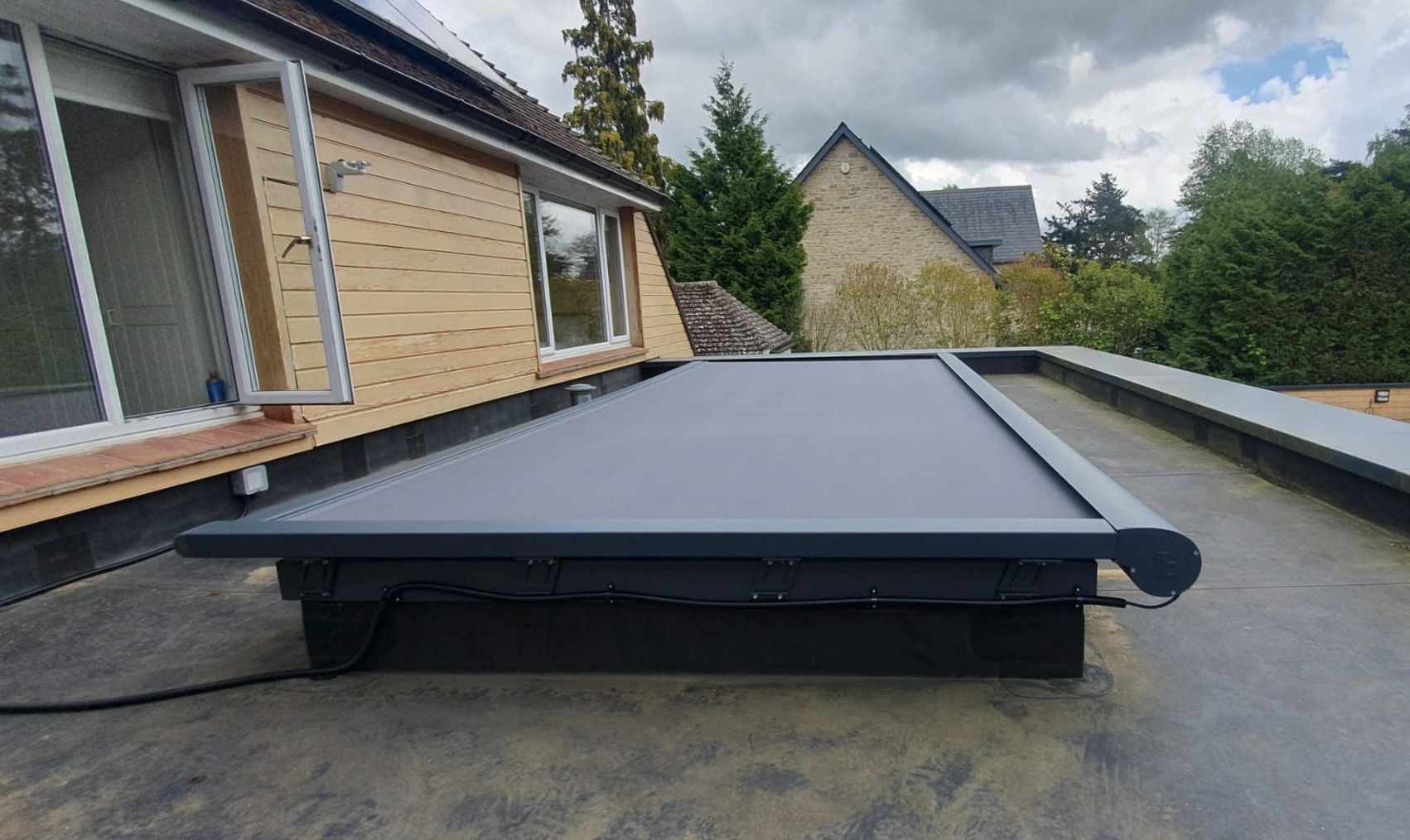
Electric awnings for roof lanterns and patio doors are the most effective external option for horizontal and angled glass. They shield the glazing from direct sun while preserving your view at lower angles.
For roof lanterns specifically, the Artemis external roof blind is engineered to sit above the glass, blocking heat from reaching the room below. For patio and bifold door openings, retractable awnings from manufacturers like Caribbean Blinds, Markilux, and Weinor provide external shade that can be extended when you need it and retracted when you don’t.
We helped Helen and Michael in Peckham, whose architect-designed kitchen was unbearably hot. An external roof blind blocked over 90% of heat gain from the outside. Their kitchen was completely transformed – comfortable even on the hottest days. It’s a powerful reminder that sometimes the best solution is an external one, tackling the problem at the source.
When External Shading Makes Sense – and When It Doesn’t
We’d love to recommend external shading for every project, but we wouldn’t be honest if we didn’t mention the practical considerations. Planning permissions may restrict external fixtures, particularly in conservation areas. Wind exposure matters – retractable awnings need to be specified for your location’s conditions. And budget plays a role – a quality electric awning installation typically starts from around £3,500–£4,000, with premium full-cassette models in the region of £5,500–£7,000+ depending on size and specification.
External shading isn’t always possible. But where it is, it’s the single most effective thing you can do for heat.
Our honest comparison of inside vs outside shading explains exactly when each approach makes sense. When external shading isn’t practical – whether due to planning constraints, budget, or building design – a high-performance internal blind with a reflective backing is the next best choice.
Upgrading the Glass Itself – 3M Window Film
Where awnings work from the outside and blinds work from the inside, 3M window film takes a different approach entirely. It upgrades the glass itself.
The Prestige series uses multi-layer nanotechnology to reject up to 97% of infrared heat while maintaining clear views. It also blocks 99.9% of UV rays. And here’s the thing that appeals to many homeowners – there’s nothing to see and nothing to operate. No hardware, no fabric, no mechanism. The glass simply performs better.
When Film Is the Right Choice
Window film is ideal for fixed glazing where you don’t need to adjust throughout the day – conservatory side panels, large picture windows, or any glass you never open. It can also be the smarter choice when budget matters. For equivalent glazed area, film is typically a lower investment than a fully installed electric blind, and it works continuously without any input from you.
3M offers several specialist films for different problems. The Prestige series is the flagship for solar heat rejection. Night Vision film reduces reflectivity for clearer views after dark while still managing daytime glare. And Thinsulate film works like an extra pane of glass – reflecting radiant heat back into the room during winter to help with insulation. Each is engineered for a specific challenge, and part of our diagnostic process is matching the right film to your situation.
The Invisible Threat: UV Damage
There’s a cost most homeowners don’t consider until it’s too late. A story we often tell involves a family with a beautiful, pale Scandinavian wooden floor. About a year after installation, they moved a large rug. The floor underneath was perfect. The surrounding wood – exposed to sunlight – was faded and yellowed beyond repair.
Here’s what that damage costs to fix:
| Item | Estimated Repair Cost |
| Reupholster a sun-damaged designer sofa | £1,350–£2,050 |
| Sand and refinish a 30m² bleached hardwood floor | £450–£750 |
| Replace faded curtains and soft furnishings | £500–£1,500 |
3M window film blocking 99.9% of UV costs a fraction of those repair bills. High-performance blind fabrics block up to 99% of UV too. Either way, it’s insurance for your other investments.
Understanding which blind fabrics offer the best long-term value helps you see past the initial price to the true cost of ownership.
When Film Alone Isn’t Enough
We believe in being straight with you. Film can’t adapt to seasons – you lose some solar gain benefit in winter too. It doesn’t provide night-time privacy. And for large south-facing roof lanterns where solar gain is extreme, film alone may not be sufficient. That’s why we often recommend film as part of a combined approach – upgrading the glass performance with film while using electric blinds for adjustable control and privacy. More on that combination below.
Managing Heat and Light Inside the Room – Electric Blind Fabrics
For rooms where you need adjustable control – the ability to fine-tune light, heat, and privacy throughout the day – electric blinds with the right fabric are the core solution.
The Science of Stopping Heat: Solar Reflectance
In our experience, the single most important number for keeping a room cool with an internal blind is Solar Reflectance (Rs). Think of it as the fabric’s ability to act like a mirror for heat.
The higher the Rs percentage, the more heat bounces back through the glass. A standard white fabric might reflect 50–70% of solar energy. A high-performance metallised fabric can reflect over 80%.
Here’s the common trap with standard fabrics: dark colours absorb heat and radiate it into the room like a radiator. Light colours reflect more heat but scatter light, creating an uncomfortable haze.
Our detailed comparison of blind fabrics for heat and light control breaks this trade-off down with real performance data.
Metallised fabrics solve the problem elegantly. A microscopic aluminium layer bonded to the backing reflects the sun’s energy regardless of the fabric’s interior colour. You get the fabrics that genuinely handle heat and glare best without forcing a compromise.
Fabric Performance at a Glance
| Fabric Type | Solar Reflectance | Glare Control | Heat Rejection | Best For |
| Dark Screen | Low (10–15%) | Excellent | Poor | Glare and TV viewing |
| Light Screen | Good (50–70%) | Poor | Moderate | Basic heat reduction |
| Metallised (Aluminium-backed) | Very High (up to 85%) | Good | Excellent | Heat AND glare together |
| Room-Darkening | Varies by colour | Total | Depends on backing | Sleep and privacy |
Choosing the Right Fabric: Function Before Fashion
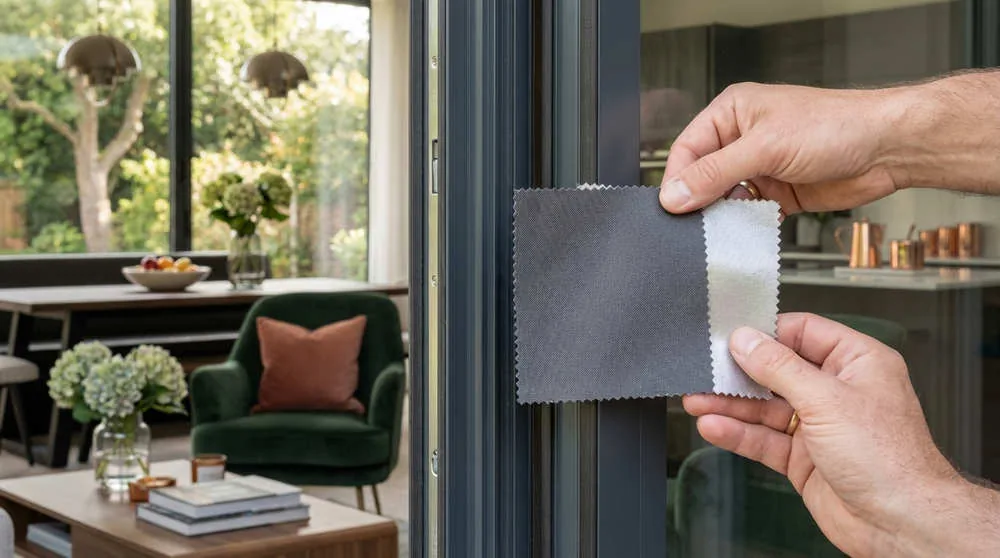
As specialists who’ve seen thousands of fabric choices, we always say: decide what job the fabric must do before you look at a single colour swatch.
The most important question to ask any supplier: “What is the Solar Reflectance value of this fabric?”
Their ability to answer tells you whether they’re focused on performance or just aesthetics. Our guide on how to avoid choosing the wrong electric blind fabric walks you through the decision step by step.
The “Goldfish Bowl” Problem and the No-Compromise Solution
Night-time privacy is the problem nobody warns you about. Those same beautiful windows that connect you to the garden during the day become transparent stages once the lights come on.
A room-darkening blind solves the privacy issue. But pull it down during the day to manage glare, and you lose the view entirely – which defeats the whole purpose of the glass.
This daily dilemma – your view or your comfort – is what frustrates homeowners most.
It’s worth noting that 3M Night Vision film can help with daytime privacy on ground-floor glazing, reducing the mirror effect so your view out is clearer while still limiting the view in during daylight hours. But once the lights come on and it’s dark outside, no film can provide privacy. That’s a job for a blind with a room-darkening layer.
The definitive answer for round-the-clock comfort is a dual blind system – combining two specialist fabrics in a single discreet housing. Our guide explains how to stop your glass extension feeling like a goldfish bowl at night without sacrificing anything during the day.
One Blind or Two? Why a Dual System Changes Everything
Think of it as the modern equivalent of net curtains and heavy drapes – but far more elegant and all in one unit.
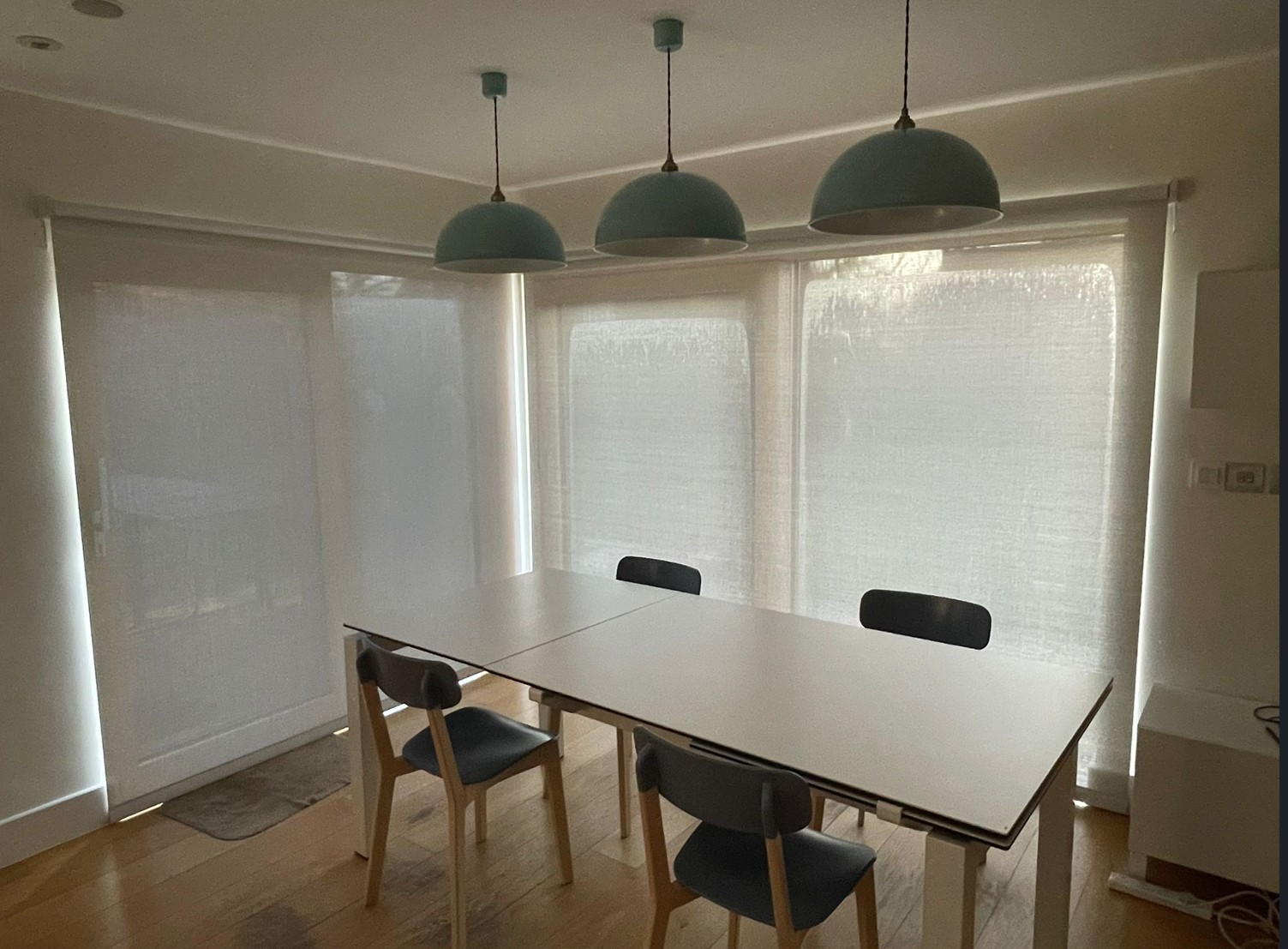
The first layer is a high-performance screen. It cuts harsh glare and reflects solar heat while still letting you see your garden clearly.
The second layer is a room-darkening fabric. It provides complete privacy at night and creates a cosy, insulated feel in winter.
When you understand the real difference between single and twin blind systems, the daily compromise disappears entirely.
The One-Blind Compromise
A single blind forces a choice: comfort or view. A dual system gives you the right tool for every moment – soft filtered light during the day, total privacy at night. It’s the difference between managing your room and truly controlling it.
A Note on Concealment – Blindspace® Hidden Systems
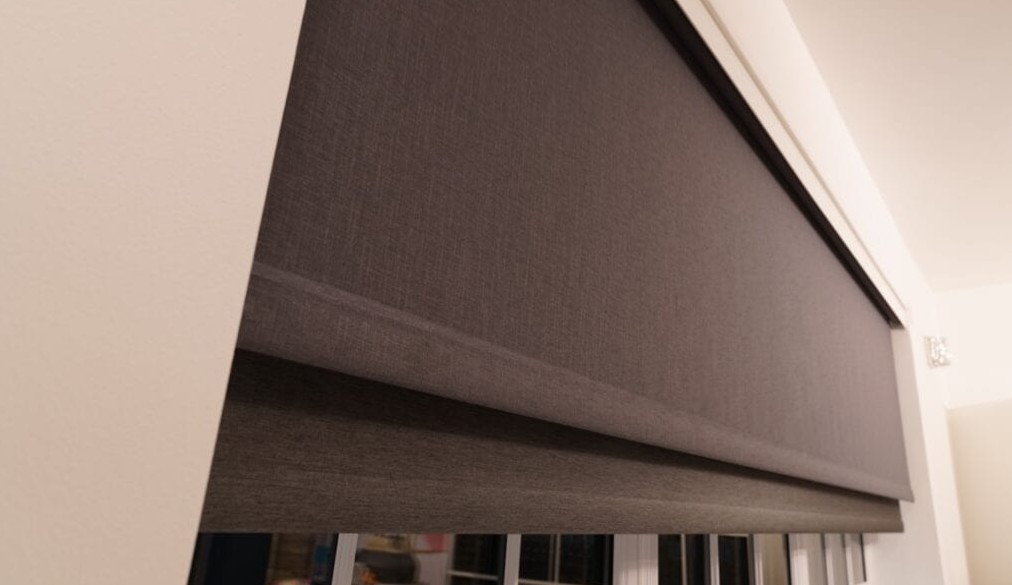
Whether your blinds are concealed in a Blindspace® ceiling pocket or surface-mounted in a visible cassette, heat and light performance is identical. The same high-performance fabric works the same way in both systems. Concealment is an aesthetic choice, not a performance factor.
That said, if you invested in architectural glass specifically for the clean lines and unobstructed views, concealment matters. A Blindspace® system makes the blind invisible when retracted – preserving the architectural intent of your glazing while giving you full control when you need it.
If you’re still in the planning or build phase, concealment is worth specifying early. It requires coordination with your builder or architect during the ceiling construction stage – something that becomes far more difficult and expensive to retrofit later.
The “Belt and Braces” Approach – Why Combining Solutions Works Best
Most rooms with serious comfort problems benefit from more than one approach. A single product rarely solves everything – and that’s not a sales pitch, it’s physics.
This is where WindowTreat is genuinely different. We’re one of very few companies in the UK that offer 3M window film and electric blinds and external awnings as an integrated service. A pure blind company can’t recommend film. A film installer can’t offer you a dual blind system. We diagnose the problem first, then recommend the right combination.
Here’s how that thinking works in practice.
A south-facing roof lantern generating extreme heat might call for an external Artemis blind to intercept 90%+ of solar energy from the outside, combined with an internal dual blind system for glare control and night-time privacy. That’s the approach that transformed Helen and Michael’s kitchen in Peckham.
A conservatory with fixed side glazing and an openable roof might be best served by 3M Prestige film on the side panels – permanently reducing heat and UV with nothing visible – while electric blinds on the roof sections provide adjustable control where you need it most.
A large bifold door wall might benefit from film on the fixed panes and electric blinds on the opening doors – each solution doing what it does best.
The point isn’t that you always need everything. Sometimes a single well-chosen product is exactly right. The point is that when we assess your space – its orientation, glazing type, how you use the room, and what bothers you most – we’re drawing from the full toolkit, not just one product category.
Enjoying Every Season – Not Just When the Weather Cooperates
We worked with Duone and Simon from Dorset who endured this frustration for a full decade. Their garden room was so hot and bright they had to wear sunglasses indoors just to see each other across the table.
For ten years, their dream of a bright, airy family space was fading. They’d looked at traditional blinds but found them unsightly, impractical, and full of trapped flies.
We installed a dual blind system with high-performance, heat-rejecting fabric. The transformation was remarkable. Their garden room finally became the comfortable, cherished space they’d planned a decade earlier.
Their story proves something important: even severe, long-standing problems are solvable.
Our guide on how to enjoy your glass extension in every season covers the full strategy – summer heat, winter insulation, and everything between.
The Cost of Your Comfort Investment
Understanding the investment across different solution types helps you plan realistically and avoid both overspending and false economies.
Electric Blind Fabric Tiers
Performance fabrics sit across three distinct price tiers:
| Fabric Tier | Price Range (per m²) | What You Get |
| Budget (Polyester) | £5–£25 | Basic privacy and light filtering. Minimal heat control. Prone to UV degradation. |
| Mid-Range (Coated Polyester) | £25–£60 | Room-darkening or dimout capability. Blocks light but may worsen heat. |
| High-Performance (Metallised) | £70–£150+ | Solar Reflectance up to 85%. UV blocking up to 99%. Engineered for demanding glazing. |
The premium for a high-performance fabric over a standard one is typically around £600 for a large window. Compare that to the UV damage repair costs above – the maths is clear.
For a fully installed electric roof lantern blind using high-performance fabric, you can expect an investment of up to £5,500. Our honest guide to electric roof lantern blind costs explains exactly what drives that figure up and down.
Electric Awnings
A quality electric awning installation typically starts from around £3,500–£4,000. Premium full-cassette models range between £5,500 and £7,000+ depending on size and specification. Bioclimatic pergola systems – which provide a permanent outdoor room – start significantly higher.
3M Window Film
3M film represents a significant investment, with installed prices for premium lines in the region of £150–£200 per square metre. For many homeowners, this makes film a more cost-effective option than electric blinds for equivalent fixed glazing – particularly where you don’t need adjustable control.
When Specialist Shading Is NOT the Answer
We’d rather be honest than make a sale that disappoints.
Specialist shading is overkill if:
- Your room faces north and never gets direct sun
- You have small, standard-sized windows that a simple roller blind handles perfectly
- Your main need is basic bedroom privacy with no significant heat or glare issues
For fixed glazing where you don’t need daily adjustment, 3M window film may be a more cost-effective solution. It permanently reduces solar gain and blocks UV without requiring motorisation or any visible hardware.
A standard off-the-shelf blind from a high-street retailer is perfectly adequate for a north-facing spare bedroom. Our systems are designed for the big, complex problems – not every window in your home.
Frequently Asked Questions About Heat, Glare and Privacy
Will a standard blackout blind keep my extension cool in summer? Not necessarily. “Blackout” refers to light blocking, not heat blocking. A dark room-darkening fabric absorbs solar energy and radiates it into the room. For heat control, you need a fabric with high Solar Reflectance – ideally with a metallised backing.
Is external shading always better than internal? For pure heat rejection, external is dramatically more effective – roughly three times better. But it’s not always practical. Planning permissions, budget, wind exposure, or building design may make it impossible. A high-performance internal blind with reflective backing is an excellent alternative, and in many situations, combining an external awning with internal blinds gives you the best of both.
Can window film solve my overheating problem on its own? 3M window film reduces solar gain and blocks UV permanently, making it excellent for fixed glazing. But it can’t be adjusted – you lose some solar gain benefit in winter too. It doesn’t provide night-time privacy. For large roof lanterns with extreme solar gain, film alone may not be sufficient. That’s why we often recommend it as part of a combined approach.
Can I combine window film with electric blinds? Absolutely – and it’s one of the most effective strategies we recommend. Film upgrades the glass itself (heat rejection, UV protection), while blinds provide adjustable glare control and night-time privacy. We call it the “belt and braces” approach, and it means each product does what it does best rather than asking a single solution to handle everything.
Can I get one product that handles heat, glare, AND privacy? A single product always involves a compromise. A translucent screen manages heat and glare but won’t provide privacy at night. A room-darkening blind gives privacy but blocks your view. Film handles heat and UV but can’t offer night-time privacy. A dual blind system – combining two specialist fabrics in one housing – is the closest you can get to handling all three without compromise.
Does high-performance glass mean I don’t need shading? Modern solar control glass helps, but it’s a fixed solution. It can’t adapt to different times of day or seasons. It does nothing for glare when the sun is at a low angle, and nothing for night-time privacy. Glass and shading are complementary, not alternatives.
How do I know which solution is right for my room? Start with your biggest problem. If it’s extreme heat, consider whether external shading is practical – it’s the most effective option. If you have fixed glazing and want an invisible solution, 3M film could be the right fit. If you need adjustable daily control and night-time privacy, electric blinds with the right fabric are the answer. And if your room has multiple issues – heat and glare and privacy – a combined approach is likely the most effective path. Our team can help you match solution to problem precisely.
Does concealing the blind in the ceiling affect how well it works? Not at all. A blind concealed in a Blindspace® pocket uses the same fabric and the same mechanism as a surface-mounted system. The heat and light performance is identical. Concealment is about aesthetics – preserving the clean lines of your glazing – not about how the blind performs.
Your Next Step
If your glass extension has become a room of extremes, you’re not stuck with it. The science is clear, and the solutions are proven – whether that’s external shading, window film, electric blinds, or a combination tailored to your space.
The question is which approach, or which combination, is right for your specific situation.
Start here: before you speak to anyone, think about your room honestly. When is it worst? What bothers you most – the heat, the glare, or the privacy? Is the problem on the roof, the sides, or both?
Having that clarity makes any conversation more productive.
When you’re ready, our specialists can assess your exact situation – orientation, glazing type, usage patterns – and recommend the right combination of solutions. No pressure, no hard sell, just an honest conversation about what would genuinely work for your home.
Planning early is key to seamlessly integrating comfort and control into your design. If you’re still in the build phase, getting us involved now could save you significant cost and compromise later.
Book a free virtual consultation to explore your options. Or call 01256 345580 for a friendly chat about your comfort problems.
We’re not right for everyone. If a simple off-the-shelf solution will work, we’ll tell you. We’d rather point you in the right direction than sell you something you don’t need.
All Heat, Glare and Privacy Articles
Understanding the Science
- Blind Fabrics Compared: Which Control Heat and Light Best? – An honest comparison of dark, light, metallised, and room-darkening fabrics with real performance data.
- Which Blind Fabrics Genuinely Handle Heat and Glare Best? – The science behind metallised fabrics and why Solar Reflectance is the number that matters most.
- How to Avoid Choosing the Wrong Electric Blind Fabric – A step-by-step guide to choosing based on function, not fashion, including UV protection.
Solving the Problem
- Inside vs Outside Shading: Which Makes More Sense? – Why external shading blocks 90%+ of heat, and when internal blinds are the smarter choice.
- Single vs Twin Blind Systems: Which is Right? – How a dual system eliminates the daily compromise between view, comfort, and privacy.
- How to Stop Your Glass Extension Feeling Like a Goldfish Bowl – The definitive solution for night-time privacy without losing your daytime view.
- How to Enjoy Your Glass Extension in Every Season – Year-round strategies for summer heat, winter insulation, and everything between.
Understanding Your Investment
- Which Electric Blind Fabrics Offer Best Value for Money? – The three fabric tiers explained, with an honest look at what “value” really means.
- How Much Do Electric Roof Lantern Blinds Cost? – A transparent price guide explaining what drives the cost of specialist roof blinds.
Avoiding Costly Mistakes
- Common Glazing and Shading Mistakes Architects Make – The top three pitfalls and how to have a confident conversation with your design team.