You’ve planned that stunning glass extension to flood your new kitchen with light, but have you thought about what happens when the sun gets a little too enthusiastic?
How do you make sure your beautiful new living space, the one you’ve invested so much in, doesn’t turn into an unusable greenhouse on the sunniest days of the year?
It’s a question we see homeowners grapple with all the time. The choice of shading can feel complicated, but it doesn’t have to be. To get you started, here are the three most important things to know.
Key Takeaways
- Stopping vs. Managing Heat: The fundamental difference is simple. External shading stops the sun’s heat before it can get through your glass. Internal shading can only manage the heat and glare once it’s already inside your room.
- Performance is Not Equal: For significant heat problems, especially on south-facing glass or framed skylight an external blind is dramatically more effective at keeping a room cool. The numbers show it can block over 90% of solar heat.
- The Right Tool for the Job: Internal blinds are a perfectly sensible and cost-effective choice when your main goals are managing glare, ensuring privacy, or adding a decorative touch in rooms that don’t suffer from intense overheating.
It All Comes Down to One Simple Idea: Stopping Heat vs. Managing It
The trend for large glazed areas is wonderful for creating light-filled homes. But the unforeseen side effect is often the “greenhouse effect,” which can make these expensive new spaces uncomfortable.
When that happens, looking for shading can feel like a distress purchase, an afterthought to solve a problem you never expected.
Because it’s often left late, many people only ever consider internal blinds. To really understand the options, however, it helps to think about it in a new way.
Are you trying to manage heat once it’s already in the room, or do you need to stop it before it ever gets through the glass? This one idea changes everything.
The Science Bit, Made Simple: How Each Type of Blind Works
Think of it like trying to stop a ball from breaking a window. It’s far easier to stop it on the outside before it hits the glass, isn’t it? The same logic applies to the sun’s heat.
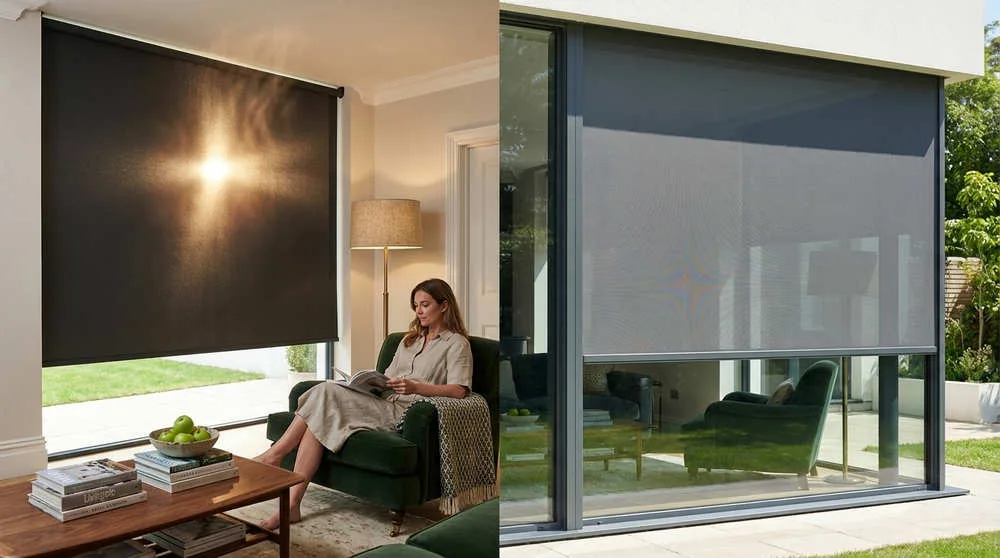
The sun’s energy travels through glass very easily. When you have an internal blind, that energy passes through the window and hits the blind fabric. I’ve stood in so many sun-soaked extensions over the years, and the first thing you notice is that an internal blind, while cutting glare, can feel like a large radiator pumping heat into the room. It absorbs the energy and then radiates that heat into the space.
An external blind works on a completely different principle. It acts as a physical shield, intercepting the vast majority of the sun’s energy before it can touch the windowpane. It’s a proactive strategy that stops the problem at the source.
The Proof is in the Performance: Inside vs. Outside by the Numbers
The most honest way to compare performance is with a measure called the g-value (or gtot). Think of it as a score for how much solar heat gets into a room, the lower the number, the better the blind is at blocking heat.
The data from industry bodies and building science is incredibly clear and shows a huge difference in performance.
A Fair Look at Internal Shading
The Good Bits
Internal blinds are by far the most common choice in the UK, and for good reason. They are generally more cost-effective upfront and are a perfectly good solution for managing privacy and reducing glare in rooms that don’t suffer from intense solar gain, like those facing north or with smaller windows. They also offer a huge range of decorative styles and fabrics.
The Compromises
The reality is, internal blinds are a reactive measure. They are trying to manage heat that is already inside your home. Because of the radiator effect, they simply aren’t designed to solve a significant heat problem in a south-facing extension or under a large roof lantern. In these cases, you’d be applying a bandage, not solving the root of the problem.
The Verdict: When Do Internal Blinds Make Sense?
An internal blind is a sensible choice when your main goal is controlling glare for a TV, ensuring privacy, or adding a decorative touch, and overheating isn’t your primary concern. If your room gets uncomfortably, genuinely hot, an unspecialised internal blind is unlikely to give you the relief you’re looking for.
A Fair Look at External Shading
The Good Bits
The simple truth is that for managing heat, the performance of external shading is transformational. This is the solution that genuinely preserves the comfort and usability of your space, protecting the investment you’ve made in your home and keeping your original dream alive.
It can be genuinely heartbreaking when the space you’ve poured so much effort into becomes a room you have to avoid. We see this all the time, and it’s exactly the problem Helen and Michael faced. Their stunning architect-designed kitchen in Peckham had extensive glazing and became unbearably hot in the sun. By installing an external roof blind, they stopped over 90% of the heat outside. Their kitchen was completely transformed back into a comfortable and usable space, even on the hottest days.
The Considerations
Of course, there are important factors to consider with external shading.
The Investment: It’s a more significant investment initially, but it’s one that protects the much larger investment you’ve made in your home, ensuring you can actually use every square metre of it. This is because the systems require more robust, weather-resistant materials, specialist motors powerful enough for large spans, and advanced fabric tensioning systems to ensure that flawless, taut finish.
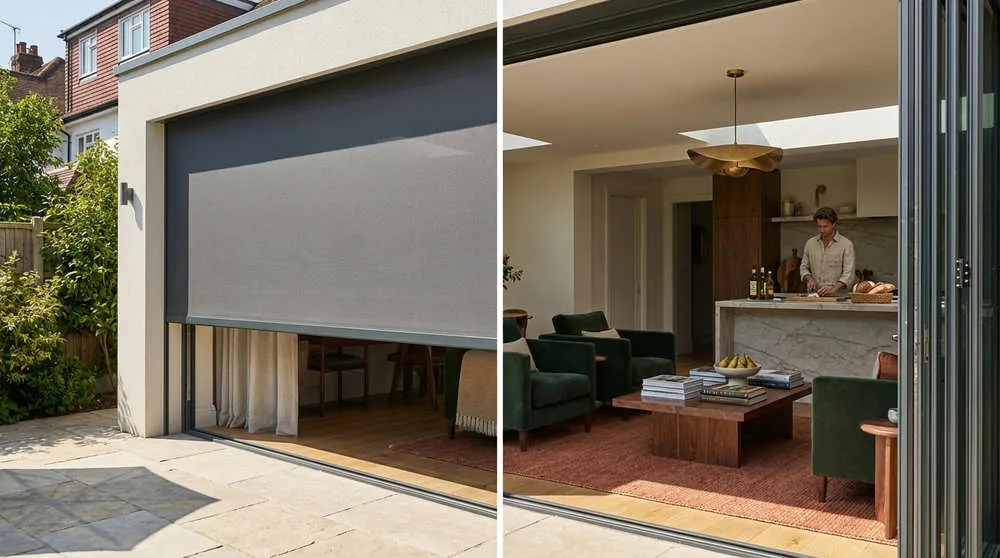
The Look: Many homeowners worry that external hardware will look bulky and spoil the look of their home. The reality is, modern systems are incredibly sleek. More importantly, when planned early, the hardware can be completely concealed within the building’s structure, making it totally invisible when not in use. This is why we champion our ‘S.H.A.D.E.’ principle, designing shading in from the start protects the architecture.
The British Weather: This is a common and fair question. Professional external systems are built to last and are rated to specific British Standards for wind resistance. Crucially, they are almost always installed with automated wind sensors that retract the blind automatically if the weather turns, protecting your investment.
The Verdict: When Do External Blinds Make Sense?
An external blind becomes a necessity for any space with a significant amount of glass facing the sun, like a south-facing extension with sliding doors or a large framed skylight . It’s for anyone who wants to guarantee their dream space remains comfortable. It’s likely more than you need for a small, north-facing window where heat build-up is never going to be an issue.
Making the Right Choice for Your Home
So, what have we learned?
- Stopping heat on the outside is always going to be more effective than trying to manage it once it’s inside.
- If your room gets uncomfortably hot, an external blind is the high-performance solution that will solve the problem.
- If your main concern is glare or privacy (and not intense heat), a good-quality internal blind is a perfectly sensible choice.
The best way to decide is to ask yourself one simple question: What is the main problem I am trying to solve? Is it that the room gets genuinely hot and unusable, or is it more about glare, privacy, and finishing the look? Your answer will point you clearly in the right direction.
Struggling with an existing space or planning a new one? Feel free to call one of our specialists. There’s no pressure; we just enjoy helping people find the right solution for their home.
Ggive us a call on 01256 345580 or book an appointment online.
Why Understanding the Difference Matters
Making the right choice isn’t about spending the most or the least; it’s about understanding the real job you need your blinds to do. By thinking in terms of stopping heat versus managing it, you’re already in a much better position to make sure the dream you have for your home becomes a comfortable reality.
Ultimately, the most sensible solution is the one that solves the root cause of the problem. And when it comes to protecting the comfort of your beautiful glazed space, stopping the heat before it gets in will always be the most effective way.