You’ve just received a quote for electric blinds for your beautiful new extension and had a moment of pure shock, thinking, ‘How can they possibly cost that much?’ It’s the first question on everyone’s mind, and honestly, it’s the one I’d be asking too.
It can feel completely out of proportion.
Before we get into the detail, the most important thing is understanding the difference between a cheap ‘expense’ and a true ‘investment’. Here’s what you really need to know.
- The Price is in the Engineering. A specialist blind for a roof lantern isn’t just fabric; it’s a tensioned system engineered to defy gravity and not sag over time.
- Fabric Performance is Key. A cheap fabric might block light, but a high-performance one manages heat, protecting your investment and making the room usable year-round.
- The Real Cost is Getting it Wrong. Choosing a cheap solution that fails often means paying twice and living with months of frustration.
- Sometimes, Cheaper is Smarter. A specialist system isn’t always the right answer. For a small, standard window, a basic blind can be a perfectly sensible choice.
You’ve poured not just tens of thousands of pounds, but so much of yourself into creating this dream space. The last thing you expected was for that beautiful glass roof to turn your new kitchen into a greenhouse on the first sunny day.
It’s a frustrating feeling, and one we’ve seen countless times.
I’ll be honest with you. A performance blind for a large roof lantern or wide bi-fold doors isn’t just a blind. It’s an engineered shading system. My job here isn’t to sell you something, but to walk you through what I’ve learned over the years so you can make a confident choice that protects the home you’ve worked so hard for.
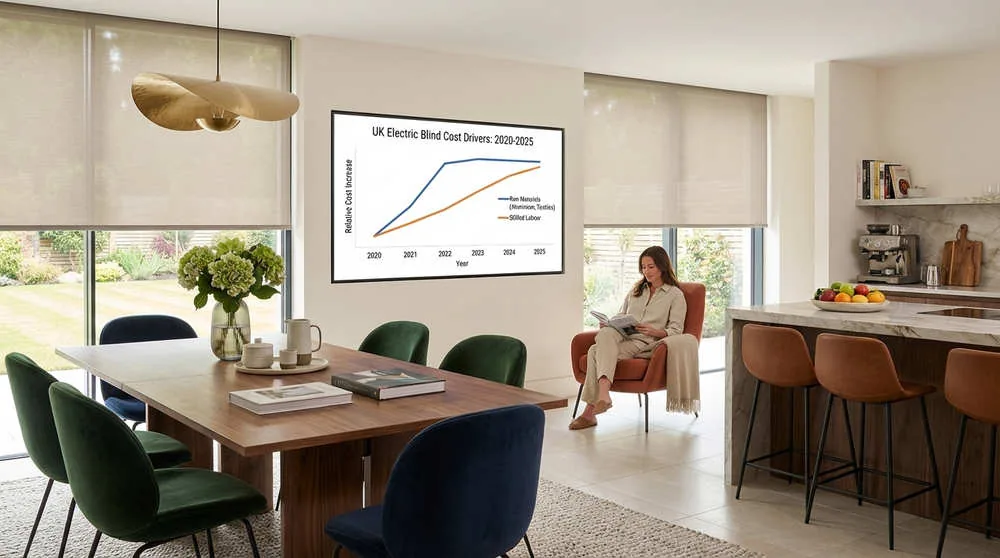
Why Are Prices Where They Are Today? A Look Back at 2020-2025
To understand today’s prices, it helps to know the journey we’ve all been on. The era of pre-2020 pricing is over, not because of arbitrary increases, but due to a “perfect storm” of global events that fundamentally changed the cost of high-quality goods in the UK.
Three powerful forces converged:
- Volatile Material Costs: Key components saw huge price spikes. High-purity aluminium, the backbone of our cassettes and hardware, more than doubled in price at its peak and has now settled at a much higher baseline than before 2020. Similarly, the advanced electronic components in our quiet, powerful motors faced global shortages, establishing a new cost benchmark.
- Macroeconomic Shocks: The UK’s departure from the EU introduced a unique “Brexit premium.” Between 2015 and 2022, UK construction material costs rose by 60% compared to just 35% in the EU, a result of new tariffs, supply chain friction, and administrative costs.
- The Skilled Labour Deficit: The UK faces a severe shortage of skilled tradespeople, particularly the specialist installers and electricians required for a flawless, integrated finish. This scarcity has naturally driven up the cost of expert labour, which is a significant part of the total investment.
These new costs are now locked into the supply chain, meaning the current price reflects a stable, long-term value of the materials and skills required to create a lasting solution.
Decoding the Options: The Three Tiers of Electric Roof Blinds
When you’re comparing quotes, it’s crucial to know that not all blinds are created equal. The market is broadly split into three tiers, and comparing them on price alone is like comparing a family car to a Formula 1 car – they’re engineered for different purposes.
The Breakdown: What Are You Actually Paying For?
So, let’s pull back the curtain on what really makes up the cost of a high-performance system.
Factors That Drive the Price Up
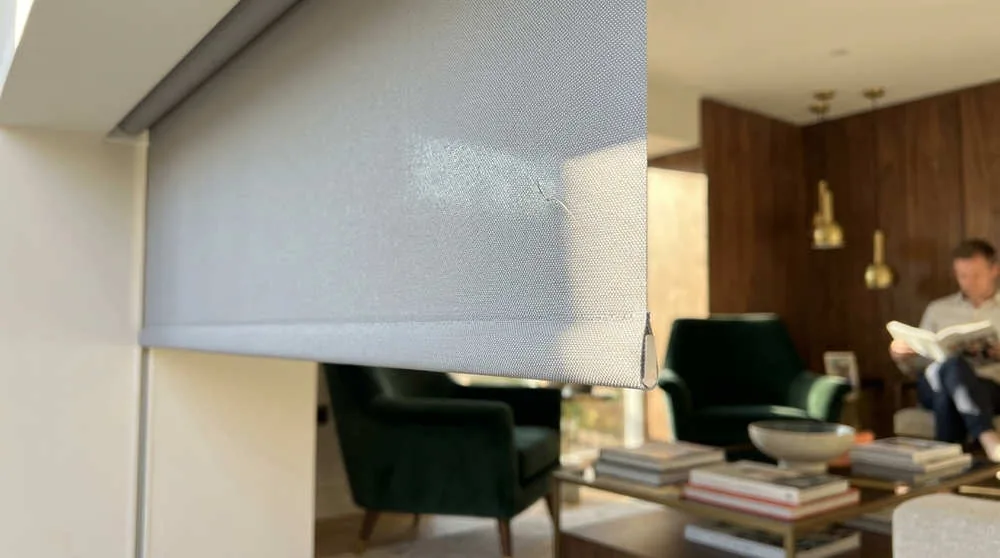
- The Engineering to Last: A standard roller blind hangs using gravity. That’s fine for a normal window, but the moment you turn it horizontally for a roof lantern, gravity becomes your worst enemy. Without the right engineering, the fabric will sag. We call it the “duvet cover effect,” and it completely ruins the crisp, clean look you’ve paid for. A technical system uses a constant-tension spring and a zipped system in the side channels to hold the fabric drum-tight. When it’s closed, it looks like a flawless ‘false ceiling’. That robust, lasting engineering is the biggest part of your investment.
- High-Performance Fabric: This is where ‘investment vs. expense’ becomes crystal clear. A standard decorative fabric is chosen for its colour. A high-performance technical fabric is chosen for what it does. Think of it like this: a normal dark fabric will absorb the sun’s heat and radiate it into your room. A technical fabric with a metallised backing acts like a mirror, reflecting over 75% of solar energy. This is what stops your room from overheating. You’re not just buying a blind; you’re investing in comfort.
- Architectural Integration: For the ultimate minimalist finish, the blind needs to disappear completely when not in use. This requires creating a “blind pocket” or recess in the ceiling during the build. This involves specialist components like Blindspace® profiles and coordination with your builder to ensure a perfect, seamless result. This early planning is a cost, but it’s far less than the cost and disruption of trying to retrofit it later.
- The Motor and Smart Technology: A large panel of high-performance fabric is heavy, and it needs a powerful, reliable motor to move it day in, day out. We use motors from brands like Somfy, who are the industry benchmark and provide a 5-year warranty for peace of mind. But for us, it’s the smart control that makes all the difference. Imagine your blinds closing automatically at dusk for privacy or reacting to the sun to keep the room cool while you’re out. It’s that intelligence that transforms it from a simple covering into a system that works for you.
Factors That Drive the Price Down
Of course, not every solution needs to be top-tier. There are sensible ways to reduce costs, and it’s about making informed trade-offs:
- Simpler Systems: Opting for a standard roller or a pleated system will be significantly cheaper than a zip-tensioned one. The trade-off is in the aesthetics (potential sagging with rollers, visible wires with pleats) and long-term cleanliness.
- Standard Materials: Choosing a standard blackout or dim-out fabric without the advanced solar-reflective coating will lower the material cost. The trade-off is that it won’t be as effective at managing heat gain.
- Manual or Basic Motorisation: A manual blind or a simple battery-operated motor will cost less than a mains-powered, smart-home-integrated system. The trade-off is convenience and the loss of intelligent automation.
- Surface-Mounted Installation: Deciding against a concealed blind pocket and opting for a visible cassette is the biggest cost-saver. The trade-off is purely aesthetic; you lose that seamless, minimalist look.
The True Cost of Getting it Wrong: Lifetime vs. Initial Investment
I want to share a story that I’ve seen play out many times. A family had just completed a stunning extension and, completely understandably, baulked at our quote for their roof lantern. They found a much cheaper option online and had it fitted.
A few months later, they called us back. The man of the house was so frustrated. The cheap blind was sagging terribly, but his real anger was that the room was still unusable. The blind did nothing to stop the heat. They had wasted their money and still couldn’t enjoy their new space.
For me, the real tragedy was that they ended up paying twice and had to live with months of disappointment in their brand-new dream kitchen. The real cost wasn’t in our initial quote; it was in getting it wrong the first time.
Beyond the Blind: The Hidden Costs to Factor In
A quote for the blind itself is often just the starting point. To achieve a truly integrated finish, there are essential ancillary works that must be budgeted for. Planning these early is the single best way to control costs.
Let’s Talk Numbers: Real-World Costs
Right, let’s talk numbers. While the final price always depends on your specific window sizes and fabric choices, here are a few real-world examples to give you a clearer idea of the investment for a fully installed, high-performance system.
- A single electric roof blind (like our high-performance Athena system) for a typical 2m x 3m roof lantern can be an investment of up to £5,500. This includes a professional survey, bespoke manufacturing, and specialist installation.
- A set of concealed electric blinds for 4m-wide bi-fold doors typically ranges from £3,000 to £5,000. This includes installation into a pre-prepared blind pocket.
- For a full room project with multiple large windows (e.g., two roof lanterns and an 8m-wide bifold door), the investment for the blinds can range from £12,000 to £17,000.
How Do People Pay for a Project Like This?
Understanding how projects of this scale are typically funded can help with planning. While some retailers offer “interest-free credit,” this is uncommon in the bespoke, high-end market because the cost of the finance is subsidised by the retailer, which is difficult to absorb without compromising on the quality of specialist materials and labour.
We made a conscious choice not to offer 0% finance. In our industry, the cost of that credit is often subsidized by using lower-cost materials or standard off-the-shelf motors. We refuse to compromise the engineering of your blind just to absorb a finance subsidy.
Many of our customers want to invest in high‑quality shading solutions, but we know that electric blinds and awnings aren’t always included in the original build budget. Sometimes they become an afterthought, or unexpected project costs mean the budget simply won’t stretch as far as planned.
To help make things easier, we offer flexible financing options designed to smooth out cashflow. In most cases, this involves a 50% payment at the point of order, followed by a direct debit spread over 6–12 months at Base Interest Rates (3.75% at the time of writing).
Every project is different, so we’ll discuss the most suitable approach with you on a job‑by‑job basis.
For affluent homeowners undertaking major renovations, the two most common routes are:
- Personal Bank Loans: For a specific part of a project, like a complete shading package, a personal loan from a high-street bank is a cost-effective option. For amounts in the £7,500 – £25,000 range, competitive fixed rates are often available, typically between 5.9% and 6.6% APR.
- Remortgaging / Further Advance: This is the most common method for funding a large-scale renovation where the blinds are one part of a bigger project. By releasing equity from the property, homeowners can access funds at their mortgage rate, which is significantly lower than other forms of borrowing.
Is a Specialist System Really Worth the Investment?
You will absolutely find cheaper options out there, and I want to be open about that. The reason we focus on these specialist systems is that the problems our clients face, like intense heat in rooms with huge amounts of glass, simply can’t be solved by basic blinds.
The value of a specialist system lies in three areas:
- Aesthetic Value: The ability for a large blind to disappear into an invisible ceiling slot preserves the seamless, minimalist interior that defines contemporary architecture.
- Performance Value: The engineering delivers tangible comfort. It eliminates glare and effectively regulates heat, making your home more comfortable and energy-efficient year-round.
- Durability & Longevity: Robust engineering and high-grade materials, backed by comprehensive 5-year warranties, represent a durable investment that lowers the total cost of ownership over time.
The philosophy that drives us is called S.H.A.D.E., which is all about seeing shading as a core part of the architecture from day one. An investment in one of our systems is an investment in a solution that works flawlessly, looks beautiful, and protects the “dream” you had for your home from the very beginning.
When is a Specialist Blind NOT the Right Fit?
So, when would I tell you that you don’t need a system like ours? Honestly, quite often.
If you have a small window in a spare bedroom that doesn’t get much direct sun, a simple off-the-shelf blind is probably the smart move. Our systems would be complete overkill.
If you have a utility room window where you just need basic privacy at night, or a small bathroom window on the north side of your house, there’s absolutely no need to invest in high-performance fabrics and tensioned engineering.
A standard blind will do the job perfectly well and save you a significant amount of money. We’re here to solve the big, complex problems that modern architecture creates.
Frequently Asked Questions About Cost
- Do your prices include VAT? Yes, all the indicative prices we provide are inclusive of VAT, so there are no surprises.
- What happens if my requirements change mid-project? We understand that builds can be fluid. We maintain clear communication and will always discuss any cost implications of a change before proceeding, ensuring you are in control.
- Are there any guarantees? Absolutely. The motors we use, typically from Somfy, come with a 5-year manufacturer’s warranty, and our installation is fully guaranteed to ensure your peace of mind.
- Is there a minimum spend? No, we assess each project on its own merits. However, our specialist systems are best suited and most cost-effective for larger, architectural glazing rather than very small, standard windows.
Making a Confident Choice for Your Home
So, it’s not just about a price tag. It’s about understanding what you’re paying for. When you get a quote for a technical blind, you’re seeing the price of robust engineering, high-performance fabric, and intelligent automation.
When you’re discussing your options with any company, here are a few good questions to ask:
- ‘What specific system do you use to guarantee the fabric won’t sag over time?’
- ‘Can you show me the data on how effective this fabric is at reflecting heat?’
- ‘What is the warranty on both the motor and the blind system itself?’
Ultimately, understanding the costs puts you back in control. It stops being about a confusing price and starts being about a conscious choice for your home.
So, the final question I’d leave you with is this: Are you looking for the cheapest way to cover a window, or the best way to protect your investment and guarantee the comfort of the home you’ve worked so hard to create?
If you have questions and want to talk through the specifics of your project, our team is here to help. For a friendly chat and a tailored estimate for your home, call our specialists.
Call: 01256 345580 or book an appointment online.