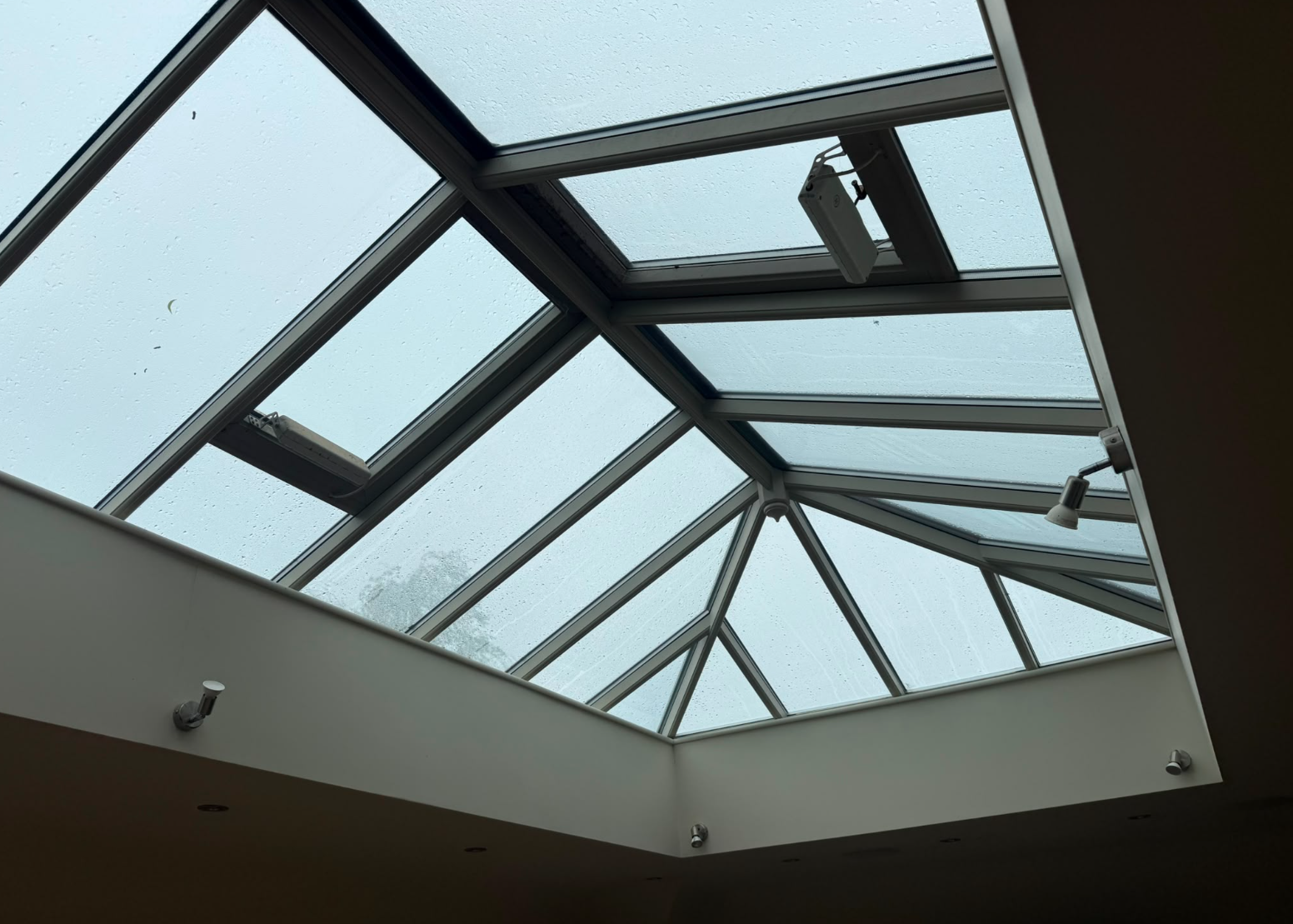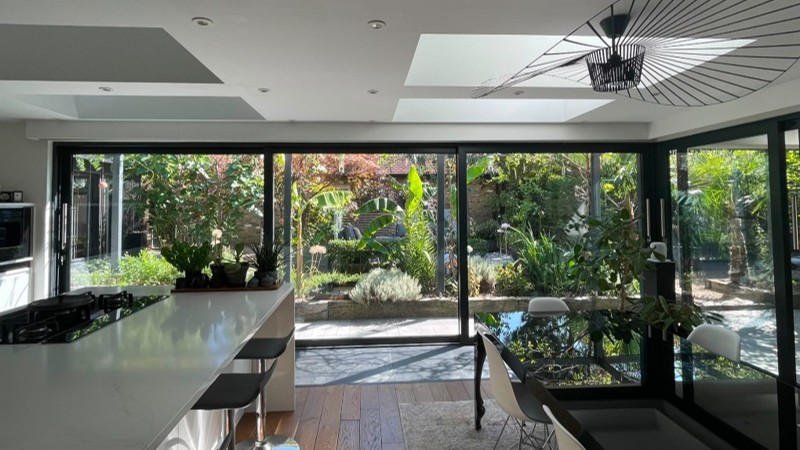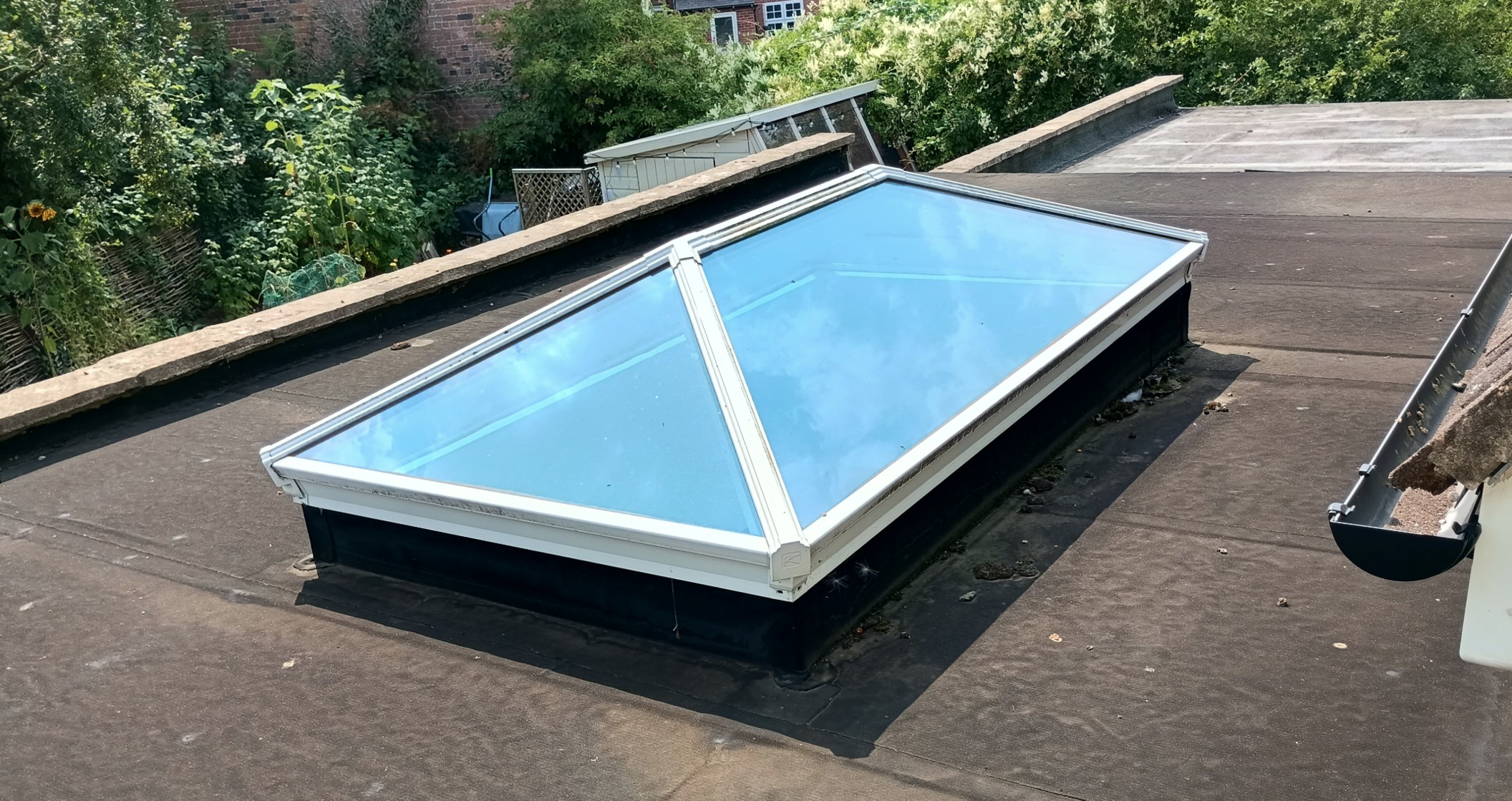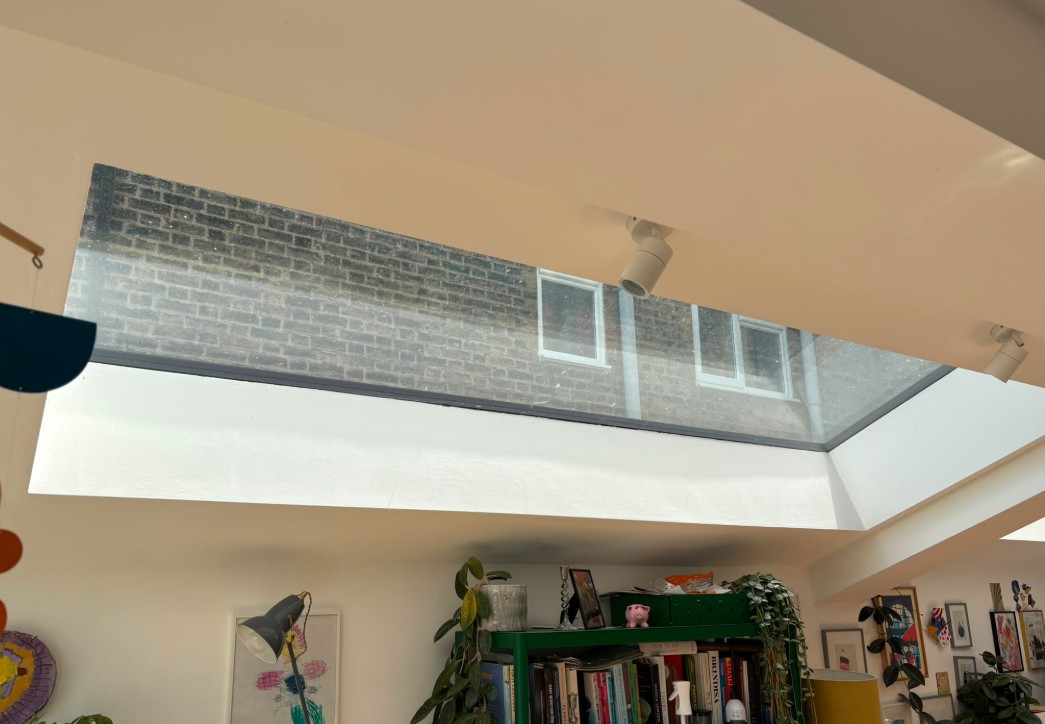








You’ve just been quoted £5,000 for a single blind. That number feels like a mistake.
You’re comparing it to the £50 roller blind in your bedroom. Those two products have almost nothing in common. By the end of this guide, you’ll understand exactly why, and you’ll have a clear picture of what every type of specialist shading actually costs.
We’ll show you real price ranges across our four core solutions. Electric blinds, 3M window films, electric awnings and Blindspace concealment as well as explain what drives costs up and down in each. We’ll be upfront about who should NOT pay for specialist systems.
Our goal is to arm you with enough knowledge to make the best decision, even if that means you don’t choose us.
Key Insights from This Guide:
- The price gap between a £200 blind and a £5,500 blind reflects fundamentally different engineering
- Each product line has a completely different cost structure – window film is priced per square metre with no motors or concealment, awnings involve external engineering, and electric blinds vary by size, fabric and motor
- Timing is the single biggest cost lever. Concealment planned during a build costs a fraction of retrofitting it later
- Cheaper systems often lead to paying twice when fabric sags and performance disappoints within months
- Specialist shading sits alongside worktops and flooring as a functional building component, not a decorative afterthought
- There are clear situations where a specialist system is genuine overkill, and we’ll tell you exactly when
Quick Reference: Investment Ranges Across All Product Lines
Electric Blinds
| Project Type | Typical Size | Indicative Cost (Installed, Inc. VAT) |
| Electric Roof Lantern Blind | 2m × 3m | Up to £5,500 |
| Electric Bifold Door Blinds | 4m wide | £3,000–£5,000 |
| Full Room Project (2 lanterns + 8m bifold) | Multiple glazed areas | £12,000–£17,000 |
Blindspace Concealment (Supply Only)
| Application | Indicative Supply Cost (Inc. VAT) |
| Roof lantern concealment | Around £3,500 |
| Bifold door concealment | Around £1,000 |
| Full room project (2 lanterns + 8m bifold) | Up to £8,000 |
3M Window Film
| Film Type | Indicative Cost Per m² (Supply, Fit & VAT) |
| Standard solar/glare film | £60 – £90 |
| Budget internal reflective side film | £40 – £60 |
| High-performance low-absorption roof film | £140 – £180 |
| Premium external non-reflective film (3M Prestige) | £150 – £180 |
| SolarGard Ecolux window film (insulation) | £150 – £200 |
Electric Awnings
| Model / Type | Typical Size | Indicative Cost (Installed, Inc. VAT) |
| Sol Edge (full enclosed cassette) | 3m × 2.6m | £4,000 – £4,500 |
| Sol Elite (premium full-cassette) | 4m × 3.1m | £5,500 – £6,500 |
| Sol Invictus (extra large full cassette) | 8m × 3.6m | £9000 – £11,000 |
| Perseus Pergolas (fabric roof pergola) | 3m × 3m | £10,000 – £13,000+ |
Every project is bespoke. These figures provide a realistic starting point, not a fixed quote.
Why Trust This Guide?
WindowTreat specialises in high-performance shading for large architectural glazing. We are Trading Standards Approved through the Buy With Confidence scheme and SafeContractor accredited. This means if something goes wrong, you have formal recourse, not just a promise from a salesperson. These aren’t vanity badges; they’re the difference between a guaranteed installation and a gamble. We use Somfy motors backed by 5-year warranties and have helped hundreds of homeowners across southern England protect their investments. We developed the S.H.A.D.E. framework because we believe shading is part of architecture, not an afterthought. If we’re not the right fit, we’ll tell you.
What We Will Cover in This Guide
By working through each section, you’ll be able to challenge any quote you receive and know exactly what you’re paying for, and what corners are being cut.
- Part 1: Why the price shock is real, and why it shouldn’t be
- Part 2: What drives the price up – the engineering you can’t see
- Part 3: What drives the price down – intelligent cost reduction
- Part 4: Electric blinds – the real-world numbers
- Part 5: 3M window film – a completely different cost structure
- Part 6: Electric awnings – external shading costs explained
- Part 7: Blindspace concealment – the cost of going invisible
- Part 8: The hidden costs that catch people out
- Part 9: The “buy twice” trap – why cheap becomes expensive
- Part 10: Premium vs high-street – an objective comparison
- Part 11: Fabric costs – why some cost 20× more than others
- Part 12: Running costs and the lifetime financial picture
- Part 13: Is it really worth it?
- Part 14: Who should NOT pay for specialist shading
- Part 15: Frequently asked questions about pricing
- Your next step
Why the Price Shock Is Real, And Why It Shouldn’t Be
Having helped hundreds of homeowners work through this exact reaction, we know precisely why the number stings. You’ve mentally filed blinds under “soft furnishings.”
A specialist shading system is an engineered building component. It belongs in the same budget category as your glazing, worktops, and flooring.
When you see how specialist shading costs compare to other extension features, the maths starts to make sense.
| Extension Feature | Typical Investment |
| Premium kitchen worktop (Dekton/quartz) | £5,000 – £8,000 |
| Aluminium sliding doors (5m wide) | £4,750 – £5,500 |
| Engineered oak flooring (40m²) | £4,800 – £6,400 |
| High-performance roof lantern blind | £5,500 – £11,000 |
| 3M window film for a conservatory roof | £1,000 – £2,000 |
| Premium electric awning | £5,000 – £11,000 |
Suddenly, shading sits alongside other premium components. The difference is that nobody questions paying £6,000 for a worktop.
They do question the blind because they’re comparing it to a £50 product. Those two things share a name, but almost nothing else.
The same applies to window film. You might have seen DIY film at £15 a roll. Professional 3M film installed at £150 – £200 per square metre is a different product entirely. It is a multi-layer technology engineered to reject heat while preserving clarity.
What Drives the Price Up, The Engineering You Can’t See
Each of our product lines has different cost drivers. Understanding what’s behind the price helps you judge whether a quote represents genuine value or a padded margin.
Electric blinds: gravity is the enemy. A standard roller blind hangs vertically. Gravity helps. Turn that same blind horizontal for a roof lantern and gravity starts pulling the fabric down.
Without advanced zip-tensioning, the fabric sags. We call it the “sack of potatoes” effect. It ruins the clean, architectural look you paid for.
Premium systems use a zip mechanism locked into side channels. This holds the fabric drum-tight, creating a flawless “false ceiling” finish.
Then there’s the motor. A large, heavy blind needs serious power. We use Somfy motors with 5-year warranties for exactly this reason. An underpowered motor on a large glazed area will fail prematurely, often within 2–3 years, leaving you with a costly mid-project replacement and potential damage to the fabric or mechanism.
Window film: the technology is in the layers. Budget films use simple dyed or metalised layers that fade, purple, and can interfere with Wi-Fi signals. Premium 3M films – particularly the Prestige series – use multi-layer optical nanotechnology. Hundreds of micro-layers of acrylic and polyester selectively block infrared heat while allowing natural light through. That technology costs more to manufacture, and it requires trained installers who understand thermal stress risks on different glass types.
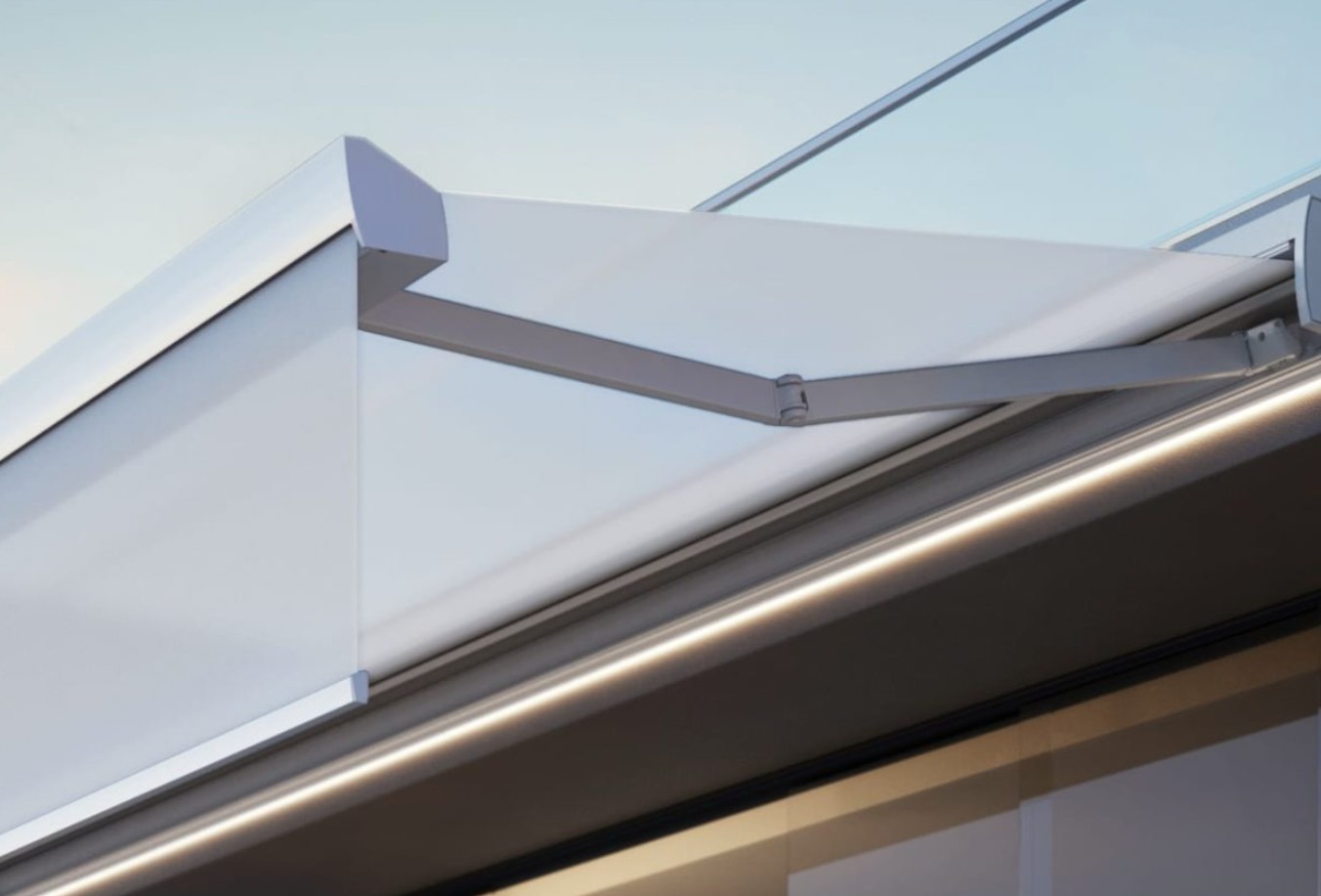
Electric awnings: structural engineering for British weather. A premium full-cassette awning isn’t a bit of fabric on a pole. The Sol ‘Elite’ model, for instance, uses multi-fix engineering and can span to 6 metres wide . It’s rated to Beaufort Scale 5 which is a genuine fresh breeze. That structural engineering is a significant part of the cost.
Blindspace concealment: the cost of going invisible. For the ultimate minimalist look, Blindspace concealment hides the entire mechanism inside your ceiling. The blind disappears completely when retracted.
That concealment is a significant cost driver. You can explore exactly what makes concealed blinds more expensive and whether it’s the right choice for your project.
High-performance technical fabrics do far more than block light. Some reflect over 80% of solar energy, acting like a mirror for heat. That technology costs more than decorative polyester.
What Drives the Price Down, Intelligent Cost Reduction
Not every window needs the full specialist treatment. Here are the honest trade-offs.
For electric blinds:
- Surface-mounted cassette instead of concealment – saves the Blindspace box cost and associated building work, but you’ll see the headbox
- Standard fabric instead of metallised – lower material cost, but less effective at managing heat
- Battery motors instead of hardwired – saves on electrician fees, but requires annual recharging
- Multiple smaller blinds instead of one wide span – avoids expensive anti-deflection engineering, but creates visible light gaps
For window film:
- Internal application instead of external – lower installation cost, but external film performs better on heat rejection because it stops energy before it enters the glass
- Standard reflective film instead of Prestige – significant cost saving (£60 – £90/m² vs £150 – £180/m²), but you’ll see a more reflective, mirror-like finish from outside
For electric awnings:
- Sol ‘Edge’ rather than Sol ‘Elite’ – the rounded cassette model uses twin cables rather than quadruple, has a lower wind rating (Beaufort 5 vs 6), but costs £1,500–£2,000 less for a similar projection
- Skipping accessories – LED lighting, infrared heaters and wind sensors each add £150 – £700 to the project
Each is a genuine choice, not a compromise, provided it matches your priorities. The key is understanding what you’re giving up before you commit.
Electric Blinds, The Real-World Numbers
Electric blinds are our core product line and typically the largest single investment. Here’s what our specialist, high-performance systems typically involve.
Roof lantern blinds are the most common project. For a detailed breakdown by size and system type, see our honest UK guide to electric blind costs.
For specific product pricing, we’ve published transparent guides:
- Electric roof lantern blind costs – size-by-size pricing with no hidden surprises
- Bifold and sliding door blind pricing – what width means for your budget
These guides include what’s in the price, what isn’t, and what to budget for beyond the blind itself.
The price range reflects several variables working together. A smaller roof lantern with standard fabric and a battery motor sits toward the lower end. A large, concealed, hardwired system with high-performance metallised fabric and smart home integration sits at the top. Both are legitimate choices – the difference is the problem you’re solving and the finish you expect.
3M Window Film, A Completely Different Cost Structure
Window film is fundamentally different to price because the cost model is different. There are no motors, no concealment pockets, no bespoke manufacturing of mechanical components. Instead, you’re paying per square metre for the film itself plus professional installation.
That makes it a more accessible entry point for homeowners who want to tackle heat or UV damage without the investment of a full blind system.
What drives window film costs:
The film itself. 3M offers several product lines, each engineered for a different problem. Standard solar film for basic glare reduction sits at £60 – £90 per square metre installed. The Prestige series – which uses non-metallised nanotechnology to reject up to 97% of infrared heat while maintaining high clarity, comes in at £150 – £180 per square metre. Ecolux by SolarGard, designed primarily for insulation (reducing heat loss by up to 38–40%), runs £150 – £200 per square metre.
Glass type and access. Conservatory roofs and high-level windows require scaffolding or specialist access equipment, which can add £200 – £400 to the project. Working-at-height surcharges typically run £100 – £300 depending on complexity.
Internal vs external application. External film performs better at heat rejection as they stop solar energy before it reaches the glass. But it can be more expensive to install due to weather-dependent scheduling and the need for edge sealing.
Pane size. Standard pane sizes are more cost-effective. Large or unusual shapes increase wastage and cutting time.
Real-world examples. Treating an Edwardian conservatory (4m × 3m) with budget internal roof film typically costs around £1,000 inclusive of VAT for the roof alone. A high-performance application on a smaller Victorian conservatory roof can reach approximately £1,900.
What window film doesn’t do. It’s fixed and non-adjustable. It can’t be retracted to enjoy an unobstructed view. It won’t provide privacy at night. And on its own, film is rarely sufficient for large south-facing roof lanterns where solar gain is extreme. That’s why we sometimes recommend film alongside blinds as a “belt and braces” approach where film handles the constant thermal load and blinds provide adjustable control.
Electric Awnings, External Shading Costs Explained
Electric awnings solve a different problem in a different location. Where blinds and film manage the glazing itself, awnings create shaded outdoor living space, extending your usable home beyond the glass.
Our awning range is curated from premium BAT Components from North Italy known for their stylish and engineered awning systems. These are fabricated with Somfy motors and Dickson Solar performance fabrics. When you buy through us, you’re getting top-tier European hardware installed and project-managed by WindowTreat.
What the investment covers:
The Sol ‘Edge’ is up to 6m wide end fix solution. It features a full-cassette design and a Beaufort Scale 5 wind rating. For a typical 3m × 2.6m installation, expect £3,500 – £4,500 all-in.
The Sol ‘Elite’ is our flagship model. A multi fix solution with square full-cassette awning with options for deluxe lighting and drop down valance. A 4m × 3.1m installation typically runs £5,000 – £6,500, while extra-large configurations (6m × 3.6m) can reach £7,000 – £9,000.
The Perseus Pergola is technically a structure rather than a retractable awning. It’s a permanent aluminium structure with a retractable fabric roof. Modules start at £10,000 – £13,000+, making this a significant landscape investment.
What drives awning costs beyond the headline price:
Installation complexity is a common surprise. Fixing to a single-storey extension often requires cantilever brackets or spreader plates to distribute the load safely. That can add £500 – £2,000 to the installation.
Electrical work is another variable. Prices generally assume a nearby power source. Running a new fused spur from the consumer unit to the patio area can cost £150 – £400 depending on the distance and interior finishes involved.
Optional accessories add up too. Wind sensors run £150 – £300. Integrated LED lighting costs £300–£500 (often charged per metre). Infrared heaters run £400 – £600 per unit. None are essential, but all enhance the outdoor living experience.
When an awning is not the answer. Awnings are sun-shading devices, not all-weather shelters. If your location is coastal, highly exposed, or a natural wind tunnel, a retractable awning may not be suitable. The Perseus pergola or a fixed glazing solution may be a better fit. An awning also won’t solve privacy issues or help with heat inside the house the way blinds or film can.
Blindspace Concealment, The Cost of Going Invisible
Blindspace is the detail that separates a beautifully finished, architecturally integrated space from one where the shading hardware is always visible. It’s a patented aluminium concealment system that creates a hidden pocket in your ceiling or wall, allowing your blinds to disappear completely when retracted.
The important thing to understand about Blindspace pricing is that it’s an additional cost on top of the blinds themselves. You’re paying for two things: the concealment hardware and the blind system that sits inside it.
Supply-only costs for the Blindspace system:
For a roof lantern concealment, the supply cost is around £3,500 inclusive of VAT. For bifold door concealment, it’s around £1,000. For a full room project covering two roof lanterns and an 8m bifold, the supply cost can reach up to £8,000.
These figures are for the Blindspace components only. Your builder installs the boxes during the build, and we install the blinds into the prepared pockets afterwards.
What drives the Blindspace price:
The system itself is precision-engineered extruded aluminium with a patented skim coat flange and safety hinge cover. Components are sized to the project – S100×100 is the entry-level profile, while C-Series custom boxes for unusual configurations cost significantly more. Corner windows, bay windows and skylights requiring mitred corners add further to the bill. Custom RAL powder coating to match a specific ceiling colour incurs a surcharge and longer lead time.
But the biggest cost variable isn’t the hardware. It’s timing.
The retrofit penalty. This is the single most important cost factor in any Blindspace project. Creating a concealment pocket after your ceiling is finished means cutting into the structure, altering steelwork or building bulkheads, and re-plastering. That can cost two to three times more than building it in during construction. In some cases, retrofitting simply isn’t practical. If a steel beam sits immediately above the window frame, there’s no space to recess the 100mm + Blindspace box without raising the lintel, which can only be done before bricks are laid.
This is why our S.H.A.D.E. framework champions planning shading from day one. Homeowners who get to the table early can make informed decisions about where to invest in concealment and where a surface-mounted cassette works perfectly well. Those who leave it too late sometimes face a compromise they hadn’t anticipated. Not because they couldn’t afford concealment, but because they ran out of time in the build programme.
If you’ve already passed that window, we can still help. Surface-mounted systems are a genuinely good solution, and for some homeowners, the visible cassette is perfectly acceptable. But if concealment matters to you, the time to act is before the plasterboard goes up.
The Hidden Costs That Catch People Out
A quote for any specialist shading is rarely the complete picture. These ancillary costs frequently surprise homeowners, and they vary significantly depending on the product.
Electric Blinds – Hidden Costs
| Hidden Cost | New Build | Retrofit |
| Electrician (fused spur) | £70 – £120 | £150 – £500 |
| Plastering (after chasing cables) | Included in build | £200 – £600 |
| Scaffolding/access (high lanterns) | Often included | £250 – £500 |
| Blindspace builder fit-out | £100 – £180 per linear metre | 2–3× higher (destructive rework) |
| Smart home programming | £300 – £600 | £300 £600 |
3M Window Film – Hidden Costs
| Hidden Cost | Typical Range |
| Access equipment (mobile towers for conservatory roofs) | £200 – £400 |
| Working-at-height surcharge | £100 – £300 |
| Removal of existing treatments (old blinds, film) | £50 – £200 |
| Removing and replacing complex electric systems | Up to £400 |
Electric Awnings – Hidden Costs
| Hidden Cost | Typical Range |
| Spreader plates/cantilever brackets (single-storey extensions) | £500 – £1,000 |
| Electrical run to patio area | £150 – £400 |
| Wind/vibration sensors | £150 – £300 |
| LED lighting integration | £300 – £500 |
| Infrared heaters | £400 – £600 per unit |
The retrofit penalty remains the single biggest hidden cost across all product lines. Whether it’s chasing cables for blinds, accessing high-level glass for film, or reinforcing a wall for an awning bracket, doing things after the build is always more expensive than planning them in.
The “Buy Twice” Trap, Why Cheap Becomes Expensive
We see this happen more often than we’d like. A homeowner comes to us and we recommend a high-performance system. The price causes them to pause.
They choose a cheaper alternative. Three, six, or twelve months later, the phone rings.
The fabric sags in the middle. It looks like a wash line. It hasn’t solved the heat problem. They ask us to rip it out and install what we first recommended.
They’ve paid twice. The expense, the disruption, the disappointment – all doubled.
For the full engineering comparison, see premium vs budget electric blinds, the real difference.
Here’s what that decision looks like over a decade.
| Factor | Budget System | Premium System |
| Initial cost | £1,500 | £4,500 |
| Expected lifespan | 2–4 years | 10+ years |
| Replacement cost (×2 in 10 years) | £3,000 | £0 |
| Motor warranty | 1 year | 5 years |
| Fabric appearance at Year 2 | Sagging, faded | Taut, like new |
| 10-year total cost | £4,500 | £4,500 |
The totals converge. But only one option involves two rounds of disruption and years of frustration.
The same principle applies to window film. Budget films use dyed layers that purple and fade over time. 3M films use nanotechnology that remains colour-stable for years. And with awnings, cheaper models using basic arm mechanisms and lower-grade fabric that sag, fade and struggle in anything beyond a gentle breeze, potentially causing structural damage to your wall fixings if the arms fail under wind load.
Premium vs High-Street, An Objective Comparison
When you see what you’re actually paying more for with a specialist, the gap becomes clearer.
| Feature | High-Street Fitter | Specialist Provider |
| Tensioning system | Guide wires or gravity | Zip-locked side channels |
| Fabric performance | Decorative polyester | Metallised technical textile |
| Motor | Basic, 1-year warranty | Somfy, 5-year warranty |
| Large span capability | Struggles above 2m | Engineered for 5m+ |
| Concealment option | Not available | Blindspace integration |
| Consultation | Measure and fit | Full diagnostic assessment |
| Film offering | Not typically available | 3M certified installation |
| External shading | Not typically available | Awnings from , Markilux, Weinor |
When is a high-street blind the right choice? For a small, standard window in a spare bedroom. For a room without intense sun. For a budget where function matters more than architectural finish.
For large glazed areas in the heart of your home, high-street systems simply aren’t built for the job.
One of our genuine advantages is the ability to combine solutions. We’re one of very few companies that offer 3M window film and bespoke electric blinds as an integrated approach – film to handle the constant thermal load, blinds for adjustable control, privacy and blackout. No pure blind company and no pure film installer offers that combination.
Fabric Costs, Why Some Cost 20× More Than Others
The fabric is where “just a blind” becomes a climate control tool. We’ve published a detailed guide on which blind fabrics offer best value for money.
Here’s the short version.
| Tier | Price per m² | What It Does |
| Budget polyester | £5 – £25 | Privacy, basic light filtering. No heat control. |
| Mid-range room darkening | £25 – £60 | Blocks light, but absorbs and radiates heat into the room. |
| High-performance | £70 – £150+ | Reflects up to 75% of solar energy. Blocks 99% of UV. Preserves your view. |
Premium fabric is also an insurance policy. UV rays silently bleach expensive floors and furniture. Reupholstering a sun-damaged sofa can cost £1,350 – £2,050. Refinishing a bleached hardwood floor runs £450 – £750.
A technical fabric blocking 99% of UV pays for itself by protecting what’s already in the room.
For awnings, fabric quality matters equally. Premium solution-dyed acrylics – like the Sattler fabrics used across our awning range – resist fading and rotting in ways that cheaper polyester alternatives simply can’t match over years of UK weather exposure.
Running Costs and the Lifetime Financial Picture
One of the most common worries is ongoing cost. The answer is remarkably simple.
Electric blinds: A mains-powered electric blind costs roughly 18 pence per year to run. Ten blinds use less electricity than a single dishwasher cycle. Battery systems need recharging around once a year. The cost is pennies.
Window film: Once installed, there are zero running costs. Film is entirely passive – no motors, no electricity, no maintenance beyond occasional cleaning. The only ongoing consideration is the warranty period and the expected lifespan (typically 10+ years for professional 3M installations).
Electric awnings: Running costs are negligible – a Somfy motor extending and retracting an awning uses minimal electricity. The main long-term cost is occasional maintenance: fabric cleaning, and potentially a capacitor replacement in the motor after many years of use (approximately £200 if out of warranty).
For the complete picture on blinds, including maintenance expectations and what to budget for long-term, read our guide on real-world maintenance and running costs.
A premium system’s biggest ongoing “cost” is almost zero. Occasional dusting is the extent of maintenance. Somfy motors are backed by 5-year warranties because they’re built to last far longer.
Is It Really Worth It?, The Return on Investment
Having seen what happens when homeowners skip this step, we can say the return is tangible in three ways.
Energy savings. Independent research shows well-fitted blinds reduce heat loss through windows by up to 33%. Window film such as SolarGard Ecolux can reduce heat loss by up to 40%, potentially saving meaningful amounts on heating bills in homes with large glazed areas. And on the cooling side, blinds and film working together can dramatically reduce the need for air conditioning, which runs at £1,500 – £5,000+ for installation alone.
Asset protection. A performance fabric or 3M film blocking 99% of UV extends the life of your flooring, furniture, and artwork. That’s protecting tens of thousands of pounds of interiors.
Reclaiming unusable space. This is the calculation most people miss.
If you’ve invested £150,000 in a stunning extension, and half of it is too hot to use for four months a year, you’ve effectively lost £60,000 of usable space. A £5,000 blind that makes the entire room comfortable year-round is less than 4% of the build cost.
Helen and Michael in Peckham lived this reality. Their architect-designed kitchen with extensive glazing became unbearably hot. For years they searched for a solution. An external roof blind blocking over 90% of heat transformed the space completely.
Their kitchen finally became the comfortable, usable room they’d originally envisioned. Their investment wasn’t in a blind, it was in reclaiming their home. Read their full story Success Story: How External Shading Made Helen Fall In Love With Her Home Again – WindowTreat
Who Should NOT Pay for Specialist Shading
We’d rather lose your business than set you up with the wrong solution.
A specialist electric blind system is NOT for you if:
- You have a small, standard window in a spare room or utility area. An off-the-shelf blind is perfectly adequate.
- Your only priority is the lowest possible price regardless of appearance or performance. We can’t compete with £200 options and wouldn’t try.
- Your room doesn’t suffer from significant heat, glare, or privacy issues. If the problem isn’t serious, a specialist solution is overkill.
- You’d prefer a DIY installation. Our systems require professional fitting and precise measurement.
- Your total budget is under £3,000 for the entire shading project. A quality engineered system for large glazing starts above this threshold.
3M window film is NOT for you if:
- You need adjustable light control or blackout. Film is permanent so it can’t be retracted.
- You need privacy at night and you need a view out. Film works by reflecting light from the brighter side, which reverses after dark.
- Your glazing has existing damage or failed seals. Film won’t fix structural issues with the glass itself.
An electric awning is NOT for you if:
- Your patio or garden is highly exposed or coastal. Retractable awnings are sun-shading devices, not all-weather shelters.
- You need to manage heat inside the house. Awnings shade outdoor space; they don’t directly address internal glazing heat gain.
- Your wall structure can’t support the mounting load without significant reinforcement.
If any of these describe your situation, a different approach will serve you well. We genuinely mean that.
Our systems exist to solve specific, serious problems in architecturally glazed spaces and outdoor living areas. If that’s your situation, we can help. If not, we’ll say so.
Frequently Asked Questions About Pricing
Do your prices include VAT and installation? Yes. Our quotations include survey, bespoke manufacturing, professional installation, and VAT. No hidden extras.
Why don’t you offer 0% finance? We generally ask for 50% upfront and 50% on completion. We can discuss payment plans for the final 50%.
What’s the most cost-effective way to fund a project like this? Personal bank loans offer competitive rates, typically around 6% APR for amounts in the £7,500–£15,000 range. That’s often better value than third-party retail finance at 12–20% APR.
Is there a minimum spend? No. But our systems are best suited for larger architectural glazing. For a small standard window, we’d honestly recommend a simpler solution.
What guarantees do I get? Somfy motors carry a 5-year manufacturer’s warranty. Our installation is fully guaranteed. We take full responsibility for manufacturing sizes from our survey. For window film, 3M provides comprehensive warranty backing for professional installations. For awnings, the same Somfy motor warranty applies, and fabric warranties cover against premature degradation.
Can I add concealment after the build? It’s possible but significantly more expensive. Retrofitting a concealment pocket means destructive building work. Planning it during construction saves both money and disruption.
Can I combine products – for example, blinds and film together? Absolutely. This is one of our strengths. We often recommend 3M film on the glass itself for constant UV and thermal protection, paired with electric blinds for adjustable light control, privacy and blackout. It’s the most comprehensive approach to managing a difficult glazing situation.
What if my requirements change during the project? We maintain clear communication. Any cost implications of a change are discussed before we proceed. You stay in control.
Your Next Step, Making a Confident Investment Decision
If you’ve read this far, you now understand more about specialist shading pricing than 95% of buyers who start searching online.
You know what drives costs up and down across electric blinds, window film, awnings and concealment. You know the hidden extras. You know when specialist shading is the right investment and when it’s overkill.
The question now isn’t “how much does it cost?” It’s “does the investment make sense for my home?”
If you’re still in the planning stages of a build, an early conversation is the single best way to keep your options open and your costs down. This is the core of our S.H.A.D.E. philosophy – designing shading in from day one.
If your extension is finished and you need help now, we’re here for that too.
See if we’re the right fit. Book A Free Call Back to explore your options with our experts. Or call 01256 345580 for an honest conversation about your project.
Sometimes the honest answer is “you don’t need us.” We’d rather tell you that upfront.
All Cost and Pricing Articles
Understanding the Investment
- How much do electric blinds really cost? An honest UK guide for 2026 – The most comprehensive pricing breakdown, covering system tiers, what’s included, and what drives the final figure.
- How much do electric roof lantern blinds actually cost? – Size-by-size pricing for the most common project type, with no hidden surprises.
- How much do electric blinds cost for bifold and sliding doors? – Width-based pricing and the engineering challenge of large spans.
What Drives the Price
- What makes concealed electric blinds more expensive? – The real process behind architectural concealment and why it costs what it does.
- Which electric blind fabrics offer the best value for money? – Why performance fabric is an investment, not an expense, and the three tiers explained.
- How does specialist shading compare to other extension features? – Putting blind costs in context alongside worktops, doors, and flooring.
Comparing Your Options
- Premium vs budget electric blinds, the real difference – A no-nonsense engineering comparison that explains why the price gap exists.
- WindowTreat vs high-street blinds, what am I actually paying more for? – An honest look at where specialist and high-street solutions each make sense.
The Long-Term Picture
- What are the real-world maintenance and running costs? – Why 18p per year running cost is the reality, and what to expect over a decade.