You’ve invested so much in creating that beautiful ‘wall of glass’ with stunning bifold or sliding doors, but are you now finding the reality of heat, glare, or a lack of privacy is compromising your dream?
And is there a nagging worry that any blind you add will be a bulky, clumsy afterthought that spoils the clean, minimalist look you worked so hard to achieve?
We completely understand that feeling. It’s a conversation we have with homeowners every single day. So, before we get into the detail, let’s get straight to the point with the most important things you need to know.
Key Takeaways
- A Performance Fabric that is designed to deliver dynamic stability across its span, can weigh over twice as much g/m2 as a budget fabric covering the same area.
- The Wider the Blind, the Higher the Cost: The main price driver is the width. A single, seamless blind covering a wide span requires significant engineering to prevent sagging, which is where the real investment lies.
- A Realistic Budget: For a quality, professionally installed electric blinds system for a typical 4-metre bifold door, you should expect to invest between £3,000 and £5,000. Very large or complex projects will cost more.
- Cheap Blinds are a False Economy: We’ll be blunt. A blind on a large, expensive door is a recipe for disappointment. The risk of sagging, poor performance, and mechanical failure is high.
- The “Dual Blind” is the Ultimate Solution: For true, no-compromise comfort, a dual system with one sheer fabric for daytime and one blackout for night is the best solution, but it is a higher investment.
First, Let’s Talk About the Dream (and the Reality)
That beautiful extension is the heart of your home, your connection to the garden, can so quickly become an unusable ‘greenhouse’.
Honestly, what we hear most often is that homeowners feel like they’re losing parts of their home because the dining table is caught in a constant glare or the living area is just too hot to relax in. The very feature that was meant to bring joy becomes a source of daily frustration.
We often say it’s like having a performance sports car with no brakes; it’s full of promise, but without control, it’s compromised.
Having seen this exact problem countless times, we think of ourselves as ‘doctors for glass’. Our job is to help you find a solution that not only works perfectly but feels like it was always meant to be there. A solution that truly protects your dream.
Lifetime Value vs. Initial Outlay: An Investment in Lasting Comfort
One of the most critical considerations in any significant home improvement project is the balance between the initial price and the long-term value.
With specialist electric blinds, this distinction is paramount. A lower upfront cost can be tempting, but it often conceals future expenses, frustrations, and a compromised experience that ultimately undermines the very reason for the investment.
We often speak with homeowners who have learned this lesson the hard way. They opted for a cheaper alternative, only to find that within a year or two, the motor becomes noisy, the “smart” features stop working, or the fabric starts to look tired.
This is the “2-year cliff” we see so often, the point just after a standard warranty expires when the compromises in quality begin to show.
Our system components have a 5-year warranty and reflects the superior engineering of our systems, designed to protect you long after the guarantees on cheaper alternatives have expired. A high-performance system’s components are engineered for a lifespan of up to 25 years, whereas mass-market alternatives often last just 2 to 5 years before needing complete replacement.
Understanding the Market: Why Have Prices Changed?
The home improvement market has experienced significant turbulence in recent years, and we believe in being transparent about how external forces have influenced the cost of specialist systems.
Between 2020 and 2025, a “perfect storm” of global events impacted the cost of high-quality goods across the UK.
This wasn’t about arbitrary price increases; it was driven by tangible factors like volatile raw material costs and a severe shortage of skilled tradespeople. The cost of aluminium, the core of our high-performance systems, surged, and the value of elite craftsmanship has rightly increased.
For homeowners planning projects today, there is good news. The extreme volatility has now subsided, and prices for core systems and specialist materials have stabilised. This means the investment you make today is based on a mature and predictable cost structure, free from the sharp, unexpected fluctuations of recent years.
What Really Drives the Cost? The ‘Span vs. Simplicity’ Challenge
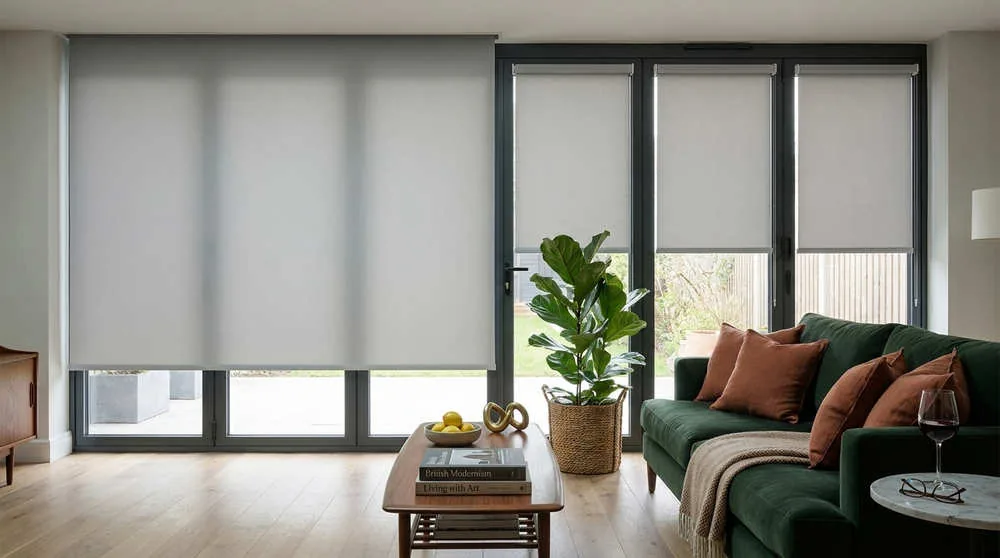
The biggest factor that determines the cost of electric blinds for large doors is the choice between one single, seamless blind or multiple smaller ones. This is what we call the ‘Span vs. Simplicity’ challenge, and it’s where basic window coverings end and proper engineering begins.
The reality is, the wider you make a blind, the more physics works against you. The tube wants to sag in the middle under its own weight known as deflection, creating an unsightly V-shape on the fabric. To stop this, the engineering has to be far more robust.
A standard blind might use a small 30-35mm roller tube, but a blind spanning over 3 metres could need a tube over 110mm in diameter just to ensure the fabric is perfectly flat. That increase in material, technology, and precision is what you’re investing in.
Here are the key things that contribute to the final price:
- The Motor: A powerful and reliable motor is the heart of the system. We use trusted brands like Somfy because they have the strength to lift large, heavy blinds smoothly for years. A quality motor might add a couple of hundred pounds to the cost, but it’s essential to avoid the frustration of a weak or noisy system that fails prematurely.
- The Fabric: For large glass doors, fabric choice is about performance, not just colour. Specialist high-performance fabrics that reflect over 80% of the sun’s heat are a step up in price from standard materials, but they are what actually make a south-facing room comfortable.
- The Concealment: For a truly minimalist look, nothing beats a concealed blind that disappears into a hidden ceiling pocket when not in use. This is a premium choice that needs to be planned during the build. The specialised cassettes for this ‘blind space’ are an architectural feature in themselves and a key part of the investment.
Navigating the Options: System Tiers in the UK Market
Not all electric blinds are created equal. The market can generally be broken down into three tiers, and understanding the difference is key to making the right choice.
So, What Should You Expect to Pay? Real-World Price Ranges
We believe in being upfront about cost. While every project is unique, these real-world examples should give you a realistic idea of the investment required for a professionally installed, specialist solution.
For a typical 4-metre wide set of blinds for bifold doors, a high-quality concealed electric blind system will likely be in the range of £3,000 to £5,000.
This price reflects the bespoke engineering, the high-performance fabric, the robust motor, and the specialist installation required to get a flawless result.
For a truly exceptional space, like the one in our ‘Eight-Metre Challenge’ story, the investment will be higher. We recently had a customer with an eight-metre-long set of sliding doors and an eight-metre-long roof lantern.
When you’re dealing with glass on that scale, it knocks most competitors out of the running. For an 8-metre span, a more complex solution using two synchronised blinds is needed, with a total project cost typically between £7,000 and £10,000. The investment is significant, but the result is a breathtaking, truly seamless finish that standard solutions simply cannot achieve.
The Ultimate No-Compromise Solution: The Dual Blind System
A common frustration is the day versus night dilemma. You want a sheer fabric to soften daylight and keep the view, but you need a blackout blind for privacy and cosiness in the evening.
The solution is a dual blind system, which fits two different fabric blinds into one discreet unit. Think of it like modern, automated net and heavy curtains. It is the ultimate investment in your lifestyle, but as it involves two blinds and two motors, you should expect it to be a significantly higher investment than a single blind system.
Why Some Companies Are So Expensive (and Others Deceptively Cheap)
The price differences you see online can be confusing. Let’s be honest about what you’re actually paying for, so you can spot true value from a false economy.
Premium solutions cost more because of the specialist engineering, the superior and quieter motors with long warranties, and the high-performance fabrics that genuinely solve your heat and glare problems. You’re investing in a complete, professionally installed service that is designed to last and protect the comfort of your home.
Cheaper alternatives are a risky compromise. They simply can’t handle the width of large doors and will inevitably sag, ruining the clean lines you paid for.
We see it more often than we’d like: a homeowner tries to save money, and within a year, they call us, frustrated that their cheaper blind performs so poorly. They end up buying twice, and that is always the most expensive option.
How Can You Make Electric Blinds More Affordable?
We know that budget is a real consideration, and there are ways to manage the cost. But it’s our job to be honest about what you’re giving up in return.
- Splitting the Span: Using multiple smaller blinds instead of one large one is the most effective way to lower the price. The compromise is purely aesthetic as you will have light gaps and a less minimalist look.
- Standard Fabrics & Motors: You can opt for simpler materials, but you will be sacrificing performance. The blind might not solve the heat issue as effectively, or the motor may not be as quiet or long-lasting.
- Visible Cassettes: A blind that retracts into a visible headbox is cheaper than a fully concealed pocket. It’s a practical solution, but again, the trade-off is the seamless, minimalist aesthetic.
Budgeting for a Flawless Finish: The ‘Hidden’ Costs
A truly exceptional result is born from meticulous planning. To protect your dream, several ancillary costs are important to be aware of, especially the difference between integrating them into a new build versus a retrofit.
Financing Your Investment
We understand this is a significant investment.
Many of our customers want to invest in high‑quality shading solutions, but we know that electric blinds and awnings aren’t always included in the original build budget. Sometimes they become an afterthought, or unexpected project costs mean the budget simply won’t stretch as far as planned.
To help make things easier, we offer flexible financing options designed to smooth out cashflow. In most cases, this involves a 50% payment at the point of order, followed by a direct debit spread over 6–12 months at Base Interest Rates (3.75% at the time of writing).
Every project is different, so we’ll discuss the most suitable approach with you on a job‑by‑job basis.
Major UK banks consistently offer competitive rates, and this approach maintains a clear distinction between your product investment with us and your financing arrangement.
Be wary of “0% finance” deals from mass-market retailers; the cost of credit is often absorbed by inflating the product price.
Your Questions Answered: Pricing FAQs
Q1: “Can I integrate these blinds with my existing Alexa/Google Home?”
Answer: Absolutely. We use a dedicated smart hub, like the Somfy TaHoma, which acts as a secure bridge between your blinds and your home’s Wi-Fi, allowing for simple voice commands and integration into smart home routines.
Q2: “What’s the real cost difference between a visible cassette and a fully concealed pocket?”
Answer: A visible cassette is part of the blind and adds around £100-£200 to the cost. A concealed pocket is a structural element. In a new build, the cost is minimal. However, retrofitting a pocket into an existing room is a multi-trade job that could cost £800 – £1,500 or more before the blind is even installed.
Q3: “Is a dual-blind system really worth the extra investment?”
Answer: For ultimate control, yes. It gives you a translucent screen for daytime glare control and a full blackout fabric for evening privacy. It’s unparalleled flexibility that a single blind cannot offer.
So, Is It Worth the Investment?
This is the most important question. After all the talk of cost, it comes down to what you value. We suggest asking yourself a few simple questions:
- What is the real cost of having a room that’s unusable for months of the year?
- How much do we value preserving the clean, beautiful look of our new doors?
- Is a short-term saving worth a long-term compromise on our dream space?
Choosing the right shading is a key decision. We believe in giving you the time and information to make it with confidence. It’s about creating a solution that feels right, works perfectly, and stands the test of time.
If you are in the planning stages, bringing us in early is the best way to seamlessly integrate comfort and control into your design. This proactive approach is the core of our S.H.A.D.E. principle, which treats shading as an integral part of the architecture, not an afterthought. Call us on 01256 345580 for a friendly chat about your options.
Or, to explore the possibilities from your own home, you can book appointment for an initial chat and a video session.
Ultimately, choosing the right shading isn’t just an expense; it’s the final, crucial step in making sure your beautiful extension lives up to its promise. It’s about reclaiming your space and ensuring it performs as beautifully as it looks, for years to come.