Have you just seen a quote for specialist shading for your new extension and are now quietly picking yourself up off the floor?
It’s a reaction we see all the time, and I’ll be honest, it’s completely understandable. The price often seems entirely out of line with what you’d expect a ‘blind’ to cost.
That feeling of surprise usually comes from a simple mis-categorisation. For years, we’ve all been conditioned to file blinds under ‘furnishings’, a decorative finishing touch. The problem is, a high-performance shading system isn’t a simple furnishing; it’s an engineered piece of functional architecture.
To help put it all into perspective, we’re going to be completely transparent about the costs. Here’s a quick look at what we’ll cover, so you can make a truly informed decision for your home.
Key Takeaways:
- The cost of specialist shading is comparable to other premium extension features you are likely already budgeting for, like high-end worktops or large bifold doors.
- It is more accurate to view performance shading as a functional building component, essential for comfort and usability, rather than a simple decorative accessory.
- The financial risk of an unusable, overheated room is far greater than the initial investment in an effective shading solution that protects your entire project.
- While cheaper alternatives exist, they often lead to significant compromises in aesthetics and performance, which can be a source of regret in a high-end architectural space.
The In-Depth Comparison: Putting the Investment into Perspective
To truly understand the value, an engineered shading system needs to be compared not with a standard roller blind, but with the other high-performance components you’re already planning for.
From my experience, seeing these numbers side-by-side is when the penny usually drops for homeowners.
A Fair Comparison: Shading vs. Other Premium Extension Components
A specialist shading system is a technical solution, designed and built to perform a specific job. When you place its cost alongside other premium features in your project, it starts to look much more familiar.
The Cost of a Premium Kitchen Worktop
This is often the centrepiece of a new kitchen. For high-end materials like Dekton or premium-grade quartz, a homeowner can expect to invest between £4,000 and £7,000, and sometimes more.
The Investment in Large Aluminium Doors
Those stunning sliding or bifold doors that create the seamless link to the garden are a major architectural feature. For a good quality 5-metre-wide system, the supply and installation cost can easily be in the region of £4,750 to £5,500.
The Price of High-Performance Flooring
A beautiful floor underpins the entire feel of your new space. For sought-after finishes like polished concrete or high-quality engineered oak, a typical 40-square-metre floor can cost between £4,800 and £6,400 to supply and install.
Now, Let’s Look at Specialist Shading
A high-performance electric roof lantern blind, fully installed, could have an indicative cost of £5,500. Seen in this context, it’s a similar level of investment to the other key features that make your extension special.
The Key Shift: Functional Architecture, Not a Decorative Accessory
The biggest mental shift is to stop seeing shading as decoration and start seeing it as a functional part of the building itself.
We use a simple framework for this called the S.H.A.D.E. principle, which is built on one core idea: shading is part of architecture, not an accessory. It’s about designing comfort in from day one to keep the dream of your perfect space alive.
This isn’t just a concept; it’s based on tangible, practical benefits.
- It’s about making your room comfortable. A beautiful glass extension that becomes a sweltering greenhouse in summer is a failed space. The right performance fabrics can block up to 97% of the sun’s heat. This is now so important that it’s addressed in UK Building Regulations (Part O), which legally require builders to manage the risk of overheating.
- It’s about protecting your other investments. That beautiful wooden floor? Or your new sofa? Specialist systems can block up to 99.9% of damaging UV rays, preventing your valuable interiors from fading.
- It’s about making your room usable, day and night. Intense glare can make it impossible to watch television or work on a laptop. The right fabric solves this, while a different fabric can give you complete privacy at night.
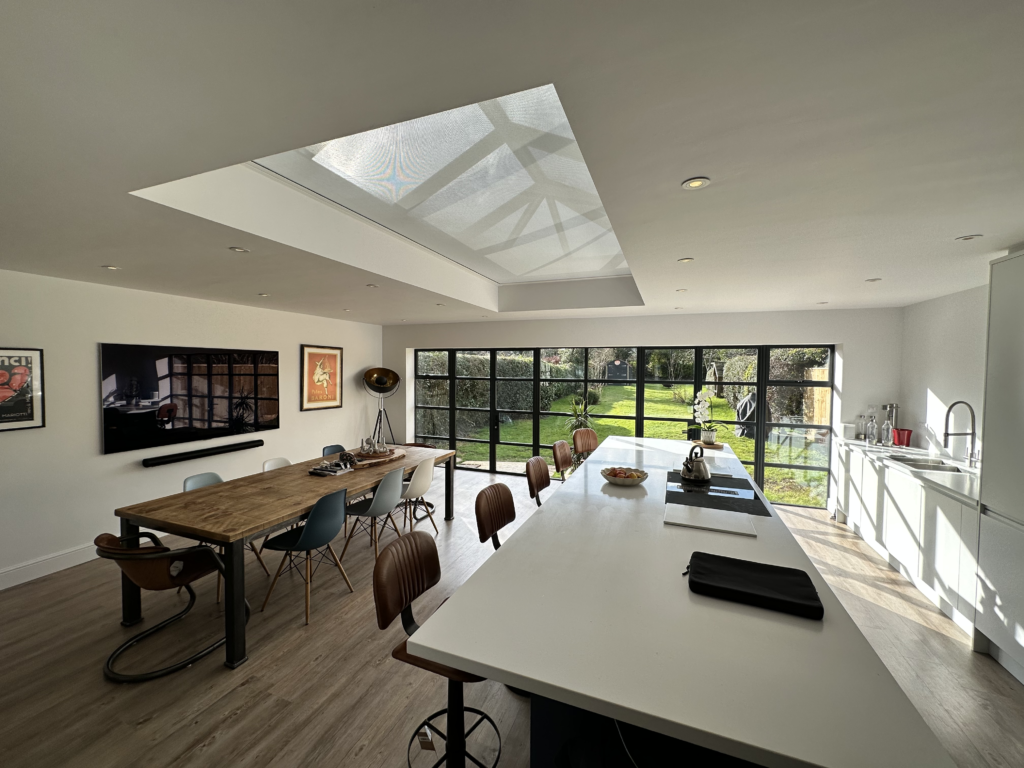
The Real Cost of Getting it Wrong: Why an ‘Unshaded’ Room is an Unusable Room
I remember a project on Hayling Island that perfectly illustrates this point. The owners had built a stunning dining room that was essentially a glass box, huge panels of glass on two sides. It was a wonderful vision, but there were no controls planned for the light or heat.
The reality was that the room became so intensely hot and bright that it was unusable for large parts of the day. The dream was compromised.
Think about it like this: if you spend £100,000 on your dream extension, but a £60,000 section of it is unusable for hours every sunny day, was ‘saving’ £5,000 on shading a wise decision?
The cost of the blinds is a fraction of the cost of a compromised, unusable space. The investment is in protecting the function of the entire project.
What About Cheaper Alternatives? An Honest Look
I honestly believe it’s vital to look at all the options, so let’s walk through the common alternatives you’ll likely come across.
Alternative 1: High-Performance Window Film
- Good fit for: A utility room or a south-facing landing on a strict budget, where dynamic control isn’t the main priority. It’s a relatively low-cost way to reduce UV and heat.
- Not a good fit for: Primary living spaces. It’s a static solution, meaning you can’t turn it off in winter, and it offers no privacy at night.
Alternative 2: Standard Off-the-Shelf Blinds
- Good fit for: A standard-sized window in a spare bedroom where budget is the only consideration. They are very cheap.
- Not a good fit for: Any high-end architectural extension. They are not engineered for large windows, the mechanisms struggle, the fabrics sag, and they simply look out of place.
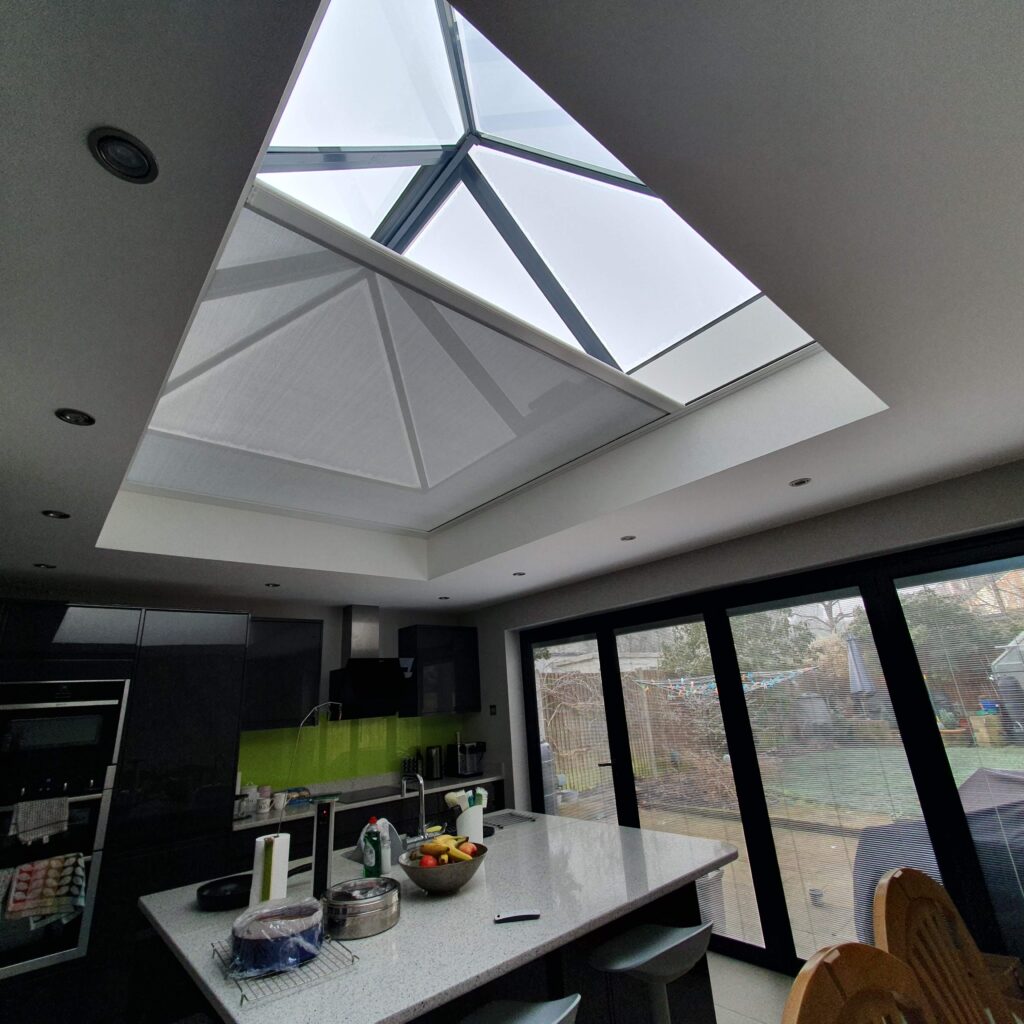
Alternative 3: Cheaper Motorised Systems
- Good fit for: A smaller, easily accessible window where a potential failure isn’t a major disaster. They offer motorisation at a lower initial price.
- Not a good fit for: Large, heavy, or hard-to-reach blinds in the heart of your home. Motor reliability, noise, and longevity are often compromised, leading to the frustrating ‘buy twice’ scenario when they fail.
Making an Informed Decision
By now, I hope the cost is sitting in a clearer context. Here are the key things we think are worth remembering.
- The cost of specialist shading is in line with other premium extension features.
- It’s a functional building component, essential for comfort and usability.
- The cost of an unusable room is far greater than the cost of the shading solution.
- Cheaper alternatives often lead to compromise and regret in high-end spaces.
Your Next Steps
- Rethink your budget: We encourage you to view shading as part of the core build cost, alongside the glazing and structure, not as a decorative extra.
- Talk to your architect early: Use the ideas here as a conversation starter. Ensure comfort and control are part of the plan from day one.
- Ask about the value: When you get a quote, ask the specialist to explain what’s behind the price, the engineering, the fabric performance, and the system’s longevity.
Planning your dream extension? It’s never too early to talk about getting the comfort and control right from the start. To see how these principles look in real homes, take a look at our customer stories.
Or, for a friendly chat about the possibilities for your space, please get in touch. Call 01256 345580 today or book your appointment here.
A Final Thought
By seeing specialist shading as a key part of the architecture, you aren’t just buying a blind; you’re investing in the comfort, beauty, and year-round enjoyment of the dream space you set out to create from the very beginning.
Ultimately, a beautifully designed glass extension that you can’t fully use isn’t a success. We believe true success is when stunning design and everyday comfort work perfectly together, allowing you to love every single part of your new space.