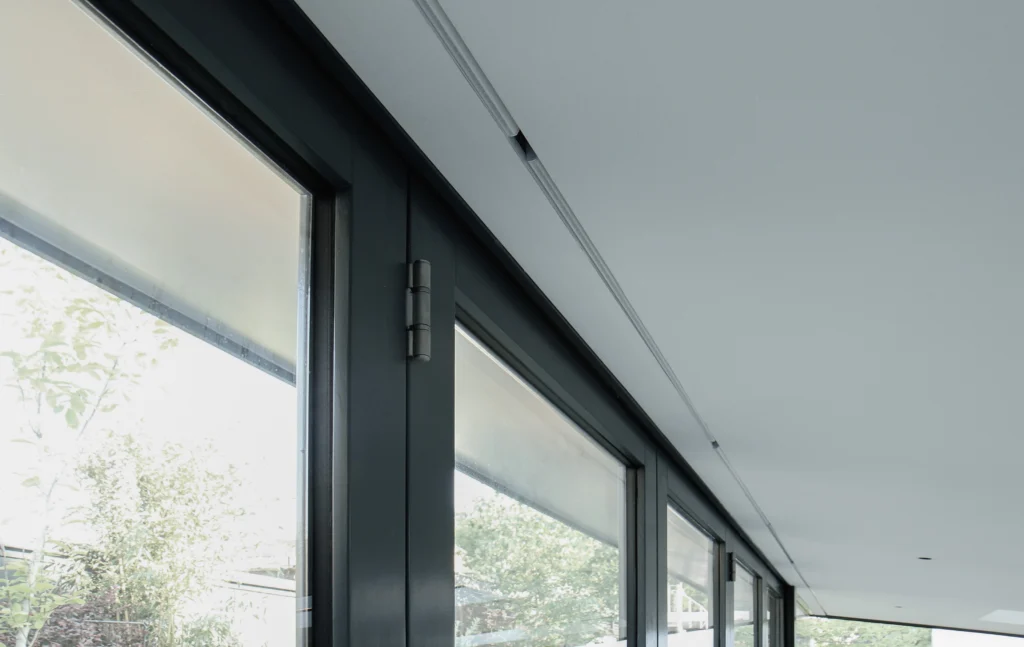
Concealed electric blinds that disappear into the ceiling
The short answer: a concealed electric blind (often called a hidden blind) sits inside a Blindspace box, a slim aluminium pocket built into your ceiling or wall before the plasterboard goes up. When the blind is up you see a fine slot and nothing else: no cassette, no headbox, no cords. When you want shade, privacy or blackout, it glides down at the touch of a button. As a worked example, the figures in one of our published quotes add up to £7,500 including VAT for a 1 m x 2 m roof lantern: 3-sided Blindspace boxes, an Athena electric blind, the survey after you order and a day’s fitting. Your builder’s timber surround and your electrician’s power supply are priced by them. The one thing you can’t do is leave it late: the boxes have to be planned while the ceiling is still open.
The short version
- Which Blindspace box for which opening: windows, doors, roof lanterns and gables side by side
- What concealed blinds cost, with a full worked example
- Concealed blinds we’ve fitted: James, Dom and George
- Worth knowing before you plan
- Your questions answered
The decision you’re really making
Most electric blinds can be fitted two ways: surface-mounted, with a neat visible cassette, or concealed, hidden in the structure. The fabric and the motor are the same either way. What you’re choosing is how the room looks every day when the blind is up, and that choice has a deadline. Planned in while the ceiling is open, concealment is part of the build; cutting it into a finished ceiling typically costs two to three times as much. If your room is already finished, there are still good options, and we’ll tell you honestly which one suits you.
Which Blindspace box for which opening?
| Opening | Box sizes | What stays hidden | Price guide (incl. VAT) | More detail |
|---|---|---|---|---|
| Windows | S-Series head box, 100 x 100 mm or 130 x 130 mm | The whole blind when it’s up | Quoted with your blinds as one total | Blindspace for windows |
| Sliding and bifold doors | S-Series head box; an S100 holds a single blind of nearly 4 m on a narrow anti-sag tube | One continuous blind, hidden when it’s up | About £4,000 to £6,000 for a 4 m opening: around £1,000 of boxes plus £3,000 to £5,000 for the blinds supplied and fitted (guide figures) | Door design guide |
| Roof lanterns and skylights | C-Series head box from 130 x 150 mm up to 190 x 340 mm, side boxes 50 mm or 80 mm, 3-sided or 4-sided | Blind and side guides, plus the hem bar with 4-sided boxes | £7,500 for a 1 m x 2 m lantern with 3-sided boxes (worked example below). Boxes alone run from about £2,300 to £8,700 by size; the blind, survey and fitting are added to that | Blindspace for roof lanterns and the estimator |
| Gable and triangular windows | Shaped Blindspace profiles along the top, sides and floor | Electric lifting blinds for angled glass | Quoted with your blinds as one total | Blindspace for gables |
Box sizes from Blindspace’s S-Series and C-Series profiles. Door figures are the guide prices in our concealed blinds cost guide; roof figures from our estimator (Blindspace 2026 prices, checked 6 November 2026) and a published June 2026 quote. Your builder’s work, electrics and plastering are priced by your builder.
What concealed electric blinds cost
Here is a real example, from a quote we published for a 1 m x 2 m roof lantern in June 2026, all including VAT:
- Blindspace boxes, 3-sided: £2,250 (4-sided, which also hides the hem bar: £2,600)
- Athena electric roof blind with touch control: £3,350
- Manufacturing survey after you order: £650
- Installation, one day: £1,250
Together: £7,500 including VAT with 3-sided boxes, or £7,850 with 4-sided. Your builder forms the timber surround and your electrician runs a fused spur to the motor, which they price as part of their work.
For other sizes, our Blindspace estimator prices the boxes from your opening size: about £2,300 including VAT for a 1 m x 2 m lantern up to about £8,700 for a 3.5 m x 6.5 m one, supplied and delivered, and it shows the ceiling void your builder needs to form. The blind, survey and fitting are added to that, and we quote them with the boxes as one total.
Concealed blinds we’ve fitted
James, Marlow. In James’s new extension, his builders fitted S100 Blindspace boxes to our technical drawings while the ceiling was being built, and we made a single blind of nearly 4 m on an anti-sag Deflect Zero tube so it would fit the slim box, with no gaps across his sliding doors. In the old cottage, where structural steel ruled out a recess, we used slim colour-matched cassettes instead: “hidden in plain sight”. James: “We’re incredibly happy… it gives us the minimalist, streamlined look we were hoping for.” Read James’s story
James, garage extension. A different James wanted blackout for the extension that houses his car collection: two roof lanterns, two sets of bifold doors and four windows. Athena blackout blinds cover the lanterns and zip blinds the windows and doors, with Blindspace boxes powder coated to match the timber frames. In his words, the blinds “appear when I want them to appear, and almost magically disappear when I don’t”, and the finished space has “the wow factor I wanted”. Read the garage story
Dom, kitchen skylight. Dom didn’t want hardware interrupting the skylight in his kitchen extension. His Athena roof blind sits in Blindspace boxes fitted at first fix, so when it’s open you see the glass, not the blind. Read Dom’s story
George, 2 m x 4 m skylight. George’s skylight is partly concealed without Blindspace boxes. Chris worked out the exact sizes for a shelf, George’s builders made it, and the electric roof blind now tucks away almost out of sight, with LED lighting in the same shelf. George: “Chris was really instrumental in making sure we could build a high‑quality shelf for the blind so you can’t see it.” Read George’s story
Why people choose concealment
- ✓ Nothing on show when the blind is up: the glazing and the ceiling line stay exactly as your architect drew them.
- ✓ Wide openings in one piece: a single blind of nearly 4 m fits inside a 100 x 100 mm box, as on James’s sliding doors.
- ✓ Better room darkening: side boxes seal the edges where light usually leaks round a blind.
- ✓ Fully serviceable: the cover clips onto a hinge and unclips for access to the blind and motor, with no cutting or redecorating.
- ✓ Colour-matched if you want it: standard white (RAL 9016), or any standard RAL colour powder coated.
- ✓ Smart control: Somfy motors with the TaHoma app, remote handsets, sun sensors and Alexa or Google Home.
Worth knowing
- Timing is everything. The boxes go in at first fix, before plasterboard, so raise them at design stage. C-Series boxes typically take 3 to 4 weeks from a complete order, plus about a week’s delivery.
- Your builder is part of the team. They form the void to our drawings, your electrician runs power to the motor and your plasterer skims up to the box. We plan it with them.
- Already finished? Roof boxes can be fitted within the opening, which keeps the ceiling as it is but takes about a fifth of the visible glass (a 1.5 m x 2.5 m opening with 4-sided Athena boxes keeps about 78%). A slim colour-matched cassette is the other route.
- Not a DIY job. Concealment needs the builder, electrician, plasterer and blind installer working to the same drawing.
Want to know if concealment suits your project? Book a free call and send us your drawings. Still weighing it up? Read concealed or surface-mounted: how to choose.
When blinds are concealed from the start, the glazing remains the hero. This delivers comfort, control, and privacy without adding visual clutter.
Whether you’re coordinating with architects during early design or glazing has already been designed, the concealment strategy must align perfectly with the glazing system to achieve a seamless result.
Our approach is built on precision and respect for the architecture. Concealed shading only succeeds when every detail works in harmony.
blindspace products
Blindspace Concealment For Architectural windows
Blindspace Concealment for Roof Lanterns & Skylights
Blindspace Concealment For Sliding & Bi-Fold Doors
Blindspace Concealment for Gable Shaped Windows
Pricing
Learning Centre
When’s the right time to plan electric blinds for my extension?
Concealed Blinds: The Complete Guide to an Invisible Shading Solution
Concealed or surface-mounted blinds. How to choose? (Honest comparison)
What happens if my expensive concealed blinds break down inside the ceiling?
Success Stories

Related Products
Electric roof lantern & skylight blinds
electric patio retractable awnings
electric architecturally shaped blinds
ZoomTEch deflect zero wide blinds
Your questions answered
Blindspace heritage
Blindspace® was created with a single purpose: to let architecture remain pure, uninterrupted, and beautifully resolved. By concealing blinds and screens within the structure itself, Blindspace removes visual clutter and preserves the clean lines architects work so hard to achieve. Every profile reflects precision engineering and a commitment to minimalism, allowing comfort and technology to appear only when needed and disappear completely when they’re not.
It’s a slim aluminium pocket, built into the ceiling or wall above the glass, that the blind rolls up into. The one we use is Blindspace. Your plasterer skims right up to its edge, so when the blind is up you see only a fine slot. A hinged cover clips over the opening and unclips when the blind or motor needs attention.
Blindspace is the concealment system we use: aluminium boxes built into the ceiling above the glass at first fix, which the blind retracts into. S-Series boxes of 100 x 100 mm or 130 x 130 mm suit windows and doors, and larger C-Series boxes suit roof lanterns and skylights. The plaster is skimmed up to the box and a hinged cover unclips for access.
Yes. Hidden and concealed both describe a blind that retracts into a box built into the ceiling, so only a fine slot shows when it’s up. Where a recess isn’t possible, a slim colour-matched cassette is the ‘hidden in plain sight’ alternative we used in James’s cottage in Marlow.
For a 1 m x 2 m roof lantern, the figures in one of our published quotes add up to £7,500 including VAT with 3-sided boxes: £2,250 of Blindspace boxes, £3,350 for an Athena electric blind, £650 for the survey after you order and £1,250 for a day’s fitting. For a 4 m sliding or bifold door, our guide figure is about £4,000 to £6,000 for boxes and blinds together. Your builder’s work and electrics are extra and priced by them. See our concealed blinds cost guide for more.
At first fix, before the plasterboard goes up, so the decision belongs at design stage, ideally while your architect is drawing the ceiling. The blind itself is fitted after decorating.
The void has to take the box: for windows and doors that is 100 x 100 mm or 130 x 130 mm. Roof lantern head boxes are larger, from 130 x 150 mm up to 190 x 340 mm for the biggest systems, with side boxes of 50 mm or 80 mm. Our Blindspace estimator gives the exact void for a lantern, and we send drawings for your builder.
Sometimes. For a roof lantern or skylight, the boxes can be fitted within the opening, which keeps your ceiling as it is but takes about a fifth of the visible glass. Cutting a full pocket into a finished ceiling is possible, but in our experience it costs two to three times as much as planning it in. Often the better answer is a slim, colour-matched cassette, which looks neat and uses the same fabric and motor. Is it too late for a minimalist look?
The Blindspace cover is hinged and clips in place, so a technician unclips it to reach the blind and motor. No cutting and no redecorating. We fit Somfy motors, which carry a 5-year manufacturer’s warranty. More on servicing concealed blinds
Often, yes. With an anti-sag Deflect Zero tube, a blind of nearly 4 m fits inside a slim S100 box, which is what we did for James in Marlow. That gives one continuous blind with no gaps. Very wide openings may need two blinds; we’ll tell you when we see your sizes.
Yes. Athena, Venus CTS and Hercules XL roof blinds all have Blindspace box sets. With 3-sided boxes the hem bar stays visible; 4-sided boxes hide that too. See Blindspace for roof lanterns and electric roof lantern blinds.
Yes. Electric lifting blinds for angled glass can retract into shaped Blindspace profiles along the top, sides and floor. See Blindspace for gable windows.
Standard white (RAL 9016). Any standard RAL colour can be powder coated for an extra charge. On James’s garage extension the boxes were powder coated to match the timber frames.
C-Series boxes are typically 3 to 4 weeks from a complete order, plus about a week’s delivery. Order them in time for your builder’s first fix.
Your builder or joiner forms the void to our Blindspace drawings and your electrician runs a fused spur to the motor position. The boxes go in at first fix, fitted by your builder to our drawings or by us, and we fit the blind once decorating is finished. We talk your trades through it so everyone works to the same plan.
Yes. A concealed blind uses the same Somfy motors as any blind we fit, so you can use a remote handset, the TaHoma app, a sun sensor or voice control through Alexa or Google Home.
If a clean ceiling line matters to you and you’re still at design stage, yes: you’ll look at that ceiling every day. If a neat cassette doesn’t bother you, a surface-mounted blind gives the same comfort for less. Concealed or surface-mounted: how to choose
Yes. We fit concealed blinds across Great Britain, except Northern Ireland, including Guildford, Godalming, Cranleigh and Bramley. Most projects start with a free call and your drawings. Book a free call
Not really. Concealment depends on the builder, electrician, plasterer and blind installer all working to the same drawing. We supply the drawings and fit the blind, so the pieces line up.