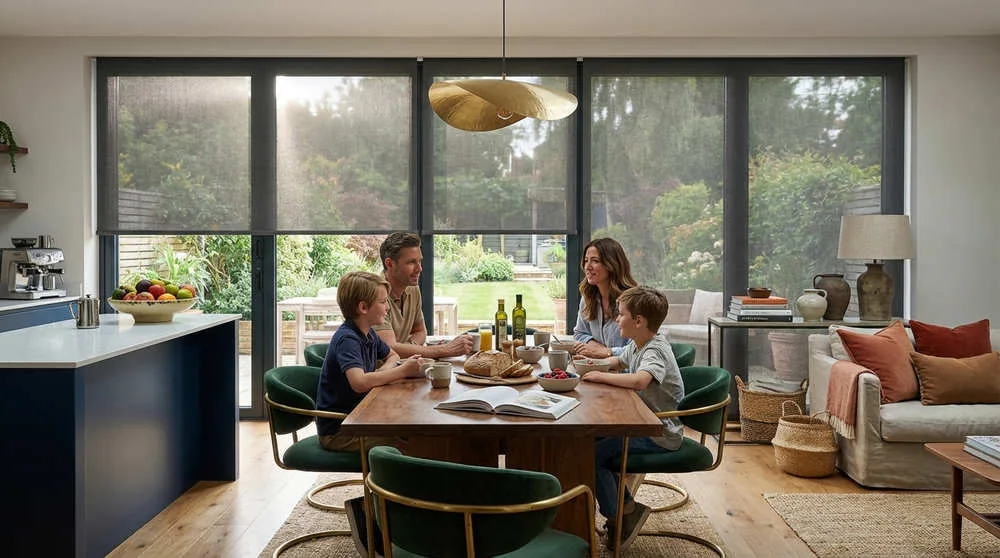
Every electric blind company claims theirs is the best. Not one tells you when a £150 alternative would do the job just as well.
If you suspect every comparison you’ve read online is quietly biased – you’re right. Most are.
This guide puts every major option side by side with honest pros and cons, including when a cheaper, simpler solution is genuinely the smarter choice.
A note on our bias: We sell premium, specialist electric blinds. We’ll tell you upfront when you don’t need them. Our goal is to help you make the right decision, even if that means you don’t buy from us.
Key Insights from This Guide:
- Most buyers face five core trade-offs: understanding which one matters most to you is the fastest path to a confident choice
- A single blind forces a daily compromise between your view and your comfort that a dual system eliminates
- The 10-year cost of a budget blind that sags and fails often exceeds the price of a premium system installed once
- For large doors over 3 metres, standard blinds physically cannot perform – specialist engineering is essential, not optional
- There are genuine situations where a simpler solution is the right choice, and we’ll tell you exactly when
Quick Reference: System Tiers at a Glance
| System Tier | Typical Cost (Installed) | Best For | Key Limitation |
| Entry-Level (Pleated/Honeycomb) | £1,500–£2,500 | Budget projects, small windows | Visible wires, fabric sag on large spans |
| Mid-Range (Standard Roller) | £2,500–£3,800 | Good aesthetics, moderate spans | Potential sagging over time, light gaps |
| High-Performance (Zip-Tensioned) | £4,500–£6,000+ | Large glazing, roof lanterns, minimalism | Higher upfront investment |
The 5 Core Decisions Every Buyer Faces
| Decision | The Trade-Off | Quick Answer |
| Single or Dual Blind? | View vs comfort | Dual for main living spaces |
| Concealed or Surface? | Timing vs aesthetics | Concealed if you’re still building |
| Inside or Outside? | Convenience vs heat performance | Outside for severe heat problems |
| Premium or Budget? | Upfront cost vs lifetime value | Premium for large, visible glazing |
| Which Fabric? | Heat control vs glare vs view | Metallised for both heat and glare |
Why Trust This Guide?
WindowTreat specialises in high-performance shading for large glazed extensions across the UK. We’re Trading Standards Approved and SafeContractor accredited – which means you have formal recourse if something goes wrong. Our approach, called S.H.A.D.E., treats shading as a fundamental part of architecture, not an afterthought. We have over 50 filmed customer testimonials – so you can see real results in homes like yours before committing – and a reputation built on telling people the truth, even when it costs us a sale.
What We Will Cover in This Guide:
Each section maps to a decision you’ll face, skip to whichever trade-off is currently blocking your choice.
- Part 1: Single blind or dual system, the comfort trade-off
- Part 2: Concealed or surface-mounted, the aesthetics trade-off
- Part 3: Inside or outside, the physics trade-off
- Part 4: Premium or budget, the quality trade-off
- Part 5: Choosing by room, function defines form
- Part 6: Solutions for large doors, why scale changes everything
- Part 7: The fabric decision, performance, not pattern
- Part 8: Smart automation, is it worth it?
- Part 9: Retrofitting, is it still worth it?
- Part 10: When a simpler solution is the right choice
- Part 11: Who this guide is (and isn’t) for
- Frequently asked questions
- All comparison articles
What Do We Mean by ‘Comparisons & Options’?
No single electric blind is “the best.” The right choice depends on your room, your glazing, your timing, and what matters most to you, aesthetics, comfort, or budget.
Single Blind or Dual System, The Comfort Trade-Off
In our experience fitting hundreds of extensions, the most common regret is choosing a single blind for a main living space.
Here’s why. A single room-darkening blind blocks glare brilliantly, but to use it, you lose the view entirely.
A single sheer lets you see out, but offers almost no privacy once your lights come on at night.
A dual system solves both. One sheer screen manages heat and glare by day. One room-darkening blind provides complete privacy at night.
Think of it as the modern version of net curtains and heavy drapes, two fabrics, each doing one job well, housed in one discreet unit.
A couple in Dorset, Duone and Simon, lived with unbearable glare for a decade. They wore sunglasses indoors. A dual system finally gave them back their garden room, understanding the single vs twin trade-off made that possible.
When a single blind is enough: Bedrooms where darkness is the only goal. North-facing rooms with minimal heat. Utility spaces where aesthetics aren’t the priority.
Concealed or Surface-Mounted, The Aesthetics Trade-Off
Timing decides this one. Not preference, not budget, timing.
A concealed system uses a product like Blindspace® to hide the blind inside the ceiling. When retracted, it’s completely invisible.
A surface-mounted system fixes a visible cassette to the wall. Modern cassettes are sleek and can be colour-matched to your frames.
| Factor | Concealed | Surface-Mounted |
| When to decide | Before plastering (design stage) | Any time, even years later |
| Visual impact | Invisible when retracted | Slim cassette visible |
| Cost | Higher (includes building work) | Lower (self-contained) |
| Performance | Identical with same fabric | Identical with same fabric |
The honest truth? Both deliver excellent comfort. The difference is purely aesthetic.
If your ceilings are finished, a concealed system means destructive building work. A high-quality surface blind is the practical, elegant choice. A well-chosen surface cassette, properly colour-matched to your frames, is a genuine aesthetic solution, not a second-best compromise. Our full guide walks you through how to choose between concealed and surface-mounted blinds with complete honesty.
Inside or Outside, The Physics Trade-Off
This is where science matters more than opinion. External shading stops heat before it touches the glass. Internal shading can only manage heat once it’s already inside your room.
An external roof blind can block over 90% of solar heat gain. A standard internal blind absorbs that heat and radiates it inward, like a large, warm radiator.
For south-facing extensions with intense overheating, electric awnings and external blinds are the highest-performing option. They intercept the problem at the source.
Where adjustable blinds aren’t practical on fixed glazing, 3M window film provides a complementary solution. It rejects UV and reduces solar gain without visible hardware, though it’s permanent, so you can’t adjust it seasonally.
When internal blinds make sense: Glare control for screens. Night-time privacy. Rooms that don’t suffer severe overheating. Decorative finishing.
When external is essential: South or west-facing glass with intense sun. Rooms that become genuinely unusable in summer.
Our detailed guide on inside vs outside shading explains the physics simply and helps you decide.
Premium or Budget, The Quality Trade-Off
Having helped homeowners through this decision for years, we can tell you the biggest difference isn’t what you see on day one. It’s what you live with for the next decade.
Budget electric blinds use simpler mechanisms. Over time, gravity wins. The fabric sags. The motor strains. The finish that looked acceptable at first becomes a daily source of frustration in your otherwise beautiful space.
| Factor | Budget System | Premium System |
| Upfront cost | £1,500–£2,500 | £4,500–£6,000+ |
| Motor warranty | 1 year typical | 5 years (Somfy) |
| Fabric tautness | Guide wires, prone to sag | Zip-tensioned, stays flat |
| 10-year cost | Often £3,000+ (buy twice) | £4,500–£6,000 (buy once) |
We once worked with a homeowner called Phil. He insisted on a cheaper system against our advice. Our specialist sold it, but noted it was “under duress.”
Months later, Phil called back. The compromise didn’t match the standard of the rest of his home. He paid to replace it entirely. He bought twice.
Our no-nonsense guide breaks down the real difference between premium and budget electric blinds with evidence, not sales talk. And if you’re comparing us specifically, we’ve written an honest assessment of what you’re actually paying more for with a specialist vs high-street.
The “Buy Twice” Reality
We see it regularly. A homeowner chooses the cheaper option, lives with sagging fabric for months, then calls us to replace it with the system we originally recommended. The total cost? Significantly more than doing it right the first time.
Choosing by Room, Function Defines Form
Your kitchen and your bedroom need fundamentally different things, and choosing one blind type for every room is where many buyers go wrong.
A kitchen needs moisture-resistant, wipeable fabric. A bedroom needs true room-darkening performance with sealed side channels. A living space with large doors needs the flexibility of a dual system.
The right blind for a busy family kitchen would be wrong for a master bedroom. Understanding which electric blind is best for a kitchen versus a bedroom prevents costly mismatches.
Solutions for Large Doors, Why Scale Changes Everything
Standard blinds physically cannot cover a 5-metre opening. The roller tube bends. The fabric sags into a V-shape. The result cheapens your entire space.
Specialist systems use technologies like ZoomTech® to actively compensate for deflection. This keeps the fabric perfectly flat across wide spans.
For patio openings, electric awnings offer an alternative external approach, shading the entire doorway from the outside and stopping heat before it reaches the glass.
Our guide explains which blind solutions work best for large sliding doors and bifolds, including when multiple smaller blinds are the smarter choice.
The Fabric Decision, Performance, Not Pattern
In our specialist work, we’ve found fabric choice determines whether your blind actually solves the problem, or just covers the glass.
The key metric is Solar Reflectance. A high number means the fabric reflects heat away. A low number means it absorbs heat and radiates it into your room.
| Fabric Type | Heat Control | Glare Control | View Through | Best For |
| Light screen | Good (reflects) | Poor (hazy) | Moderate | Heat-focused rooms |
| Dark screen | Poor (absorbs) | Excellent | Crisp and clear | Glare on TV screens |
| Metallised | Excellent | Good | Good | Both heat and glare |
| Room-darkening | Depends on colour | Total | None | Bedrooms, cinemas |
Three guides cover this in depth:
- Blind fabrics compared for heat and light control, the science made simple
- Which fabrics genuinely handle heat and glare best, the metallised advantage
- How to avoid choosing the wrong fabric, common mistakes and how to prevent them
Smart Automation, Is It Worth It?
Smart blinds aren’t about laziness. They’re about your home managing itself.
A sun sensor closes the blinds when the room gets too hot, even when you’re out. A dusk programme lowers them automatically for privacy every evening. Pre-set ‘scenarios’ transform convenience: cinema mode, holiday mode, morning sun.
But smart automation isn’t for everyone. If you prefer simplicity, a standard remote does the job. For an honest look at both sides, read our guide on the real pros and cons of smart electric blinds.
Retrofitting, Is It Still Worth It?
A beautiful result is absolutely still possible in a finished room.
The trade-off is between “invisible” and “elegant.” A concealed pocket requires building work. A high-quality surface cassette, colour-matched to your frames, integrates cleanly without disruption, and looks far better than most homeowners expect.
Battery-powered motors eliminate the need for chasing cables. Modern batteries last around a year on a single charge.
Our guide covers everything you need to know about retrofitting electric blinds, the honest pros, cons, and potential pitfalls.
How Specialist Shading Compares to Other Extension Investments
A specialist blind system costs roughly the same as a premium worktop, between £3,000 and £5,500.
The difference? A worktop sits in your kitchen. A blind system determines whether you can actually use the room you spent £150,000 building.
Our comparison of specialist shading costs versus other high-end extension features puts the investment into proper perspective.
Solving the ‘Goldfish Bowl’ Problem
Those beautiful glass doors become a stage once your lights come on at night.
The solution is a dual system. Sheer fabric by day. Opaque fabric at night. The transition can be automated so you never think about it.
Samantha’s family in Cirencester discovered this solved an unexpected problem too. Their rescue dog, Cooper, barked at his own reflection in dark glass every evening. Automated blinds closing at dusk stopped the barking completely.
Read the full guide on how to stop your extension feeling like a goldfish bowl at night.
Enjoying Your Extension in Every Season
Year-round comfort is achievable. It requires control, not compromise.
A dual system with high-performance fabric manages heat in summer and insulates in winter. Smart automation adapts the blinds to the conditions so you don’t have to.
Our guide on how to enjoy your glass extension in every season provides a practical framework for taking back control of your space.
When a Simpler Solution Is the Right Choice
We wouldn’t be honest if we didn’t say this clearly. A specialist system isn’t always necessary.
Here’s when a simpler option genuinely makes more sense:
- Small, standard windows in spare rooms or utility spaces, an off-the-shelf blind is perfectly adequate
- North-facing rooms that never overheat, basic privacy blinds do the job
- Fixed glazing where you just need UV protection, 3M window film is a cost-effective, invisible solution
- Rarely adjusted windows, a manual blind might be all you need
- Very tight budgets, a good high-street blind is better than no blind at all
Our specialist systems are engineered for large, architecturally significant glazing where performance and aesthetics are paramount. For a small bathroom window, they’d be overkill.
Who This Guide Is (and Isn’t) For
This guide is ideal for you if:
- You have a glass extension with large windows, roof lanterns, or bifold doors
- You want to understand your options before speaking to anyone
- You value honest advice over a polished sales pitch
- You’re willing to invest in the right solution to protect your home
This guide is NOT for you if:
- You have standard-sized windows in a standard home, a high-street blind will serve you well
- You want the absolute cheapest option regardless of quality or longevity
- Your budget won’t stretch beyond £500, our solutions start significantly higher
- You just want someone to tell you what to buy without understanding why
We’d rather guide you toward the right option for your home than sell you something that doesn’t fit.
Frequently Asked Questions About Choosing Electric Blinds
Is a concealed blind always better than a surface-mounted one? No. Both deliver identical comfort performance with the same fabric. Concealment is purely aesthetic. If your room is finished, a surface-mounted system avoids costly building work and still looks sleek.
Can I mix blind types across different rooms? Absolutely. A dual system for your living space, a single room-darkening blind for your bedroom, and a simpler blind for a utility room is a sensible, cost-effective approach.
Does a dark fabric keep my room cooler? The opposite, actually. Dark fabrics absorb heat and radiate it inward. For cooling, choose a light-coloured or metallised fabric that reflects heat away.
Will internal blinds stop my extension overheating? Internal blinds manage heat that’s already inside. For severe overheating, external shading or 3M window film is significantly more effective.
How do I know if I need a specialist or a high-street company? If your glazing is large, architectural, or complex, a roof lantern, wide bifolds, a gable window, you need a specialist. For standard windows, a reputable high-street fitter is a perfectly good choice.
What’s the biggest mistake homeowners make? Choosing based on price alone. The cheapest option often costs more over ten years when it sags, fails, and needs replacing.
Your Next Step
If you’re still weighing up your options, that’s a good sign, it means you’re making a considered decision.
Your best next step depends on where you are in your project. At the planning stage with your architect? A quick conversation now can save significant cost and frustration later. Room already finished and dealing with heat or glare? We can talk you through what’s realistically achievable.
Either way, there’s no pressure. We’d rather help you understand your options than rush you into a decision you’re not ready for.
Book a free virtual consultation to discuss the possibilities for your space. Or call 01256 345580 for a friendly, honest chat.
Now that you understand the comparison landscape, explore what real homeowners wish they’d known before choosing, it’s full of hard-won lessons that could save you time and money.
All Comparisons and Options Articles
Understanding the Core Trade-Offs
- One blind or two? Making sense of single vs twin systems: Why a single blind forces a daily compromise, and how a dual system eliminates it.
- Concealed or surface-mounted blinds – how to choose: The honest pros and cons of each approach, with timing as the key deciding factor.
- Inside vs outside shading – which makes more sense?: The physics of where shading works hardest, with external, internal, film, and awning options compared.
Navigating Quality and Cost
- Premium vs budget electric blinds – the real difference: What the engineering gap looks like in practice, and how the 10-year costs compare.
- WindowTreat vs high-street blinds – what are you paying more for?: An honest breakdown of what drives the price difference between specialist and generalist companies.
- How does specialist shading compare to other extension features?: Why shading costs roughly the same as a premium worktop, and why it matters more.
Choosing the Right Fabric
- Blind fabrics compared – which control heat and light best?: A straightforward comparison of fabric types with performance data.
- Which blind fabrics genuinely handle heat and glare best?: Why metallised fabrics overcome the standard light-vs-dark compromise.
- How to avoid choosing the wrong electric blind fabric: The common mistakes and how to prevent them with three simple steps.
Choosing for Your Situation
- Best blinds for large sliding doors and bifolds: Why scale changes everything, and how specialist engineering solves the sag problem.
- Which electric blind is best for a kitchen versus a bedroom?: How function defines form, with practical guidance for each room type.
- How to stop your extension feeling like a goldfish bowl at night: The privacy solutions that work without sacrificing your daytime view.
Making It Work Practically
- Smart electric blinds – the real pros and cons: An honest look at when automation adds genuine value and when it’s unnecessary.
- What to know about retrofitting electric blinds: Your realistic options when the build is already finished.
How to enjoy your glass extension in every season: A practical framework for year-round comfort without compromise.