We understand. You’ve been quoted for an electric blind for your beautiful new roof lantern, and the price has given you pause. You’re probably wondering how a blind could possibly cost as much, or even more, than the roof lantern itself.
It’s a completely fair question, and honestly, it’s one we hear all the time.
This isn’t a sales pitch. It’s a straightforward guide to help you understand exactly what goes into the cost of a specialist roof lantern blind, so you can feel confident in your decision.
Here are the most important things to know before we dive in.
- The Cost is in the Engineering: The price isn’t really for the fabric you see; it’s for the hidden, high-performance engineering required to make a blind work flawlessly against gravity.
- Cheaper Isn’t Always Better: Lower-cost alternatives often come with significant compromises in appearance, durability, and functionality, which can lead to disappointment.
- It’s a Lifestyle Investment: The true value of an effective roof blind is measured in reclaiming your living space, turning an unusable ‘greenhouse’ back into a comfortable room you can enjoy all year round.
Why a Roof Blind Isn’t Just a Blind on its Side
The real issue is that we naturally assume a blind for a roof should be priced like a blind for a window. The truth is, they are two completely different engineering challenges.
We often liken a roof lantern without a blind to a performance sports car with no brakes – bold, beautiful, and full of promise, but without control, it’s compromised. To handle that heat and gravity, you need a braking system engineered for the job.
Think of it like this: it’s easy to let a weight hang from your hand, but it takes a lot of strength to hold that same weight out at arm’s length. A roof blind is constantly fighting gravity, and what we’ve seen time and again is that this fight requires serious, robust engineering.
Our job as specialists, ‘doctors for glass,’ as we sometimes think of ourselves, is to help you understand these differences. This guide is designed to give you that clarity, whether you end up working with us or not.
What Makes Specialist Blinds a Premium Investment?
So, let’s look at what you’re really paying for. While the fabric is the part you see and choose, it’s the hidden engineering that makes up the bulk of the investment. A horizontal blind is a highly engineered system designed to do one thing perfectly: defy gravity.
Advanced Tensioning Systems
Honestly, the part that trips most people up is how the fabric stays taut. To prevent that dreaded ‘sack of potatoes’ sag, the very best systems use a ‘zip’ tensioning mechanism.
A zip-like ribbon is welded to the fabric edges and locked securely into a side channel. This allows the fabric to be held under constant, active tension, giving it that beautiful ‘fabric ceiling’ look when it’s closed.
This precision system is a world away from a simple roller, and it’s a primary reason for the premium cost.
High-Performance Motors and Hardware
The motors needed to operate large, heavy blinds against gravity must be powerful and durable. We use specialist motors designed for these demanding applications, ensuring smooth, reliable operation for years. The robust aluminium cassettes and side channels are also engineered to handle the strain without flexing or failing.
Specialist Technical Fabrics
Your roof lantern is exposed to the most intense sun and heat. Standard fabrics simply aren’t up to the task. We use advanced technical textiles with proven performance characteristics, such as high solar reflectance to block heat gain and specific weaves to control glare without sacrificing all your natural light. These materials cost more but are crucial for delivering the year-round comfort you need.
What Factors Can Drive the Price Down?
While high-performance systems represent a significant investment, it’s helpful to know what choices can lead to a lower initial cost. It’s all about understanding the trade-offs. The price can be reduced by:
- Choosing a Simpler System: Opting for a standard roller or a pleated/honeycomb system instead of a zip-tensioned one will lower the price. The trade-off is the aesthetic compromise of visible guide wires and a less taut finish, or the potential for sagging over time.
- Visible Hardware: Deciding against a fully concealed system saves on the cost of creating architectural pockets like Blindspace®. The trade-off is that the blind’s cassette and hardware will be visible when retracted.
- Standard Fabrics: Selecting a fabric for its colour or basic blackout properties, rather than for advanced solar-reflective performance, can reduce the material cost. The trade-off may be less effective heat management.
- Smaller Sizes: As with any bespoke product, smaller blinds require less material and potentially less powerful motors, naturally reducing the overall cost.
While these options will save you money upfront, it is worth considering if the trade off in aesthetics is something you will be happy with living with for the next ten years.
Understanding the Different Tiers of Roof Blinds
The electric roof blind market can be broken down into three main categories. Seeing how they compare makes it easier to understand where the value lies.
Why Are Some Roof Blinds So Much Cheaper? (And What’s the Catch?)
Of course, you’ll find cheaper options on the market, often pleated or ‘honeycomb’ blinds. They can seem like a good deal, but it’s important to understand the compromises you might be making.
These systems often rely on visible nylon cords, like a ‘washing line’, to hold them up, which can spoil the minimalist look you’ve worked so hard to create. Because they can’t be tensioned tightly, they are prone to sagging over time, an issue that gets worse in the heat of a roof lantern.
What we’ve seen is that the components are often plastic, which can go brittle, and they are notoriously difficult to clean, becoming traps for dust and dead insects.
The Hidden Cost of “Buying Cheap, Buying Twice”
This situation can lead to disappointment. We often hear from homeowners who end up replacing a cheaper system with the high-quality solution they first considered. It’s that classic, frustrating case of ‘buy cheap, buy twice’.
A customer comes to us, we talk them through the right solution for their space, and then the price causes them to pause. They look at the budget, decide to ‘tailor their cloth,’ and opt for a cheaper alternative. Then, six or twelve months later, the phone rings. It’s the same customer. They’re frustrated. The cheaper blind looks like a wash line, it sags in the middle, and it just hasn’t delivered.
They end up buying twice, having gone through the whole thought process, the installation, and the disappointment twice over.
Investing in the right, high-quality solution from the start not only preserves the dream for your home, but it often saves you money and frustration in the long run. The lifetime cost of a durable, reliable system is invariably lower than replacing an inadequate one.
How Have Prices for Blinds Changed Over Time?
If prices feel higher than you expected, you’re not wrong. The last five years have seen unprecedented cost pressures in the UK construction sector. From 2020 to 2025, a ‘perfect storm’ of factors has fundamentally reshaped the cost of high-value goods like specialist blinds.
This was driven by soaring raw material costs, with aluminium, a key component, increasing by over 50%. This was compounded by global supply chain shocks from the pandemic and unique UK economic pressures that added a ‘Brexit premium’ to imported materials and components. While material costs have now stabilised, the market is still feeling the effects of a persistent skilled labour shortage, which continues to drive up the cost of specialist installation.
A Realistic Price Guide: What to Expect in the UK
Okay, let’s talk numbers. Based on industry data and our own experience, here’s a realistic guide for a professionally installed, high-quality tensioned electric roof lantern blind.
- For a typical 2m x 3m roof lantern, you can expect a cost in the range of around £4,500.
- For very large systems, like 3m x 6m, the investment can be upwards of £8,000.
- Concealment (Optional): If you require the blind to be completely hidden within the ceiling, the supply of the specialist Blindspace® boxes is an additional cost, typically around £1,000 – £3,500 depending on the size and linear metres required.
Our specialist systems, using the robust engineering we’ve discussed, fall within these industry price ranges. We’ve chosen to focus on these solutions because we believe in providing a system that performs beautifully and will last for years, protecting the investment you’ve made in your home.
The final price will, of course, depend on a few key things:
- Size: The single biggest factor driving the cost.
- System Type: A tensioned zip system will always be a higher investment than a less robust alternative.
- Motorisation: A reputable motor designed for the task.
- Fabric Choice: High-performance thermal fabrics carry a premium over standard ones.
- Concealment: Adding architectural pockets like Blindspace® for a completely hidden finish adds considerably to the total project cost.
- Installation: The complexity of the fit, especially when working at height.
From Surprise Cost to Lifestyle Investment: Reclaiming Your Dream Space
That price tag can feel high, but we think the real question is, what is the value of reclaiming your living space? What we’ve seen time and again is that homeowners find their dream extension has become an unusable ‘greenhouse’ in the summer, and the dream starts to fade.
A perfect example is a couple we worked with, Duone and Simon from Dorset. They had a beautiful garden room, but it got so hot and bright they told us they had to wear sunglasses indoors. After we installed one of our performance roof blinds, their space was transformed.
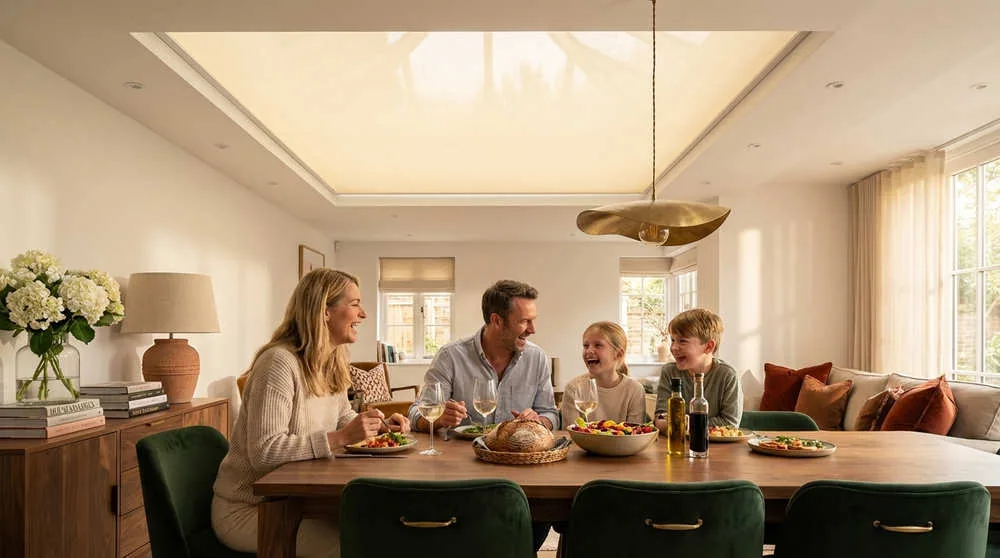
It finally became the comfortable, cherished room for family lunches they had always envisioned. Their investment wasn’t just in a blind; it was in the daily enjoyment of their home.
Frequently Asked Questions About Roof Blind Costs
Do your prices include VAT and installation?
Yes, our quotations for blind systems are fully inclusive of a site survey (where we take full responsibility for measurements), bespoke manufacturing, and professional installation by our specialist team. VAT is also always included.
What are the potential ‘hidden’ or extra costs?
The main additional costs are usually related to preparing the site, which often involves other trades. These can include:
- Electrical Work: A hardwired blind requires a fused spur, which may cost £150 – £300 for an electrician to retrofit.
- Access Equipment: For high or awkward spaces, the hire of an internal scaffold tower might be needed, typically costing around £250 for a week.
- Architectural Work: If you want a fully concealed blind, creating the recess or ‘pocket’ (e.g., with Blindspace®) is a building task that needs to be budgeted for separately.
- Smart Home Integration: If you want your blinds to talk to systems like Control4 or Crestron for automated ‘scenarios’, specialist programming is required. This typically ranges from £300 – £600 depending on the complexity of your system.
Is financing available?
Many of our customers want to invest in high‑quality shading solutions, but we know that electric blinds and awnings aren’t always included in the original build budget. Sometimes they become an afterthought, or unexpected project costs mean the budget simply won’t stretch as far as planned.
To help make things easier, we offer flexible financing options designed to smooth out cashflow. In most cases, this involves a 50% payment at the point of order, followed by a direct debit spread over 6–12 months at Base Interest Rates (3.75% at the time of writing).
Every project is different, so we’ll discuss the most suitable approach with you on a job‑by‑job basis.
How to Make a Confident Choice for Your Home
So what does all this really mean for your project? In essence, the cost of a good roof lantern blind comes down to the specialist engineering needed to defy gravity, not just the fabric. While cheaper systems exist, they often come with compromises in looks and longevity that can ultimately lead to regret.
The true value, as Duone and Simon found, lies in reclaiming a comfortable, usable living space.
When you look at your own project, the questions to ask yourself are: How important is a flawless, taut finish to me? Do I want a solution that will last for years without issues? And what is it worth to me to be able to enjoy my beautiful new room all year round?
Thinking about this early is key to integrating comfort seamlessly into your design. This proactive approach is a core part of what we call the S.H.A.D.E. principle, which helps protect your vision from the start. If you’d like to talk through the options for your home, our specialists are always here for a friendly chat.
To see how these systems look in real homes, you might find our Case Studies page helpful.
Get in Touch
If you have questions and want to talk through the specifics of your project, our team is here to help. For a friendly chat about the best options for your home, call our specialists.
Call: 01256 345580 or book an appointment online.