You’ve poured your heart, soul, and a significant budget into creating a stunning glass extension.
But now you’re looking at electric blinds and are left wondering if the huge price gap between the options is just clever marketing. It’s a question we get asked all the time, and I want to give you some honest clarity.
To help you see past the sales pitches and make a choice you won’t regret, here are the essential things to know:
- The real difference is in the unseen engineering, not just the surface appearance.
- The tautness of the fabric in a large blind is the most obvious giveaway of quality.
- A premium investment is about long-term peace of mind and protecting the dream you had for your home.
More Than Meets the Eye: Why Engineering Matters
The reality is, when you’re looking online, most electric blinds look remarkably similar. It’s no wonder so many homeowners feel unsure. You see two products that seem to do the same job, but one costs several times more than the other.
That’s why this guide isn’t just about what the blinds look like. Honestly, I believe it’s all about the engineering.
The real difference isn’t what you see on day one; it’s what you experience every day for years to come.
The Real Differences: A No-Nonsense Breakdown
The Engine Room – Motors, Noise, and Smarts
The motor is the heart of any electric blind, and it’s one of the biggest factors in its cost and performance.
Budget Blinds: The main advantage of a budget motor is that it makes motorisation more accessible. However, this often comes with compromises. They can be noticeably noisy, and believe me, that loud whirring is something you really notice during a quiet evening. The batteries may also need recharging every few months, which becomes a real chore. Smart features are often limited to a basic remote.
Premium Blinds: In contrast, premium motors from specialists like Somfy are engineered for near-silent operation. They are built for reliability and are typically backed by a 5-year warranty for peace of mind. Battery life is far superior, and more importantly, they offer true smart integration. This means they can connect seamlessly with your home automation, allowing for control via voice commands, schedules, or even sun sensors that automatically adjust the blinds to keep a room comfortable without you lifting a finger.
The Fabric – More Than Just a Pretty Colour
For large glazed areas, I’ve always believed the fabric’s job is about performance first, decoration second.
Budget Fabrics: These are often inexpensive and come in a wide range of colours. The downside is that their thermal performance is usually minimal. They might be marketed as ‘thermal’ but often lack the specialist coatings needed to effectively reflect heat, and they can be more prone to fading.
Premium Fabrics: Think of these as ‘technical textiles’. They are engineered to do a specific job. Some have a highly reflective coating to bounce summer heat away, while others have specific ‘openness factors’ that cut glare without losing your view. This is about making your home more comfortable all year round and protecting your furniture from sun damage.
The ‘Saggy Blind’ Problem – How to Spot Quality Engineering
This is perhaps the most obvious visual giveaway of a blind’s underlying quality. On a large horizontal blind, like in a roof lantern, gravity is a powerful and relentless force.
With many budget systems, the fabric will start to droop over time. It creates a rippled, uneven look that we call the ‘duvet cover ‘ effect. It completely undermines the clean, sharp lines of your architecture and, honestly, it’s often a huge source of disappointment for homeowners.
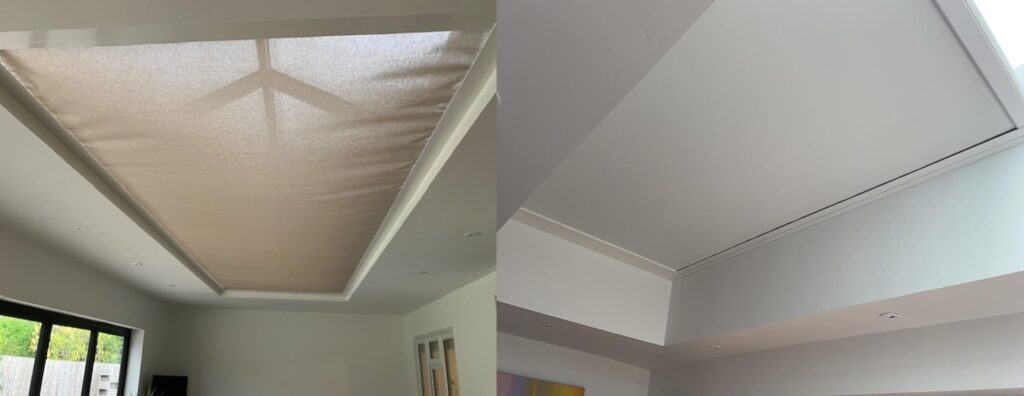
A premium system uses advanced mechanics, like zip-tensioned technology, to help prevent this. The fabric is securely locked into discrete channels along the sides. A roof blind system needs ultimate fabric tension to give the flawless finish that looks like a ‘false ceiling’ when closed as oppose to the saggy duvet cover effect.
Durability and The Fear of ‘Buying Twice’
The fear of making a costly mistake is very real, and nothing illustrates this better than the experience of homeowners we’ve helped.
I remember working with a lovely couple who had just finished a beautiful kitchen extension with a huge roof lantern. It was the centrepiece of their home.
To save on costs right at the end of a long, expensive project, they opted for a budget electric blind they found online. Within a few months, they told me they couldn’t stand looking at it.
The fabric sagged noticeably, and every time they looked up, all they saw was the ugly finish delivered by the budget system. It cheapened the whole aesthetic of the stunning new space they had invested so much in.
They called us feeling utterly deflated, admitting they’d made a mistake that was now a constant source of irritation. They ended up paying twice – once for the blind they couldn’t live with, and again for the properly engineered, zip-tensioned system we installed. It was a powerful lesson for them, and it’s why we champion our S.H.A.D.E. (Shading deserves to be designed, Human-Centered, Architecturally considered, Directing the light, Environmental Performance) process. Thinking about shading from the start protects your vision and prevents this kind of disappointment.
So, Who Is Each Option Really For?
To build trust, it’s important to be honest. Here’s our straightforward advice on making the right choice for your home.
When a Budget Electric Blind Might Be a Good Fit
- For a spare room or a less-used area with a standard-sized window.
- If you are on a very strict budget and understand and accept the potential compromises on noise, longevity, and aesthetics.
However, I would directly advise that this is not the right choice for a high-end extension with large architectural glazing, such as bi-fold doors. It’s not for you if a flawless, minimalist look is essential, or if your biggest fear is unreliability and having to buy again.
When Investing in a Premium System is the Right Choice
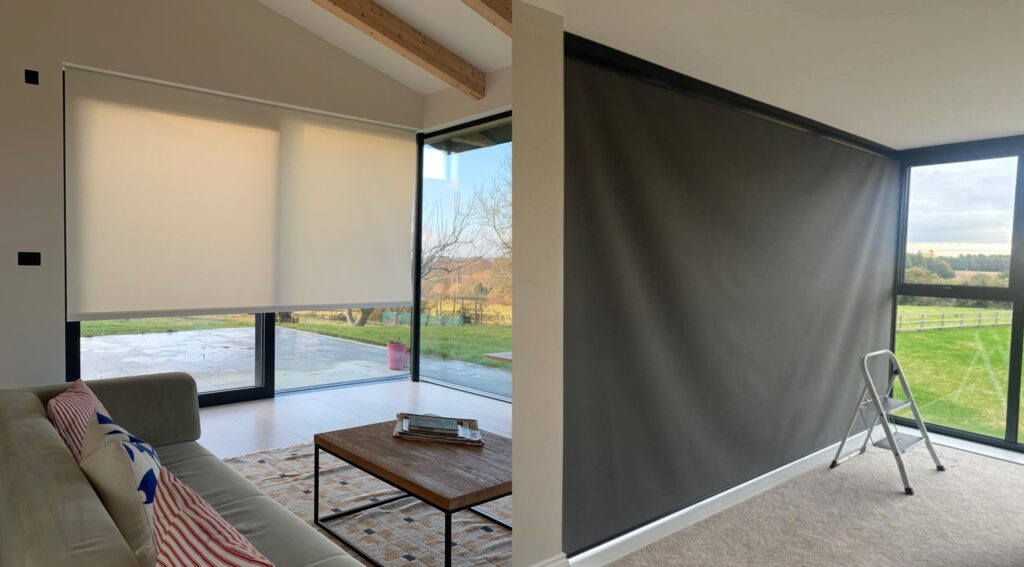
- This is the ideal solution for homeowners investing in their ‘dream’ space, especially those with large roof lanterns, bi-fold doors, or gable windows where performance and aesthetics are paramount.
- It’s for those who want a reliable, ‘fit and forget’ solution that integrates seamlessly with their smart home.
- It’s for anyone who sees shading not as an accessory, but as an essential part of their home’s comfort and design.
Of course, if the upfront investment is genuinely not feasible, then it’s not the right fit. It might also be overkill for a small window in a utility room.
Making a Confident Choice for Your Home
Ultimately, this isn’t just a financial decision; it’s a choice about the long-term comfort and enjoyment of your home. The goal is to invest in a solution that enhances your beautiful space, not one that becomes a daily reminder of a compromise.
To find your answer, sometimes it helps to ask a couple of direct questions:
- Is this blind for a primary living space I will look at every single day?
- A year from now, how much will a sagging or noisy blind genuinely bother me?
Answering those honestly will often point you in the right direction.
Planning early is the best way to seamlessly integrate comfort and control into your design. If you have any questions, our specialists are always happy to have a friendly chat about your options. Call our specialists on 01256 345580 or book an appointment online.