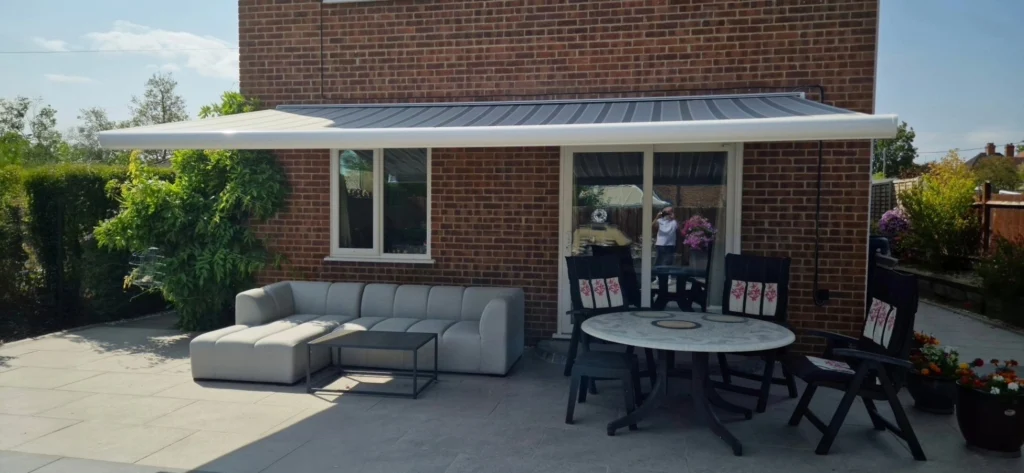
Electric retractable awnings create shade that transforms patios into comfortable outdoor living spaces. Step from full sun into the shade beneath one on a hot afternoon and it feels markedly cooler, even though the air is the same temperature. That is the radiant effect of shade, and it is the main reason an awning makes a patio usable. Modern high-performance fabrics block most of the direct solar radiation (manufacturers quote figures above 90 percent for some fabrics), helping you enjoy your patio for longer and with far greater comfort.
Why does shade feel so much cooler when the air is no cooler at all? In direct sun your body absorbs radiant heat from the sun itself and from everything the sun has warmed: the paving, the furniture, the glass doors behind you. Shade removes the direct load and keeps those surfaces cooler too, so they give off less heat towards you. You will often see this described as a drop of ten degrees or more in how hot it feels. The real difference depends on how strong the sun is, whether there is a breeze, how dark the paving is and how humid the day is, so we do not promise a number. On a still, bright afternoon it is large and immediate; on a hazy day it is smaller. Either way, the shade is doing its job: cutting the radiant heat you feel, not cooling the air.
However, the real question customers ask is simple: how much shade will you actually get throughout the day? The answer depends on several moving parts, and understanding them is essential before choosing the right awning.
Why Awning Shade Varies
Awning shade is dynamic. It changes hour by hour, season by season, and property by property. Three core variables determine how much shade an awning can provide:
- Property orientation and surrounding environment trees, fences, neighbouring buildings, and the direction your home faces all influence shade coverage.
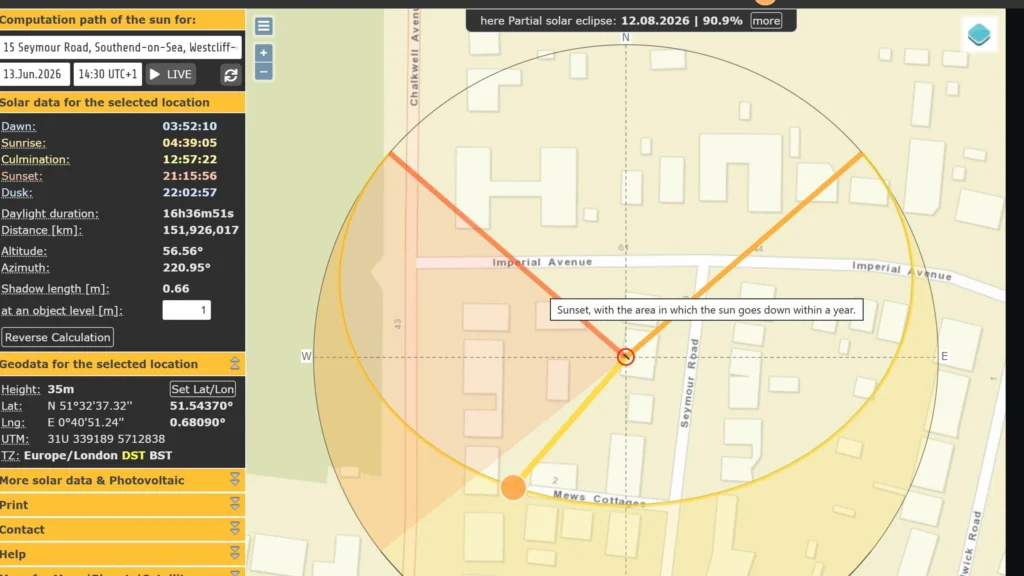
- Sun position across the day and throughout the year. As the sun rises, climbs, and lowers, the angle of incoming light constantly shifts. This link allows you to see the path of the sun around your home though out the year https://www.suncalc.org/
- Awning geometry including height, pitch, width, and projection These physical dimensions directly affect how far shade reaches and how quickly it retreats.
Because these factors are always changing, there is no guarantee of fixed shade coverage. Instead, the goal is to maximise shade by choosing the right awning size and configuration.
Real‑World Shading Throughout the Day
To demonstrate how awning shade behaves in real conditions, the BBSA (The authority on UK Shading BBSA) produced a timelapse video showing shade movement across a home from morning to evening. This visual evidence is invaluable for customers because it reveals how shade lines shift, shorten, and lengthen throughout the day.
Key observations from the BBSA timelapse include:
- Shade lines move constantly as the sun changes position.
- Shade shortens as the sun rises and lengthens as it lowers.
- Low morning and evening sun can creep under the awning, especially on East and West facing patios.
This timelapse reinforces a crucial message: shade is dynamic, not static. It sets the stage for understanding why larger awnings often perform better in real‑world conditions.
Why Bigger Awnings Usually Perform Better
Larger awnings deliver more reliable shade because they create a deeper and wider protected zone. As the sun moves, the central area beneath a large awning remains shaded for longer.
Smaller awnings, by contrast, produce narrow shade bands that shift quickly and often leave seating areas exposed.
Wider systems reduce the risk of sunlight creeping into living spaces, especially when shading bifold or sliding doors.
Shading The House Versus Shading Patios
Shading Bifold or Sliding Doors
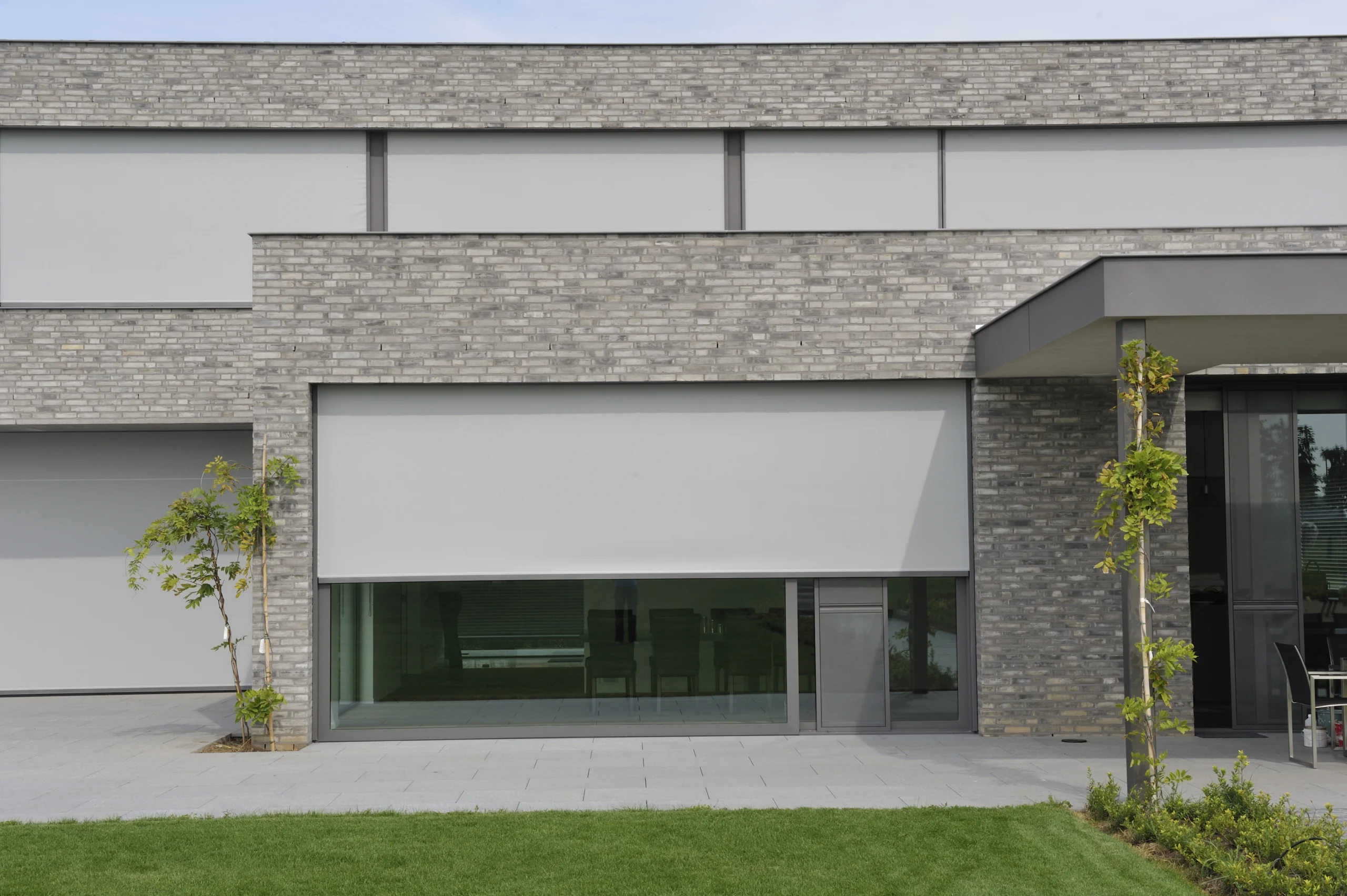
If your goal is to reduce indoor heat gain, the awning should be wider than the doors themselves. Many installations align the awning exactly with the door width, but this almost guarantees heat gain because sunlight easily enters around the edges.
When guaranteed full coverage is required, 3M Prestige Exterior Film or Harmonia XL External Screens may outperform awnings. These solutions cover the entire glass area, delivering consistent heat rejection regardless of sun angle.
Shading a Patio Seating Area
For patio shading, the sun’s path determines how much of your seating area remains protected at different times of day. A typical awning has a 2 m leading‑edge height for head clearance, which influences the shade length.
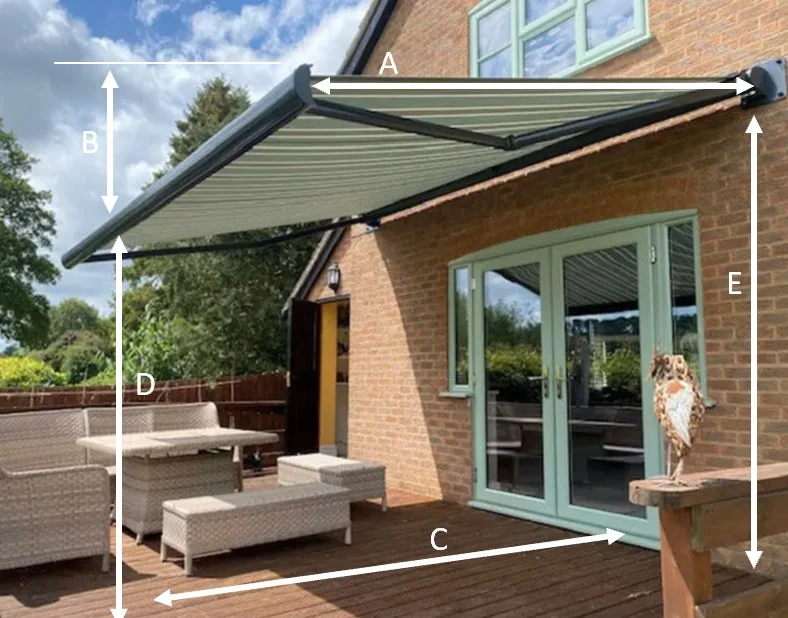
| A: Projection Arms (mm) | B: Drop (mm) | C: Distance From Wall (mm) | D: Head Height (mm) | E: Awning Height (mm) |
| 1600 | 400 | 1550 | 2000 | 2400 |
| 2100 | 525 | 2030 | 2000 | 2525 |
| 2600 | 650 | 2515 | 2000 | 2650 |
| 3100 | 775 | 3000 | 2000 | 2775 |
| 3600 | 900 | 3485 | 2000 | 2900 |
| 4100 | 1025 | 3970 | 2000 | 3025 |
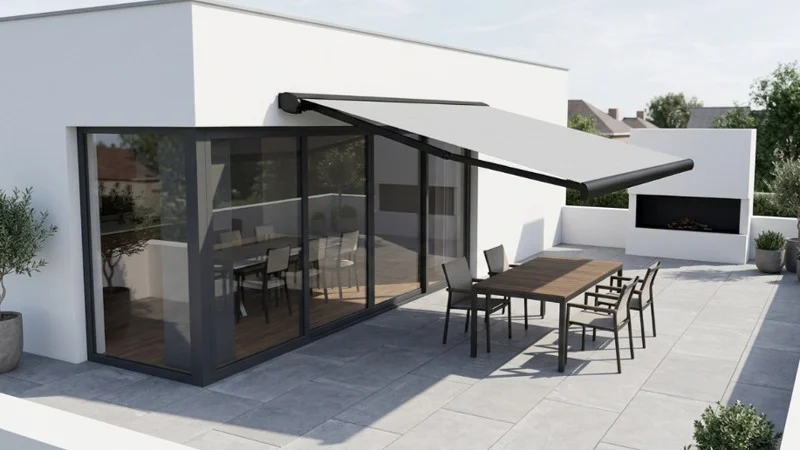
Larger projections are often required to shade full dining sets. The simulated example below shows that a much wider and deeper awning is required to offer shading throughout the day, for all guests around the outdoor dining table.
Awning Sizing Rules
Choosing the right size is essential for meaningful shade performance. Practical sizing rules include:
- Width should exceed the area being protected, not simply match it.
- Projection determines shade reach during midday and late afternoon.
- Height and pitch influence shade retreat, especially when the sun sits low.
Correct sizing ensures the awning delivers shade where you actually need it.
Awnings for Side Return Extension Roof Glazing
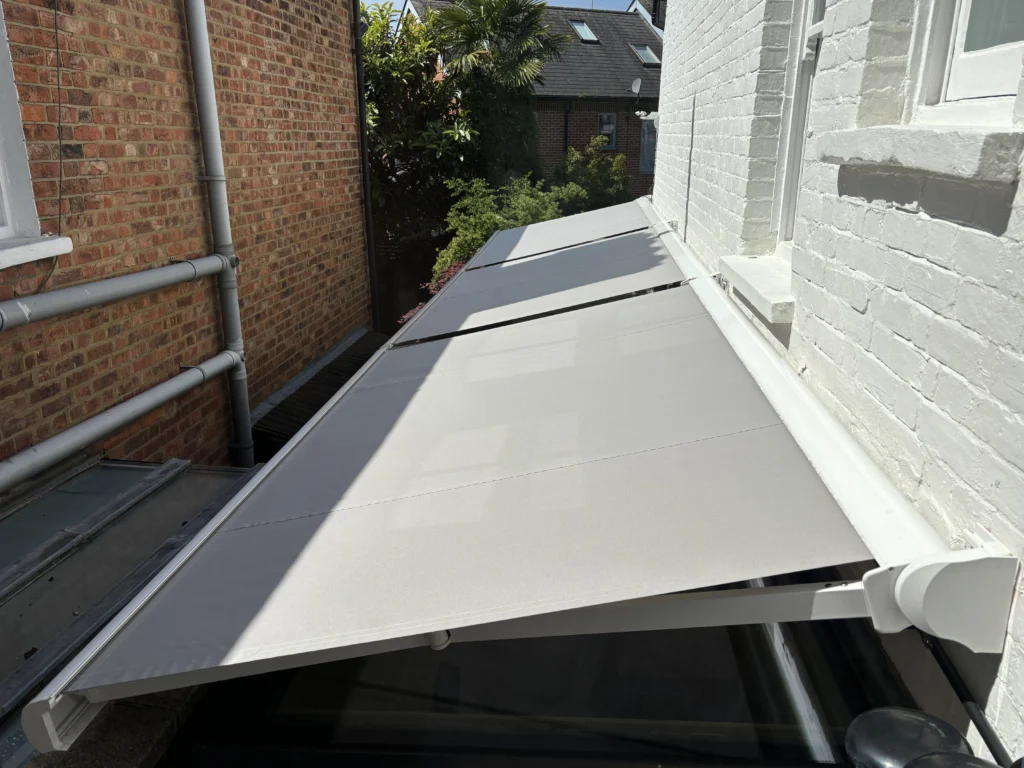
Awnings are not limited to patios or sliding doors. They can be a smart way to shade long runs of side return overhead glazing where the architecture demands a clean, minimal finish. A single unit can cover a large expanse of glass in one movement, keeping the living space visually light while still delivering meaningful heat reduction.
Sunlight will always try to creep around the edges, but the broad projection and uniform shading plane make an awning a strong option when the goal is simplicity, low visual impact, and reliable daytime cooling. It is a practical solution for homeowners who want to protect a narrow extension without adding tracks or frames that interrupt the design.
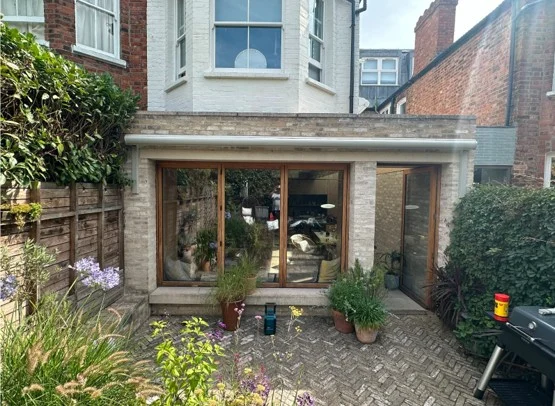
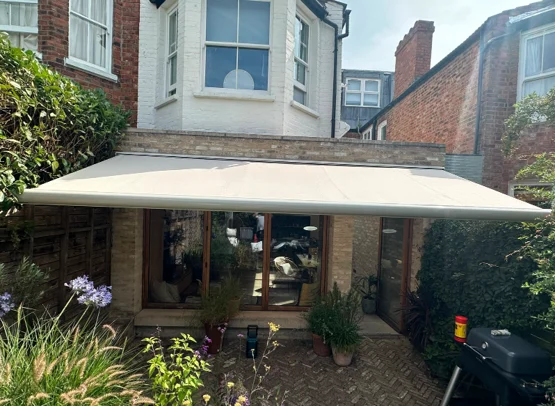
Janice achieved great shading for her London side return glazed extension using this awning approach Discover Janice’s full success story
WindowTreat Awning Models and Their Shading Capabilities
Sol Lite
- Up to 4m wide made to measure (end fix brackets)
- Up to 2.6m projection arms @ minimum awning width of 2950mm
Sol Edge
- Up to 6m width made to measure (end fix brackets)
- Up to 3.1 m projection arms @ minimum awning width of 3450mm
Sol Pro
- Up to 6m width made to measure (end fix brackets)
- Up to 4.1m projection arms
- Creates significantly larger shading footprints which is excellent for deeper seating areas
Sol Elite with drop down valance
- Up to 6m width made to measure (multi-fix brackets)
- Up to 4.1m projection arms
- Integrated 1.2 m drop‑down valance option
- Perfect for East and West facing patios where low sun creeps under the awning
- Investment roughly double that of Sol Edge at the same width
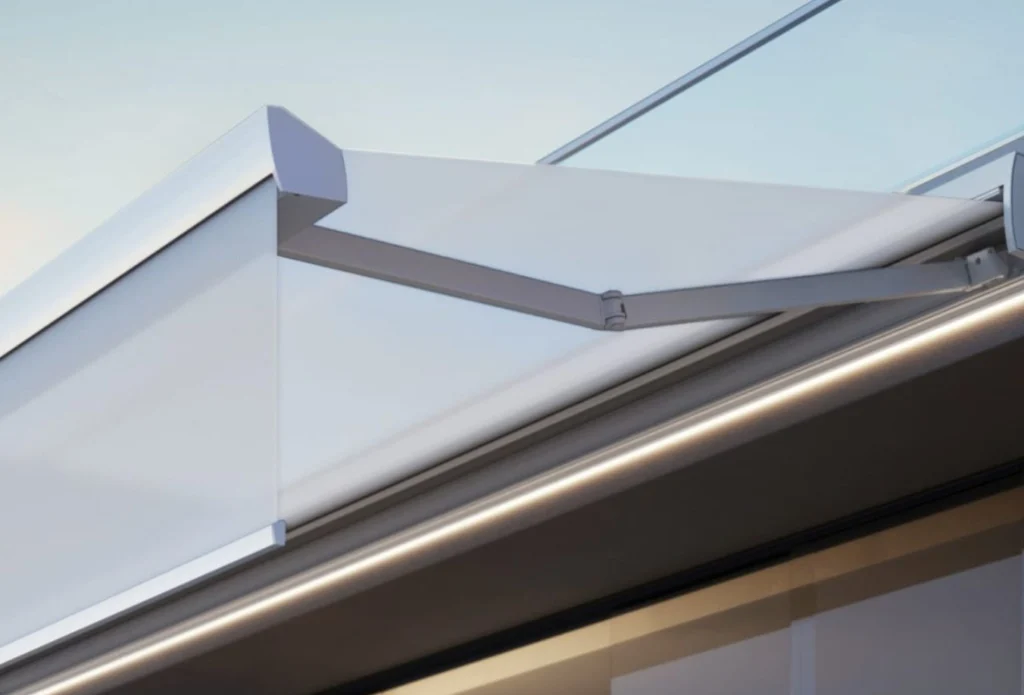
Sol Invictus
- Up to 12 width made to measure (multi-fix brackets)
- Up to 4.1m projection arms
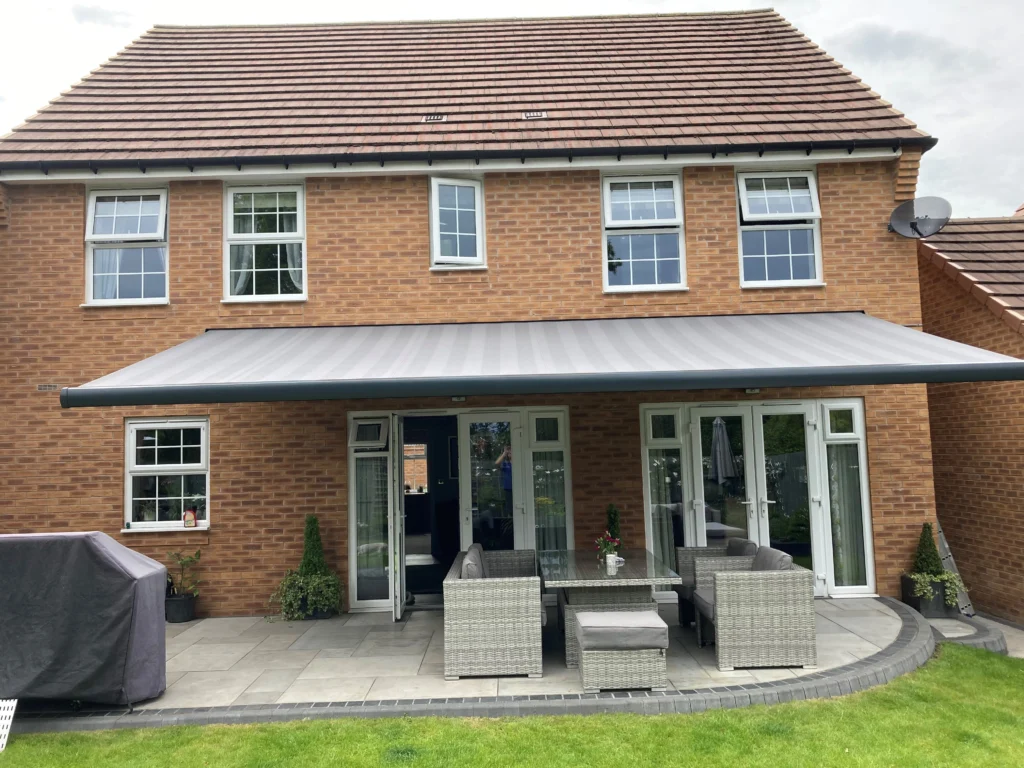
Realistic Expectations and Honest Guidance
Shade varies hour by hour and month by month. No manufacturer can guarantee exact shade coverage because sun position and environmental factors constantly change.
The goal is to maximise shade, not promise fixed results. Larger systems, correct orientation analysis, and optional valances all improve reliability and comfort.
Electric retractable awnings are excellent for comfort and outdoor living. Their shade performance depends on sun position, property orientation, and awning geometry. Correct sizing is essential for meaningful heat reduction, and alternatives exist when full coverage is required.
This transparent, expert approach ensures homeowners understand how awnings perform in real life conditions. This is essential for the right solutions being chosen for their home.
Next Steps
If you are ready to explore the right electric retractable awning for your home, send in your enquiry and our experts Steve and Chris will help you understand the best way forward. If you prefer to talk it through, you can schedule a call back using the diary below. We are here to make the learning process clear and simple.
Supporting Links
Success Story Awnings Janice – WindowTreat
Bespoke Electric Awnings: Why They Cost What They Do (And Why It Is Worth It) – WindowTreat
⚡ Electrical Requirements for Electric Patio Awnings – WindowTreat
When Is the Right Time to Plan an Awning Above My Sliding or Bi-Fold Doors? – WindowTreat