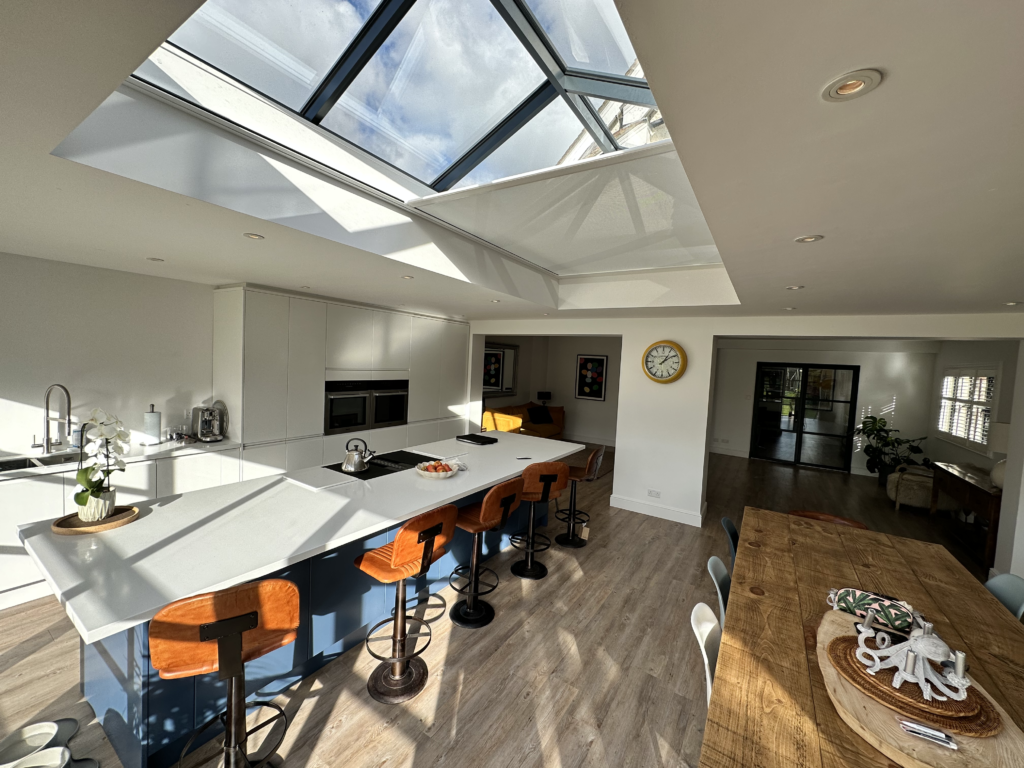
An Athena electric roof blind gives homeowners a smooth, tensioned roller blind system for larger roof lanterns and skylights. It can control heat, glare and brightness whilst having no visible cords across the structural opening. However, the system still needs the right dimensions, fabric, fixing position, power supply and installation design.
This guide explains where Athena fits, how a Single Athena differs from a Twin Athena, what the blind looks like when retracted and deployed, and what you need to plan before ordering one.
What is an Athena electric roof blind?
An ordinary roller blind relies on gravity. That works on a vertical window, but it does not work beneath horizontal or sloping glass. The fabric needs additional support to help prevent it from sagging. Most Roof Lantern Blinds Sag. Here’s Why.
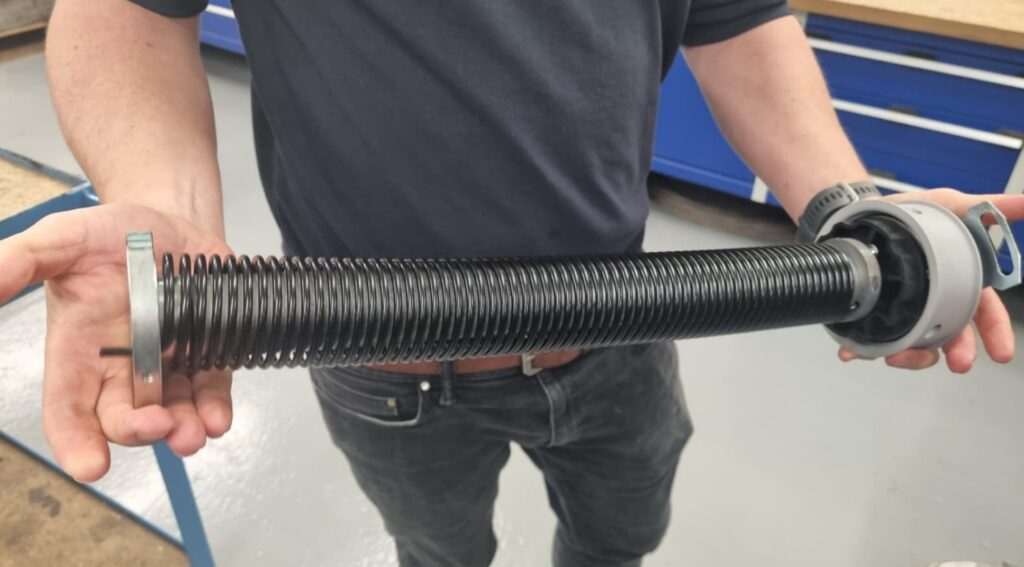
Athena solves this problem with a tensioned mechanism. The system pulls the fabric from a headbox and guides its zipped ribbon edges through side channels. A torsion spring helps maintain tension across the fabric as the blind travels, even when it reaches its fully deployed position. These highly tensioned systems can travel in any direction, including horizontally.
As a result, Athena produces a smoother and more controlled roller-fabric finish than a constant-tension spring system such as the Venus CTS system.
When does Athena make sense?
Athena usually earns its place when a homeowner wants several things at once:
- a roller blind rather than a pleated cellular finish;
- no visible support cords crossing the fabric;
- stronger fabric control for a smoother finish;
- high-performance fabrics that help manage comfort in the home;
- the option to conceal some or all of the hardware; and
- electric operation that makes daily use practical.
However, a small, modest roof opening may not need Athena’s additional engineering. Honeycomb SKY or Venus may provide a suitable result at a lower cost when the appearance, dimensions and fabric choice meet the brief. This can be especially true when a home has several skylights or lanterns to manage. By contrast, an exceptionally large opening may require Hercules XL. Therefore, we start with the homeowner’s needs, their living space and the desired outcome before choosing the system.
Single Athena or Twin Athena?
The roof dimensions first determine whether the opening falls within the parameters of a Single or Twin Athena.
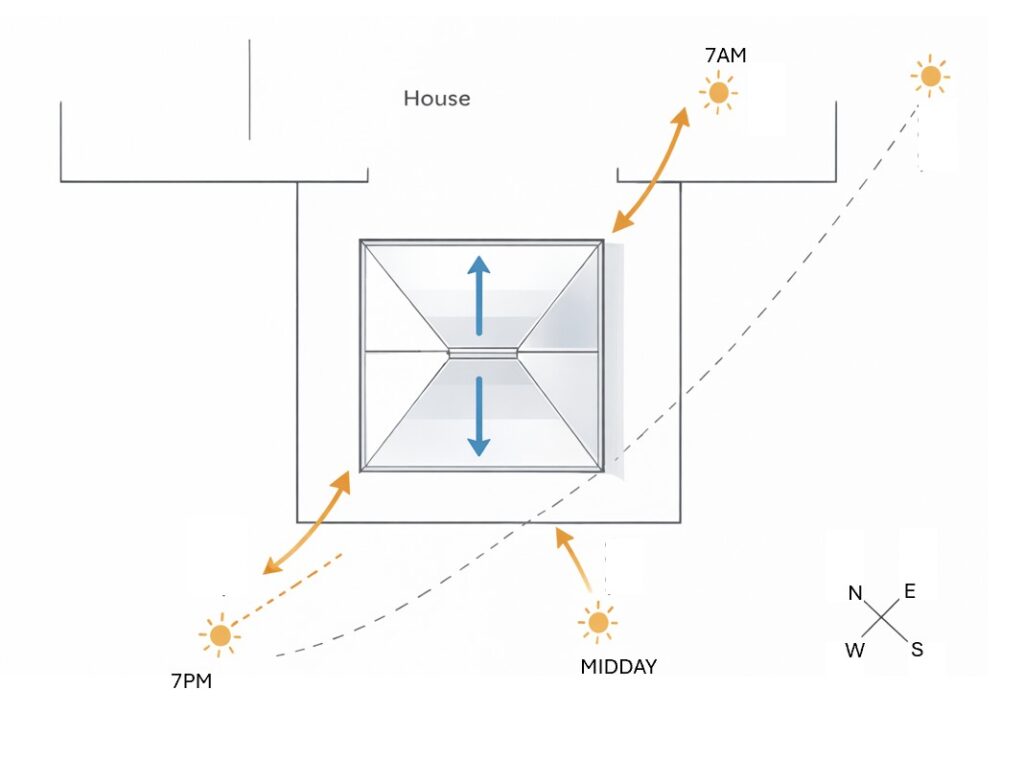
However, homeowner preferences may still favour a Twin Athena when both options fit. Two independent blinds can deploy across the opening more quickly and provide greater control over natural light. This can be useful when the sun reaches different areas of the roof glazing as it moves throughout the day.
Single Athena
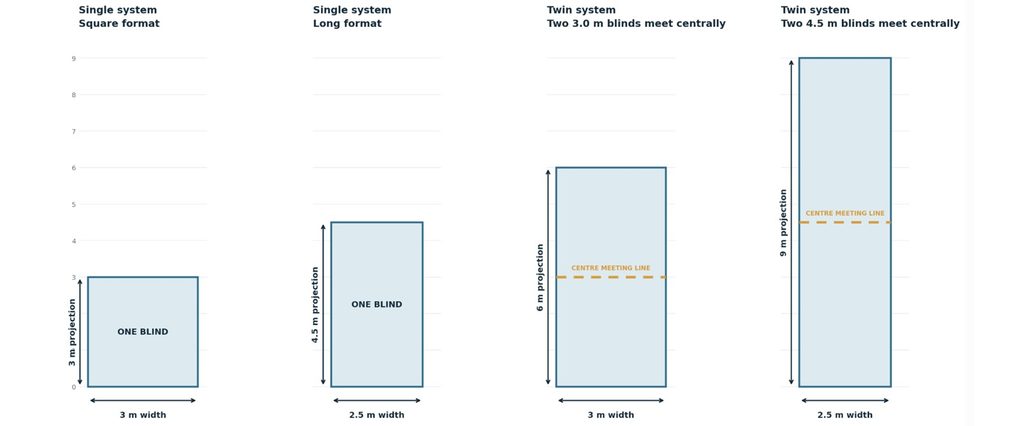
A Single Athena travels from one end of the roof opening to the other. As a working guide, one blind can cover approximately 3000mm by 3000 mm. For a narrower but longer opening, it can extend to approximately 2500 mm wide by 4500 mm projection. It’s minimum system width is 650mm.
One blind gives the roof a simple visual arrangement and leaves only one headbox to position or conceal. However, the rolled fabric must fit inside that headbox. A projection up to 3000 mm draw allows a headbox 105mm high. Beyond 3000mm, the system needs a headbox 125mm high to house the additional fabric.
The side channels that guide the zipped fabric from one end to the other are 55mm wide.
Twin Athena
A Twin Athena uses two opposing blinds that meet in the centre. Depending on the proportions, the pair can cover approximately 3000mm by 6000mm or 2500mm wide by 9000mm projection. Its minimum system width is 650mm.
Dividing a long roof between two blinds reduces the distance each blind travels and the amount of fabric stored in each headbox. Where the total projection remains below 6000mm, each blind travels less than 3000mm, which allows headboxes approximately 105mm high. The homeowner can also operate each blind independently when the controls and room use support that choice.
However, the two fabrics create a central meeting point and the design must coordinate a headbox at each end instead of one.
The maximum size alone does not settle the decision. We also consider the fabric limits, possible mid-welds, headbox sizes, direction of sunlight and how the roof blind should look in both the open and closed positions.
What does Athena look like when it is open?
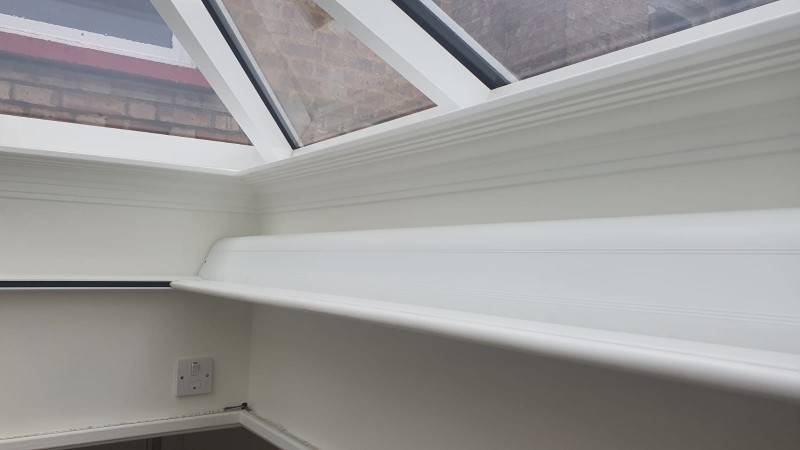
When the blind retracts, the fabric rolls into its headbox. The hem bar returns to the headbox end, while the two side channels remain in position along the edges of the opening.
The final appearance depends on how the system was planned:
- Visible retrofit: The headbox and side channels sit within the finished roof opening. This route suits completed homes because it avoids major building work.
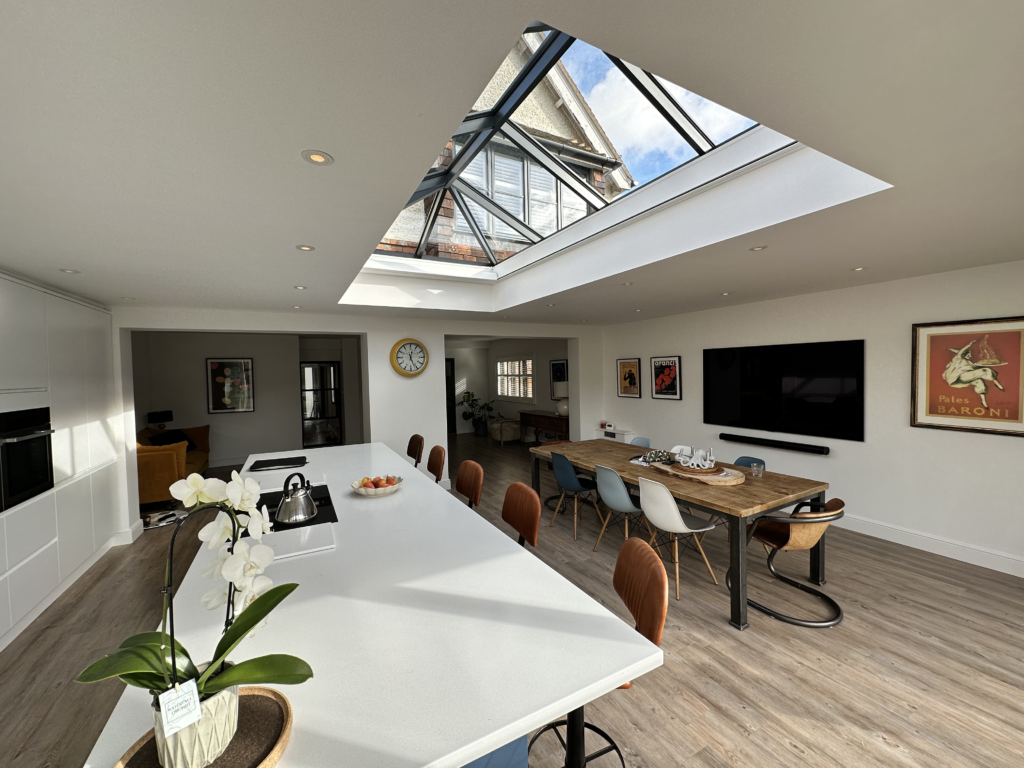
- Purpose-built shelf: A builder creates a shelf or reduced aperture that hides the headbox and can also disguise the side channels. This route can create a clean result without a complete concealment system.
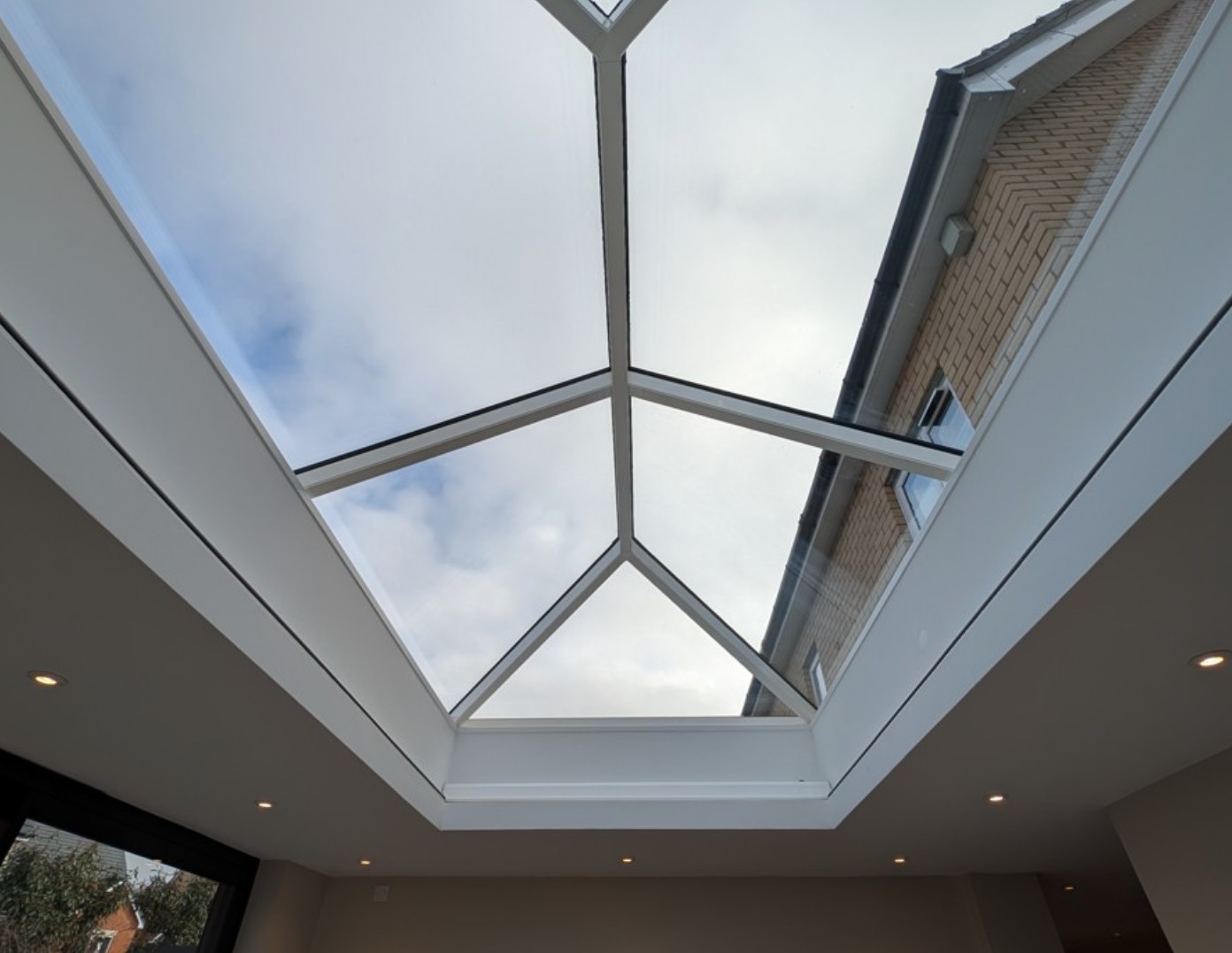
- Blindspace concealment: Purpose-made boxes hide the headbox, hem bar and side channels within the structure. When planned correctly, the homeowner sees the fabric when deployed and an uninterrupted opening when retracted.
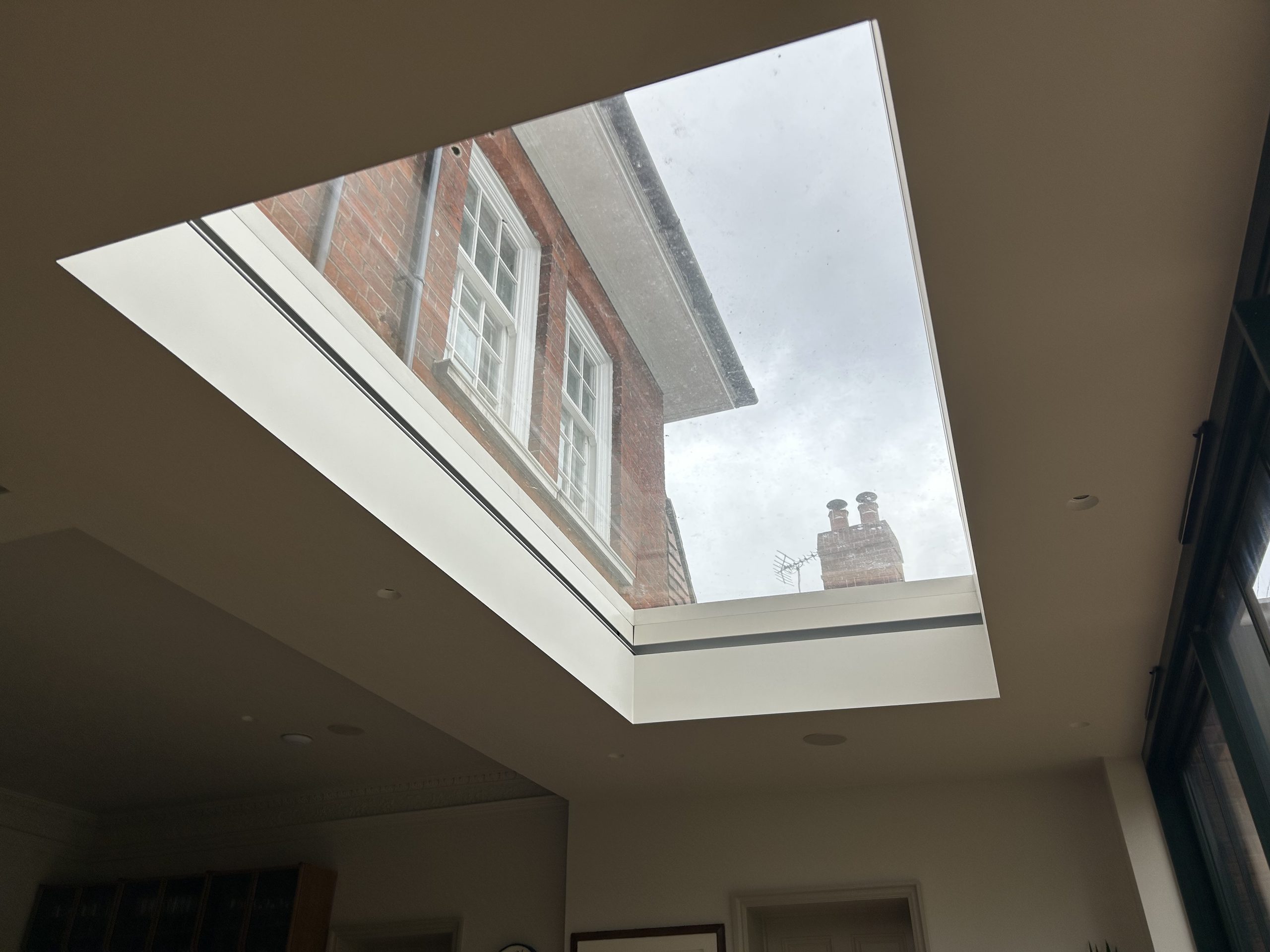
Full or partial concealment changes the appearance, preparation and cost. It does not improve the fabric’s heat or glare performance. Therefore, treat it as an architectural choice and plan it early enough to avoid compromises.
What does Athena look like when closed (deployed)?
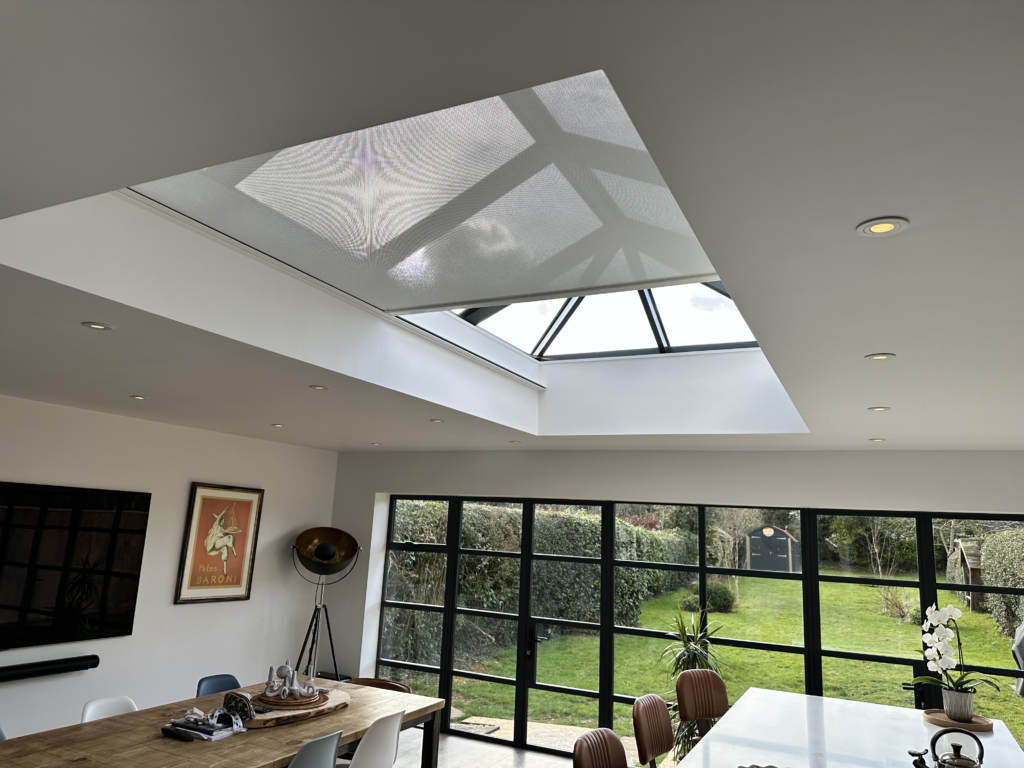
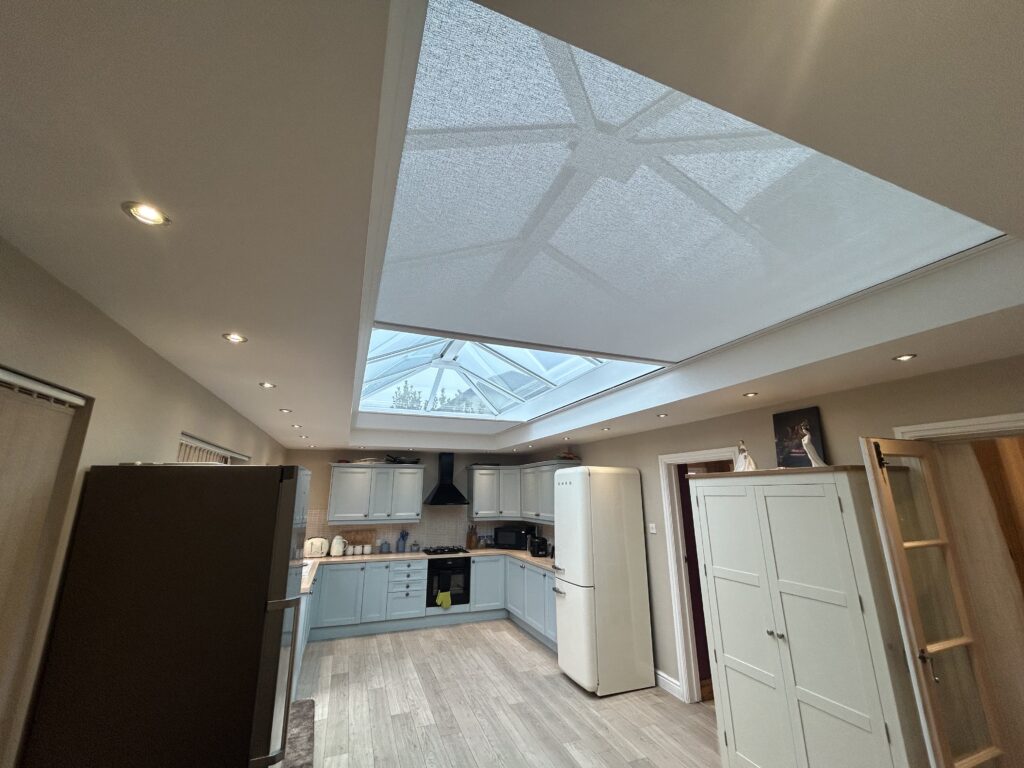
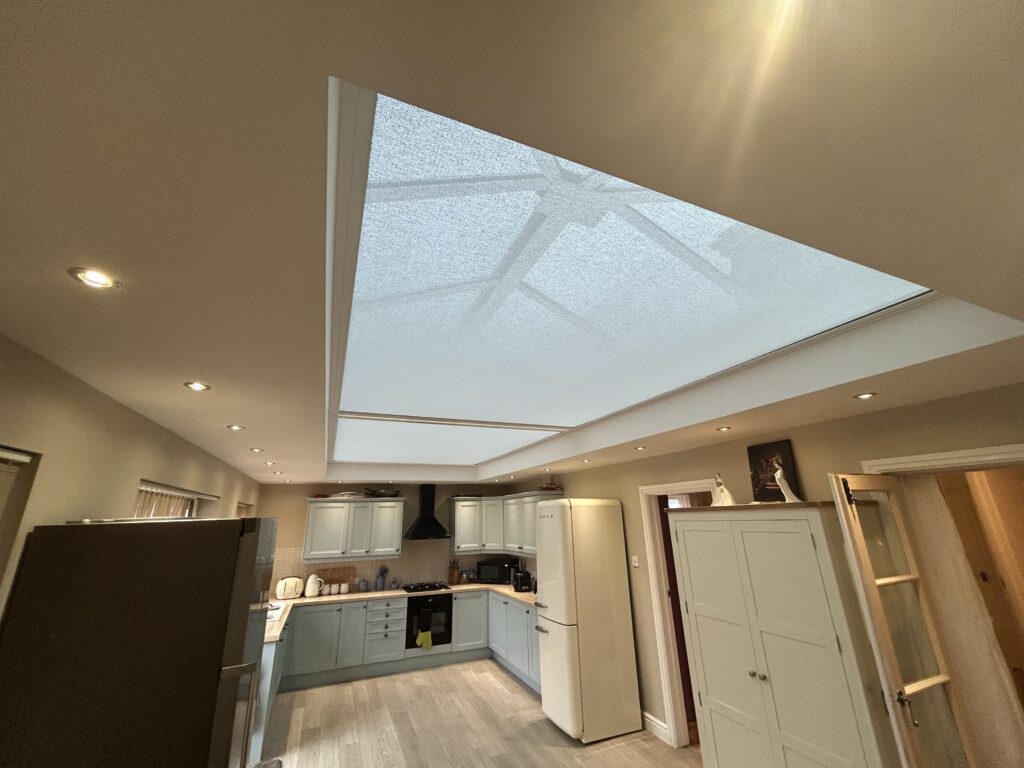
When deployed, Athena’s fabric stretches across the roof opening and becomes a significant visual surface. Its higher tension helps control waviness and rippling, particularly along the zipped edges, provided the blind remains within the system’s specified parameters.
However, no large horizontal textile will look as perfectly flat as plasterboard. Fabric choice, blind size, temperature, weave and viewing angle can all affect its appearance. Choosing a roof blind system with sufficient fabric tension for its size is therefore essential to achieving a suitable finish.
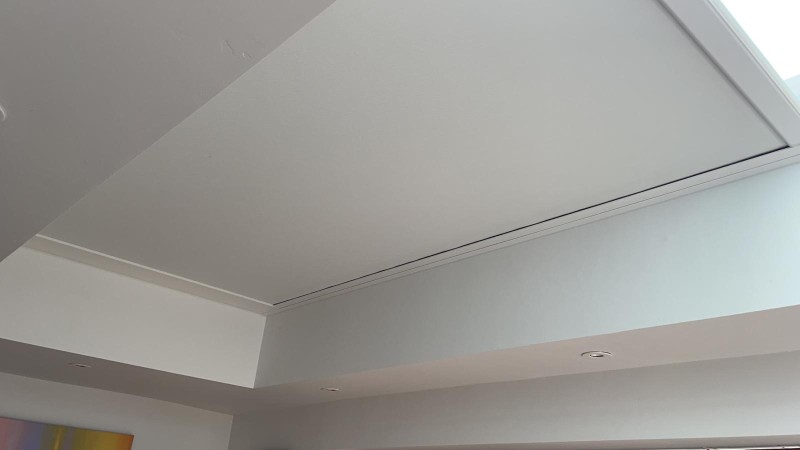
The roof structure design will determine how much of the Athena’s aluminium hardware remains visible when the blind is closed. With a Twin Athena system, the two aluminium hem bars will always meet in the centre and remain visible whether headboxes and side channels are concealed.
Planning the fabric clearance below the glass
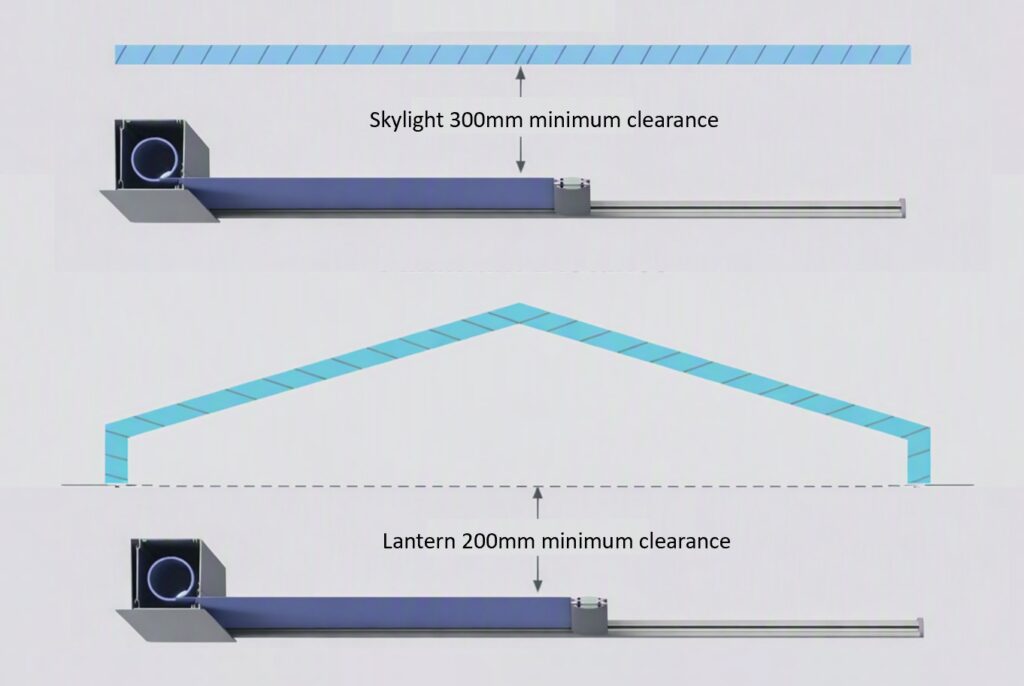
The deployed fabric must maintain the required clearance below the insulated glass. This distance needs to be considered when positioning the headbox, side guides, concealment details and surrounding finishes.
Choosing an Athena fabric
If a neat, tensioned fabric finish without visible support cords is non-negotiable, Athena is a strong contender. Fabric choice is just as important as the system itself because it determines whether the blind delivers the performance you need.
The fabric must be dimensionally stable so that it retains its shape under tension. It must also address the main reason for installing a roof blind, helping to transform the extension into a more comfortable and usable space. Once that priority is clear, we can consider the secondary benefits that matter to you.
Performance fabrics can provide different combinations of summer solar heat gain reduction, light management, TV glare control, improved acoustic comfort, night-time privacy and winter insulation. Selecting from Athena’s wide range of compatible fabrics is therefore critical to achieving the right balance of performance for each homeowner.
Only the Toughest Fabrics Earn a Place in Athena Electric Roof Blind Systems
Planning mains power and controls
All mains-powered roof lantern and skylight blinds require the electrical supply to terminate within the upstand. This allows a clean, concealed connection to the blind motor inside the headbox. Bringing the power supply only to the wall or ceiling can result in visible cabling and costly rework later.
Once power reaches the upstand, its final position will depend on the required fabric clearances and the chosen connection method. Options may include a 5A fused spur, a flex cable protected by a suitable fuse, or a Blindspace concealment system.
The Somfy tubular motor sits inside the roller tube and can be positioned at either end of the headbox, which also protects the fabric when the blind is retracted.
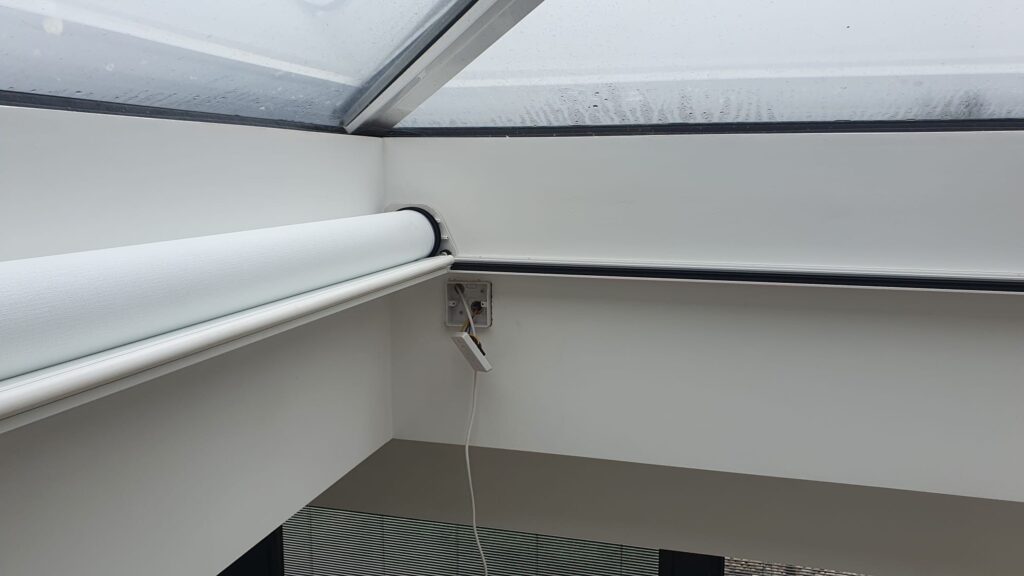
The electrical requirements and available options are explained in Electric Power Requirements for Premium Interior Roof Blinds.
Control options range from handheld remote controls and smart-control hubs for the radio motor Somfy Sonesse 40 RTS to wired wall switches and home automation systems for hardwired version Somfy Sonesse 40 WT.
The Athena Solar Kit
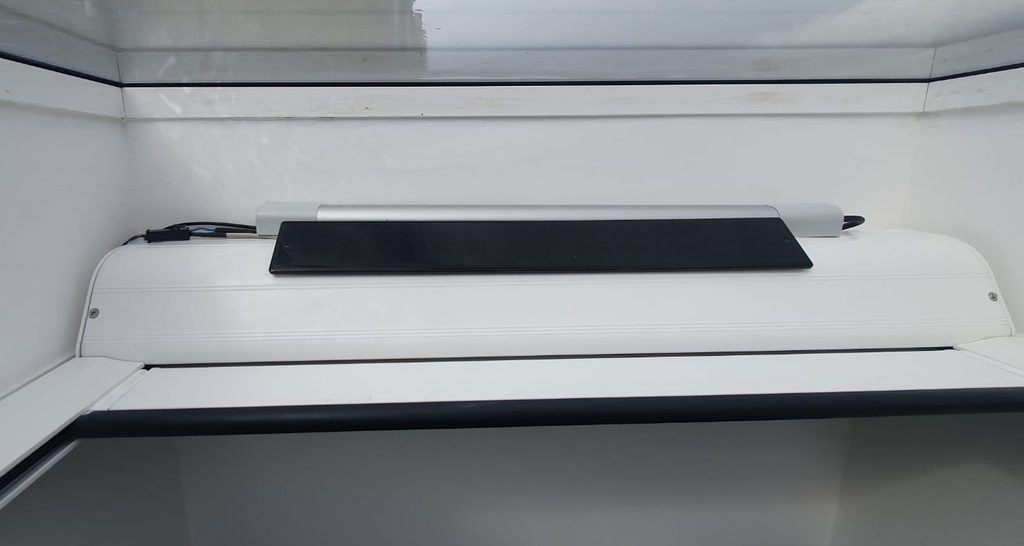
The Athena Solar Kit allows the roof blind to operate without a mains supply at the upstand. It combines an external lithium-ion battery pack with a solar panel mounted on top of the Athena headbox and an upgraded Somfy Sunea 40 io motor.
This option can make a retrofit far more practical. If the ceiling and upstand are already finished, installing a mains supply may be difficult or undesirable. By avoiding electrical installation and subsequent decorative work, the Solar Kit can help offset its additional £750 cost over the mains powered Athena version.
Understanding Athena noise levels
The mains-powered Athena uses a Somfy Sonesse 40 motor with a published sound level of 40dB(A). As an everyday reference, this is similar to the gentle hum of a refrigerator. The Athena Solar motor is published at 70–72dB(A), depending on the motor variant. That sits around the level of normal conversation or some vacuum cleaners. These comparisons provide context, but they do not mean the finished blind will sound exactly like either appliance. NIDCD sound-level examples,
Decibels use a logarithmic scale, so the difference between 40dB(A) and 70dB(A) is substantial. However, manufacturer motor ratings and everyday noise examples are not exact like-for-like measurements. Motor data is recorded under controlled test conditions, while the sound heard in a room depends on the complete blind.
The headbox, roller tube, fixings, motor position and blind size can all influence noise. Room size, hard surfaces and reverberation also affect how prominent the motor sounds. With a twin Athena, two motors may operate simultaneously. Two equal 40dB(A) motors would produce a theoretical combined sound power of approximately 43dB(A), although the installed result may differ.
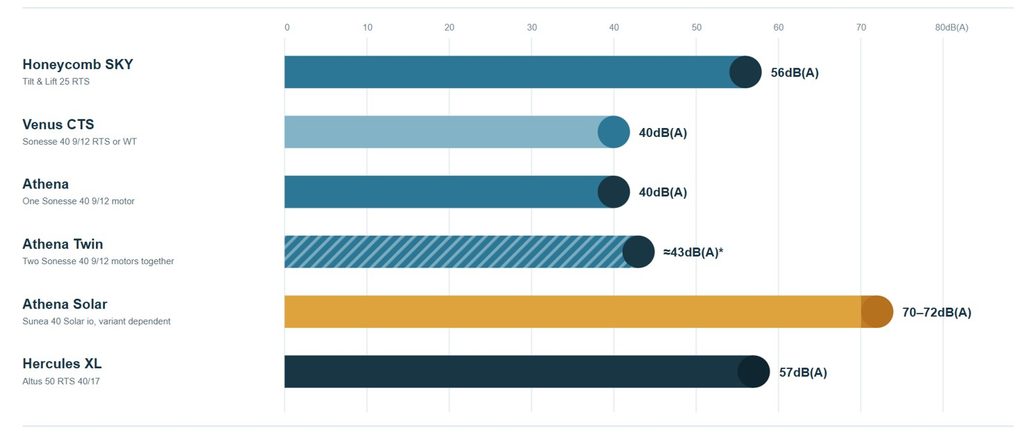
Where quiet operation is the priority, the mains-powered Sonesse motor has the clear advantage. Athena Solar is primarily a practical retrofit option where avoiding new mains wiring and decorative work justifies the higher operating noise.
How quickly does Athena operate?
Athena’s fabric travels at approximately 3m per minute. A blind covering a 3m projection will therefore take approximately one minute to fully deploy or retract.
How much does an Athena electric roof blind cost?
As an initial guide, the manufactured blind normally falls within these ranges:
| System | Indicative blind cost including VAT |
|---|---|
| Single Athena | £2,850 to £4,500 |
| Twin Athena | £4,500 to £8,000 |
WindowTreat does not normally supply Athena without a manufacturing survey and installation. Add £1,900 including VAT for the manufacturing survey and standard installation of up to two tensioned roof blind systems. This comprises a £650 manufacturing survey and £1,250 installation.
This standard pricing applies to typical roof lanterns and skylights in accessible ground-floor extensions. Unusually high installations or projects requiring scaffolding, lifting equipment or other specialist access are assessed and priced separately.
What determines the price ?
- Superior Tensioning components The torsion spring, zipped ribbon technology, hem bar and associated mechanisms must maintain suitable fabric tension across a large horizontal opening.
- Motor and controls: The price depends on the Somfy motor, control method and number of motors. A twin Athena requires two motors.
- Athena Solar Kit adds £750 per motor to the blind cost. However, avoiding a new mains supply and subsequent decorative work can offset some of this additional expense.
- Performance fabric: The fabric must be dimensionally stable so that it retains its shape under tension. Cost also varies with the fabric area, width, weave and required combination of solar control, light management, privacy, acoustic comfort and insulation.
- Aluminium and fabrication: The headbox, profiles and supporting components must be cut, machined and assembled for the individual opening. Aluminium, factory energy and other manufacturing input costs fluctuate over time. London Metal Exchange, Office for National Statistics.
- Installation and logistics: Delivery, travel, fuel, parking, installer time, access and site conditions all contribute to the completed project cost.
What is Athena like to live with?
Sharon chose two single Athena roof blinds for her extension. In this video, she explains why she selected the system and what difference the finished blinds have made to the space. Discover Sharon’s success story or watch her feedback below
Athena electric roof blind
Links To Other Athena Success Stories
Sally’s Cheltenham Success Story: The Athena Electric Roof Lantern Blind – WindowTreat
George’s Partially Concealed Electric Roof Blind – WindowTreat
Success Story: Rupert & Kitty’s Multi Use Extension for Light, Comfort and Flexibility – WindowTreat
Success Story: Sarah’s 30 Year Orangery Refurbishment – WindowTreat
The Athena at a glance
These figures provide an initial guide rather than a manufacturing specification or quotation. The final design depends on the exact width and projection, fabric, motor, controls, fixing structure, installation position and access.
| Question | Working guide |
|---|---|
| What type of blind is it? | A motorised, tensioned roller roof blind with zipped fabric edges |
| Where can it be used? | Internally beneath rectangular roof lanterns and skylights at correct fabric to glass distances. |
| Single Athena parameters | Approximately 3000mm by 3000mm, or 2500mm wide by 4500mm projection |
| Twin Athena parameters | Two opposing blinds can cover approximately 3000 mm by 6000mm, or 2500mm wide by 9000mm projection |
| Minimum Width of Athena Systems | Minimum headbox widths are 650mm |
| What does it look like? | A smoother roller-fabric finish than a typical CTS roof blind, with no support cords across the fabric |
| Installation choices | Visible retrofit, a purpose-built shelf, or full Blindspace concealment |
| Motor and power | Mains-powered Somfy Sonesse 40 RTS or WT, or the Athena Solar Kit with a Somfy Sunea 40 io motor |
| Athena fabric operating speed | 3 metres per minute when deploying or retracting |
| Fabric choice | A broad range of dimensionally stable screen, privacy and blackout fabrics |
| Indicative blind manufacturing cost | Single Athena: £2,850 to £4,500. Twin Athena: £4,500 to £8,000. Prices include VAT and require confirmation for the actual specification |
| Survey and standard installation | £1,900 including VAT for a manufacturing survey and standard installation of up to two tensioned roof blind systems |
Next Steps
If Athena appears to meet your requirements, use the calendar below to book a callback at a convenient time.