Net curtains have done one job well for a hundred years: they let daylight in and keep the street’s eyes out. If you’re here, you want that job done without the nets. This guide explains what really stops people seeing into your home, by day and after dark, and the combination we fit that covers both: privacy film for the daytime, and an electric blind that closes itself when the lights come on.
The short answer
Yes, daylight privacy film works. Fitted to your glass, it turns your window into a mirror from the street in daylight: people outside see the street reflected, you see out, and you keep the daylight and the clean glass that net curtains take away.
It works because of one rule: whichever side of the glass is brighter wins. Outside is brighter than your room all day, so the reflection wins and hides you. After dark, with your lamps on, your room is the brighter side, and no window film hides a lit room, whatever anyone tells you.
So the alternative to net curtains that works around the clock is a pair: privacy film by day, and an electric blind on a sunset scene by night.
The brightness rule: why anything hides a room at all
When someone looks at your window, they see two pictures on top of each other: the street reflected in the glass, and a dim view of your room coming through it. Whichever is brighter wins.
Ordinary double glazing reflects only about 15% of the light that hits it and lets through about 82%. On its own it hides almost nothing, except deep inside a room on a bright day.
Privacy film tips the balance by reflecting more and letting through less, so the reflection wins. Net curtains tip it a different way, with a bright veil. Both depend on it being brighter outside than in. After dark, with your lamps on, the street is dark, there is little to reflect, and your room becomes the brightest thing in view. That is the whole reason you need a second layer for the evening.
The day-and-night answer: film by day, a blind that closes itself at dusk
- Morning. Your blind opens on its morning scene. The film takes over: from the pavement, people mostly see a reflection of the street, while you see out.
- Daytime. The film works as long as it is brighter outside than in. You keep the view, the daylight and the clean glass that net curtains never gave you.
- Dusk. As the light outside fades and the lamps go on, the balance tips the other way. Your blind closes on its sunset scene before the room becomes a lit stage, so you never have to remember.
- Evening. Blind down. A sheer fabric keeps the room soft; a dim-out or blackout fabric gives full privacy. A dual blind gives you both on one window.
- Away. Holiday mode keeps the routine running, so the house looks lived in.
Interior designers call this layering, and it is one of the top curtain trends for 2026. Film and a blind are simply layers that look after themselves.
Try this tonight: the two-minute dusk test
Before you spend anything, find out what your street actually sees.
- At midday, go outside and stand where a passer-by would. Look at your window for two seconds, as someone walking past would, then stop and stare. Note what you can make out: furniture, people, the TV.
- After dark, switch on the lamps you normally use and do the same again.
- If you can, ask someone to sit in your favourite chair while you look.
Use your eyes, not your phone: a camera adjusts its exposure and shows far more, or far less, than a person sees. Most people are surprised twice. Clear glass hides less by day than they thought, and at night almost everything shows. That second surprise is the gap net curtains, and window film on its own, leave open.
Why net curtains work, and what they cost you
Net curtains work by being brighter than your room. Daylight falls on the street side of the net and makes it glow, and that glowing veil outshines the dimmer room behind it. Someone walking past sees white fabric, not your sofa.
They do it cheaply and they ask nothing of your glass. But they cost you in four ways:
- Daylight. A net sits between you and the window all day and takes a share of the daylight with it. A plain voile takes less than a lace or a patterned net, but none of them is free.
- The view. You see out, but through a haze.
- Upkeep. Washing, re-hanging, and replacing them when they turn grey.
- Night. Once your lamps outshine the daylight on the net, shapes and movement start to show.
Net curtains became part of British streets with the machine-made lace industry of the East Midlands, which by the early twentieth century was making lace curtains for every kind of household (Textile History). They came to stand for a respectable home: a tidy veil between the family and the street. They also gave us a phrase. “Curtain-twitcher”, for someone who watches the street without being seen, dates from around 1940 (Word Histories).
Three kinds of privacy, and why it matters which you want
“Can people see in?” is really three questions, and each is harder to answer than the last:
- Can they recognise you? Faces and screens. The easiest to hide.
- Can they see what you’re doing? Posture, movement, who’s on the sofa. Harder.
- Can they tell anyone is there at all? The hardest. Close to the glass, no film hides this completely.
Net curtains and window film mostly win at the first two. Before you choose, decide which one you care about, and for which seat.
Four things then decide how well any film works on your window:
- What the glass reflects. Bright sky or pale houses opposite make a strong reflection to hide behind. A dark hedge or fence makes a weak one.
- How far into the room you sit. The further back, the more private.
- Lamps on or off. A lamp lights you up whatever the film does.
- Windows behind you. In a room with windows on two sides, light from behind can turn you into a silhouette.
Upstairs rooms are easier: people looking up from the pavement see the glass at an angle, and glass reflects more at an angle.
Your window film options instead of net curtains
| Option | Light through the window | Reflected to the street | Reflected back into the room | Best for |
|---|---|---|---|---|
| Clear double glazing, no film | 82% | 15% | 15% | The starting point |
| 3M Night Vision 25 (inside) | 23% | 29% | 10% | Ground-floor rooms on a path with houses opposite; clearest view out at dusk |
| 3M Night Vision 15 (inside) | 12% | 39% | 9% | Rooms with windows on two sides, or a sofa close to a big window |
| Global DR25 Dual Reflective (inside) | 23% | 38% | 19% | Good all-round privacy at a lower cost |
| Global DR15 Dual Reflective (inside) | 15% | 50% | 20% | Lower cost, for rooms with windows on two sides |
| Global SR35 Silver Reflective (inside) | 35% | 40% | 42% | Bright rooms where a mirror effect inside on dull days is acceptable |
| Solar Gard Silver 35 Exterior (outside) | 32% | 38% | 43% | Sunny windows where heat matters too |
| Global SR20 Silver External (outside) | 16% | 59% | 61% | Maximum privacy plus strong heat rejection; 5-year product warranty |
| Global SR15 Silver External Plus (outside) | 15% | 61% | 62% | The same job with Global’s 10-year product warranty |
| Global Nichrome 20 External Plus (outside) | 20% | 29% | 36% | Privacy without a mirror finish outside; a neutral grey look |
| Global Nichrome 35 External Plus (outside) | 32% | 20% | 27% | Softens the view and cuts heat; by day it makes you a shadow, not hidden |
| 3M Prestige 20 Exterior (outside) | 19% | 6% | 13% | Heat and glare, not privacy: it reflects too little to hide you by day |
| 3M Prestige 40 Exterior (outside) | 39% | 7% | 13% | Heat and glare only; you stay in view |
| Café-height frosted band | Most of the window stays clear | Frosted at eye level | The closest modern match to net curtains; private day and night where it covers | |
| Lace-pattern or decorative frosted film | Depends on the pattern | The look of lace, without the fabric | People who liked the look of net curtains |
Figures are for each film on a standard 4-16-4 clear double-glazed unit, calculated with Lawrence Berkeley National Laboratory’s WINDOW engine from measured data in its International Glazing Database. They are whole-window values, which is why they differ from the film-only numbers on some data sheets.
The two Prestige rows are there because people are offered 3M Prestige for privacy, and it is the wrong film for that. It is one of the best heat and glare films made, and it is designed not to reflect, which is exactly why it can’t hide you. Privacy is bought with reflection. The Nichrome films are the exception that proves the rule: Nichrome 20 reflects enough to work from the pavement without a mirror finish; Nichrome 35 doesn’t quite, so we sell it to soften a view, not to hide a room.
How far back you sit matters as much as the film. With 3M Night Vision 25 and an ordinary window you are hidden from about 1.8 m into the room; sit a metre from patio doors and only the 15% films and the exterior silvers hide you.
Two things in that table matter more than the brand names. First, reflective films buy privacy by letting through less light: 3M Night Vision 25 lets through less than a third as much light as clear glass. That is why we usually recommend the lightest film that covers the seats you care about, not the darkest. Second, the 3M Night Vision films reflect little on the inside, so your view out at dusk stays clear instead of turning into a mirror.
If you liked what net curtains did at eye level, the frosted band is worth a serious look. Interior designers have brought half-height privacy back: Homes & Gardens calls café curtains a designer favourite for rooms that need privacy and light, and Homedit explains why: most people look into the lower half of a window, not the top. A frosted band does that job with nothing to wash, and works after dark too where it covers.
One film we don’t use for privacy: 3M Prestige. It is a heat and glare film. By day it softens the view of your room, but it does not hide you.
Electric blinds with scenes: the night-time half of the answer
A blind only protects your privacy if it is down when it matters, and that is exactly the moment people forget. Scenes take the remembering away.
- Sunset scene. Blinds close at dusk on their own, before the room lights up. The timing follows dusk through the year, and you can offset it to close a little earlier or later.
- Morning scene. They open at dawn, or later if you set an offset, so the film takes over again.
- Away and holiday mode. The routine keeps running while you’re out, so the house looks lived in.
- Per-room scenes. Close the street side and leave the garden side open; one tap for the whole house.
- Control your way. Phone app, a handheld remote, a wall switch, or your voice through Alexa, Google Assistant or Apple Home. We fit Somfy motors with the Somfy TaHoma hub, and our blinds also work with Control4, Crestron, Lutron and KNX.
Choosing the fabric. A sheer softens the room, but like a net curtain it shows shapes once the lamps are on. A dim-out or blackout fabric gives full privacy. A dual blind puts both on one window: sheer for the evening, blackout for sleep.
Hiding the blind. If you’re building or renovating, a Blindspace® box hides the blind completely. In a finished room, a slim retrofit headbox does the job without building work. Side channels close the gaps at the edges, so there is no strip of light to see through.
More on how scenes and automation work in everyday life: Smart electric blinds: the real pros and cons.
Which answer for which window
| Your window | By day | After dark |
|---|---|---|
| Ground-floor front room on a path, houses opposite | 3M Night Vision 25 or Global DR25 | Electric blind on a sunset scene |
| Room with windows on two sides | 3M Night Vision 15 or Global DR15, to stop silhouettes | Electric blinds on both walls, one scene |
| Sofa within a metre or two of patio doors or a bay | 3M Night Vision 15, Global DR15 or Global SR15 External Plus; the 25% films leave you as a shadow | Electric blind on a sunset scene |
| Window facing a hedge or fence | A café-height frosted band, or the blind partly down | Electric blind on a sunset scene |
| Upstairs, looking out to open sky | A lighter film is often enough; Solar Gard Silver 35 Exterior also cuts heat | Electric blind on a sunset scene |
| You don’t want a mirror finish on the outside of the house | Global Nichrome 20 External Plus | Electric blind on a sunset scene |
| You liked the look of net curtains | Café-height frosted band or lace-pattern frosted film | The frosted part still hides you; add a blind for full cover |
| Bathroom or cloakroom | Frosted film | Frosted film covers it |
| Home office facing the street | Screens are the easiest thing to hide | Electric blind on a scene or schedule |
Why a hedge is different: film needs something bright to reflect. A dark hedge gives it almost nothing, so at the sofa film alone won’t stop people noticing you. A frosted band at eye level, or a blind, does.
Who can see in? Try your own room
Swipe the glass to change the film, tap it for the blind, and drag the day from dawn to night. Tap the lines underneath to change what is opposite, where the sofa is, the window size and whether there is a window behind you.
What your house will look like from the street
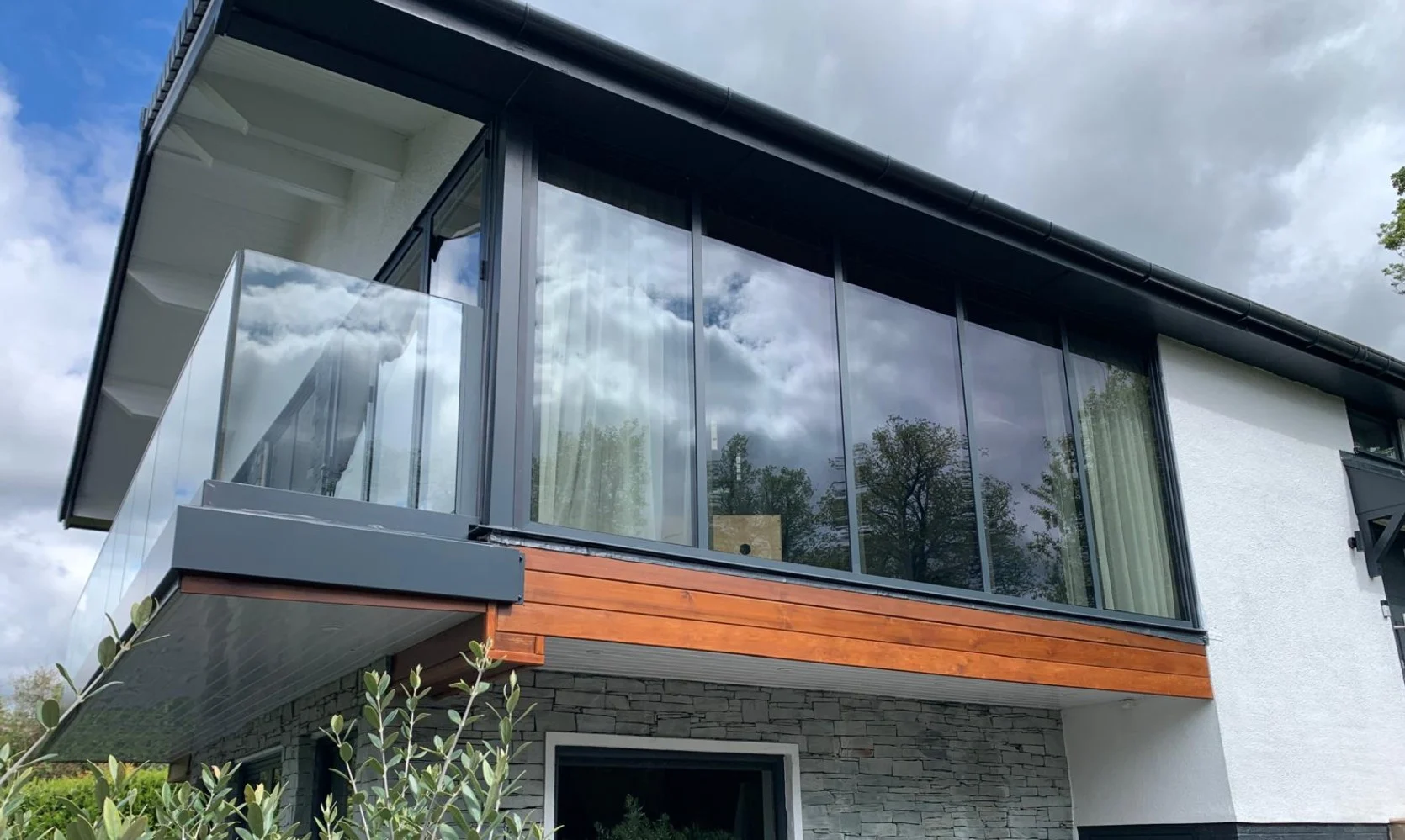
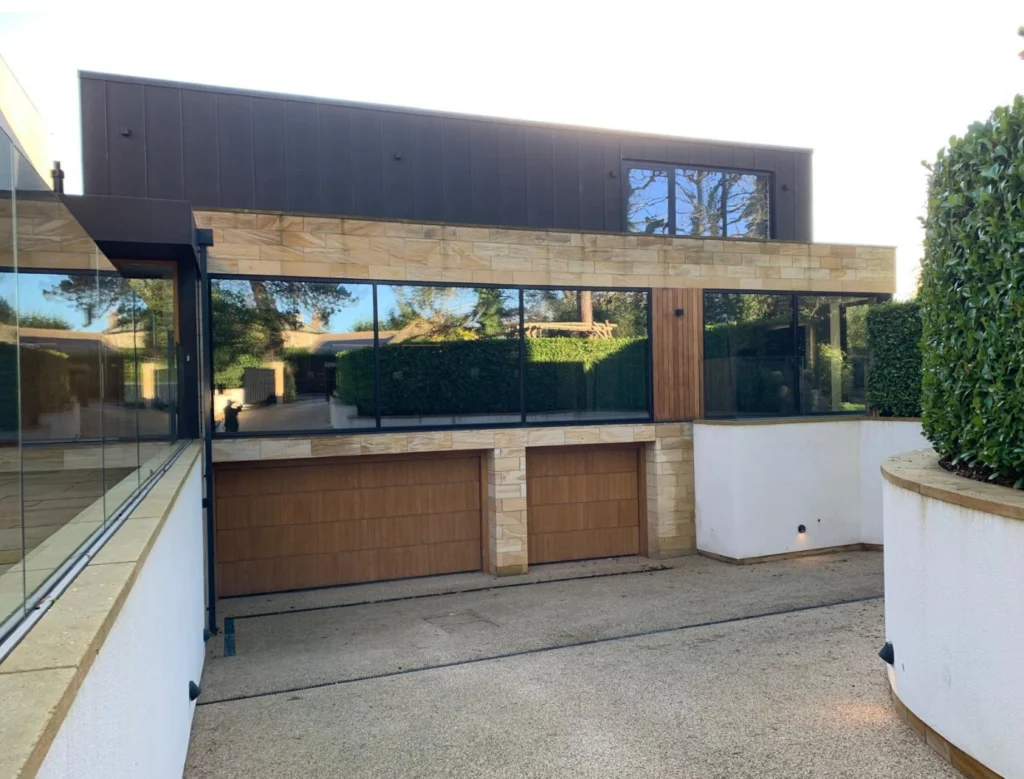
This is often the real decision, so look at the photos before the specifications. 3M Night Vision gives a soft tint that most passers-by won’t notice. Silver films look like mirrors, which suits some houses and stands out on a terrace. A frosted band looks deliberate, like etched glass. If you film only the ground floor, the upstairs windows will look different; we can show you samples on both before you decide.
The daylight cost of privacy
Every privacy film works by letting less light through, so the darker the film, the sooner the lamps go on. On a bright summer day you won’t notice. On a grey winter afternoon you will.
In our modelling of a sofa in the middle of a room, the darkest films can mean lamps on for most daylight hours on overcast days. In money that is small, roughly £15 to £40 a year of LED lighting at the current price cap. In how the room feels, it is not small at all. These are illustrative figures until our test afternoon confirms them.
That’s why we start with the lightest film that keeps you private where you actually sit, and let the blind handle the evening.
What daylight privacy film costs
Privacy film, supplied and fitted on vertical glazing, costs about £45 to £100 per m² for inside films and £90 to £180 per m² for outside films. For a typical 1.8 × 1.2 m front window, that is roughly £100 to £220 inside or £200 to £390 outside. These are installed prices for the film alone; electric blinds are priced for each window. The price moves with the film, the pane sizes, access and how many windows are done together, and London jobs carry a higher rate. Full detail is in our window film pricing guide.
Electric blinds are priced for each window, because the fabric, the size and whether the blind is concealed change the price more than the motor does.
If you have one small window, only need daytime privacy and don’t mind the look, net curtains or a DIY frosted film are the sensible answer, and we’d tell you so. Fitted film earns its cost on large or street-facing glass, where the view matters.
Can my glass take window film?
Not every pane should have every film, and it’s worth asking any installer about.
Films fitted on the inside, including 3M Night Vision, absorb some of the sun’s energy and warm the glass. On the wrong pane that can crack it, so a thermal stress check comes before any quote for an inside film. Before we quote we record the glass type, the age and condition of the sealed units, the frame, any shading and how much sun each pane gets, and run the film manufacturer’s thermal stress assessment. Toughened glass passes easily, and you can often spot it by a small mark etched in one corner. Where a film isn’t safe for your glass, we’ll say so and suggest an outside film, a frosted band or a blind instead.
Living with it
- Inside on dull days. Silver films reflect strongly on the inside too, so on a grey afternoon your window can look like a mirror from the sofa. 3M Night Vision reflects far less inside, which is why we usually recommend it for living rooms.
- The first few weeks. New film holds a little moisture and can look hazy or slightly dimpled while it dries out. Leave it alone and don’t clean it for the first 30 to 60 days. Sun speeds this up; a north-facing window fitted in winter can take longer (Madico).
- Cleaning. After that, a soft cloth and mild soapy water. No scourers or blades.
- Warranty. Each manufacturer sets its own terms. 3M Night Vision carries a 12-year warranty and 3M Prestige Exterior 10 years. Solar Gard Silver 35 Exterior carries 10 years. Global’s interior films carry a 10-year warranty on the product only; Global’s exterior films 5 years (External) or 10 years (External Plus), product only. Every metallised exterior film we fit is edge-sealed, which those warranties require; 3M Prestige Exterior is not metallised and needs no edge seal. Somfy motors on our blinds carry a five-year warranty.
- Compared with net curtains. No washing, no re-hanging, no greying. The blind needs occasional dusting.
The downsides, plainly
- Birds. Mirrored glass can confuse birds, especially on garden-facing windows. If you already get bird strikes, see our anti-bird-strike films.
- Renting. Film can be removed by a professional, but ask your landlord before fitting it.
- Listed buildings and leaseholds. Film is usually treated as reversible, but rules vary. Check with your conservation officer, or your lease if it controls how windows look.
- Night. Film alone does nothing for privacy after dark with the lights on. That is not a flaw we can fix with a better film; it is why we pair it with a blind.
Net curtains vs window film vs blinds, side by side
| Net curtains | Privacy film alone | Café-height frosted band | Film plus electric blind with scenes | |
|---|---|---|---|---|
| Privacy by day | Good | Good where it reflects; weaker near the glass or facing a hedge | Full, where it covers | Good |
| Privacy after dark, lights on | Shapes show | None | Full, where it covers | Full: the blind closes itself |
| View out by day | Hazy | Clear, slightly tinted | Blocked where it covers | Clear, slightly tinted |
| Daylight | Some lost | Lost; depends on the film | Most kept | Lost by day; depends on the film |
| From the street | Net curtains | Tint or mirror | Like etched glass | Tint by day, a neat blind at night |
| Upkeep | Washing and replacing | A wipe | A wipe | A wipe and occasional dusting |
| Cost | Lowest | Medium | Low to medium | Highest |
| Remembering to close it | Always there | Nothing to close | Nothing to close | Scenes do it for you |
Try a sample before you commit
The only proof that counts is your own window. Book a free call with a specialist and ask for samples: we put film sample panels on your glass and bring blind fabric swatches. Then go outside and stand where your neighbour or a passer-by would, ideally on a dull afternoon, which is the hardest test for film. Look again once the lamps are on, with a swatch held up. You’ll see for yourself what each option hides, and from where.
Questions people ask about replacing net curtains
No. Once your lamps are brighter than the street, people can see in through any window film. That’s why we pair film with an electric blind that closes itself at sunset.
Not in the way a police interview room is. It works on the balance of light: when it’s brighter outside, people mostly see a reflection while you see out. How much it hides depends on what the glass reflects, how far into the room you are, and whether your lamps are on.
Silver films do. 3M Night Vision gives a softer tint that most people won’t notice. A frosted band looks like etched glass. Look at the street photos above, then at a sample on your own window.
You can, and some people do for a few weeks while they get used to the change. But the point of film is that you stop needing them, and keeping them throws away the view you’ve paid for.
Yes. With a Somfy TaHoma hub, your blinds follow scenes you set: at dusk and dawn, with an offset if you want them earlier or later, or while you’re away. You can still use a remote, a wall switch, your phone or your voice whenever you like.
Yes, where it covers: no one can see through it, lit or not. Someone standing right against the glass may show as a blurred shape.
It helps. Most window films block up to 99% of UV according to their data sheets, but sunlight and heat fade things too, so film slows fading rather than stopping it.
Usually not for an ordinary home. If your home is listed, check with your conservation officer; if you rent, ask your landlord; if you’re a leaseholder, check whether your lease controls how windows look.
Your next step
Send us photos of your windows and we’ll suggest the film and blind for each one, with a price. Or book a free call with a specialist, who will go through your windows with you and arrange film samples and blind swatches so you can see the difference from the street yourself.
Or email your photos to info@windowtreat.co.uk or call us on 01256 648000.
Not sure which film? Try your own room in the Who Can See In? tool above.
Read next

Related Articles