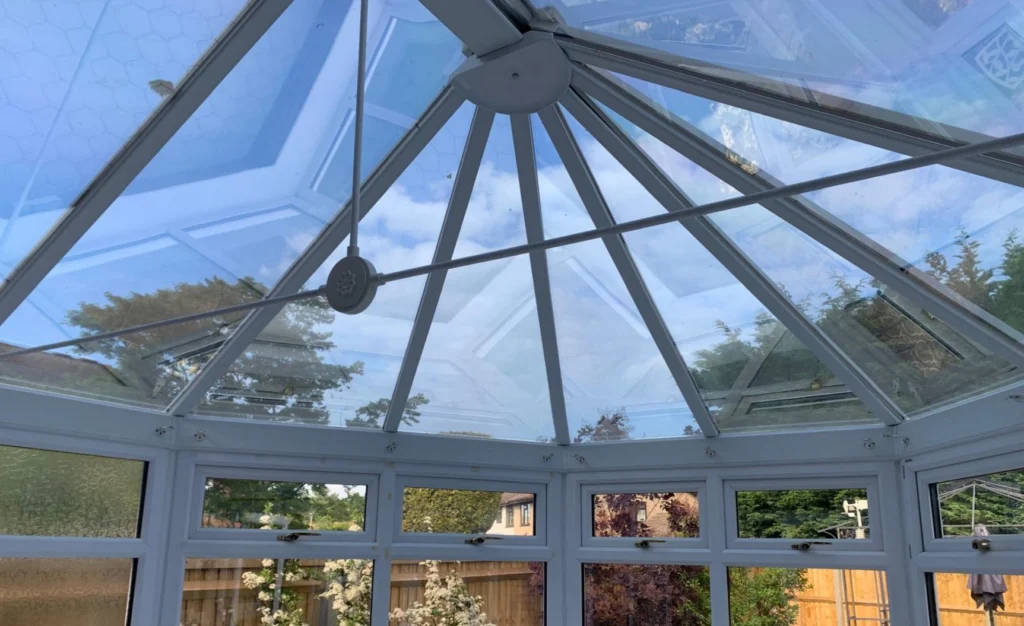
Conservatory roof film: the short answer
For most glass conservatory roofs, the solar film we fit is 3M All Seasons 35, on the inside. On 3M’s double-glazing reference it cuts solar heat gain by about 54% and glare by about 65%, and it still lets through about 28% of the light, so the room stays bright. Low Reflect Extreme suits TV rooms and the brightest roofs, and Silver 20 is the budget option. Typical prices are £150 to £225 per square metre of floor for 3M All Seasons 35 and £80 to £155 for Silver 20.
The short version
- Glass roof: the film goes inside, and it has to be a reflective film. Clear or neutral films do very little inside modern double glazing.
- Low lean-to roof: 3M All Seasons 35 only.
- Polycarbonate roof: the one roof we film outside, with Solar Gard Silver 20 for polycarbonate. Solar inserts are the alternative.
- Every figure we quote you is the improvement you can expect over the roof glass you have now, not a single-pane lab figure.
- The right film takes much of the sun’s heat and glare out of the room. No film turns a glass room into an air-conditioned one on the hottest days.
Jump to: Which roof have you got? | The films compared | Roofs we’ve filmed and what we measured | Worth knowing before you choose | Questions
Which roof have you got?
The film follows the roof. Most people start by asking which film is best, but the answer depends first on what the roof is made of and how low it sits.
- Glass roof, normal pitch: 3M All Seasons 35 inside for most rooms; Low Reflect Extreme if screens and glare are the problem; Silver 20 if price comes first.
- Low-pitch, low-level lean-to: 3M All Seasons 35 only. The roof is close above your head and takes the high summer sun almost face-on, so it needs strong heat control that keeps the room bright.
- Polycarbonate roof: Solar Gard Silver 20 for polycarbonate, fitted outside, or solar inserts.
- Orangery roof lantern or flat skylight: these have their own page: orangery and skylight roof films.
We fit roof film inside a glass roof for two reasons. Many conservatory roofs have a self-cleaning or easy-clean coating on the outside that film won’t stick to, and working on a fragile glass roof risks leaks and falls. We don’t fit 3M Prestige Exterior on conservatory glass roofs.
The roof films compared
| Film | Light through | Glare cut | Heat | Our verdict |
|---|---|---|---|---|
| 3M All Seasons 35 (inside) | About 28% | About 65% | About 54% less solar heat gain; about 11% less winter heat loss through the glass | ✓ Our pick for most glass roofs, and the only film we fit on a low lean-to |
| Low Reflect Extreme (inside) | About 7% | About 93% | Our darkest roof film | ✓ For TVs, home offices and the brightest roofs |
| Silver 20 (inside) | About 17% | About 78% | Classic silver reflective film | ✓ The lowest price that still works. Not for a low lean-to |
| Solar Gard Silver 20 for polycarbonate (outside) | Not quoted here | About 85% (maker’s reference) | Film made for polycarbonate; over 99% of UV blocked | ✓ For polycarbonate roofs only |
| Clear, neutral or lightly tinted films (inside) | Varies with the tint | Varies with the tint | In our modelling a 50% neutral film cuts solar heat by only about 4% | ✗ We don’t fit them on conservatory roofs |
Light and glare figures are for the film on double glazing. Heat figures for 3M All Seasons 35 are on 3M’s double-glazing reference; results on low-e roof glass are lower, as with every internal film.
Roofs we’ve filmed and what we measured
- Gerrards Cross conservatory extension: 3M All Seasons 35 inside the glass roof and 3M Prestige Exterior outside the side glass. The owners told us: “We are now really looking forward to spending our days in our conservatory extension and can already feel the difference made by the products WindowTreat installed.” Read the Gerrards Cross story.
- Amersham roof lantern: 3M All Seasons 35 inside a sky lantern. See the Amersham lantern.
- How bright it stays: at midday on 4 May we measured 68,000 lux in the garden and 7,500 lux inside a filmed conservatory, still about ten times brighter than the top of the guidance for an office.
- What it does to the heat: on a 14 m² south-facing roof on a clear June day, our modelling puts the heat coming through at 1pm at about 7.6 kW with no film and about 3.5 kW with 3M All Seasons 35: from about four fan heaters to under two.
Worth knowing before you choose
- On the hottest days, open a window as well. 3M All Seasons 35 takes about 54% of the sun’s heat out on 3M’s double-glazing reference, and the breeze clears the warm air.
- The film has to be reflective. Inside modern double glazing, clear films do very little, which is why we only fit films that make a real difference.
- Choose the look as well as the performance. Silver 20 looks mirrored from the garden by day and from inside after dark. Low Reflect Extreme has a low-reflect inner face, so you see far less of your room mirrored in the roof at night.
- A little help in winter too. 3M All Seasons 35 cuts heat loss through the glass by about 11%; for a cold room, blinds add more.
- Your glass is checked first. We check every film against your glass type, size, coatings and shading before we recommend it.
Prices, real examples and what changes the cost are in our conservatory roof film cost guide. For the side glass and the whole room, see conservatory and orangery window films.
Book a free call and send us a couple of photos of your roof. We’ll tell you which film suits it and what it will cost.
A conservatory roof on a clear June day
Solar heat coming through 14 m² of south-facing glass roof near London, hour by hour.
Sunshine on the roof Untreated double glazing 3M All Seasons 35, fitted inside
How the three roof films we fit compare, from the published optical data and our own modelling. Light and glare figures are for the film on double glazing; every figure we quote is the improvement you can expect over the glass you have now.
| Film | Light through | Glare cut | Best for |
|---|---|---|---|
| 3M All Seasons 35 | About 28% | About 65% | Most glass roofs, and the only film we fit on a low lean-to |
| Low Reflect Extreme | About 7% | About 93% | TV rooms, home offices, the brightest roofs |
| Silver 20 | About 17% | About 78% | The lowest price that still works |
3M All Seasons 35: our pick for most roofs
All Seasons 35 is a spectrally selective reflective film. Sunlight is about half visible light and half invisible near infrared, and both become heat when they land on you or the floor. This film stops much more of the near infrared than of the visible light. On 3M’s double-glazing reference it cuts solar heat gain by about 54% and glare by about 65%, blocks 99% of UV and lets through about 28% of the light: roughly a third of what clear double glazing passes, which on a sunny day is still many times brighter than a well-lit office. It also cuts winter heat loss through the glass by about 11%, which is why 3M calls it All Seasons.
On a 14 m² south-facing roof on a clear June day, that takes the heat coming through at 1pm from about 7.6 kW to about 3.5 kW: from four fan heaters to under two. On a low-pitch, low-level lean-to roof, it is the only film we recommend. See it on a conservatory extension in Gerrards Cross and a sky lantern in Amersham.
Low Reflect Extreme: for screens, glare and the brightest roofs
Our darkest roof film. It lets through about 7% of the light and cuts glare by about 93%, so a TV or laptop is easy to see even under a glass roof at midday. Its inner face is low-reflect, so after dark you see far less of your own room mirrored in the roof than with a classic silver film. Choose it when glare, not brightness, is the problem.
Silver 20: the budget film that still works
The classic silver reflective film, and the lowest-cost roof film that still makes a real difference. It lets through about 17% of the light on double glazing and reflects about 55 to 60% on both faces, so it looks mirrored from the garden by day and from inside after dark. Typically about £80 to £155 per square metre of floor. Not for a low lean-to roof, where we fit 3M All Seasons 35.
The films we do not fit on conservatory roofs
Clear, neutral and lightly tinted films fitted inside modern low-e double glazing. In our modelling a neutral film letting through 50% of the light cuts solar heat by only about 4%, and a 70% neutral film by under 1%. Much of the sun’s energy they absorb warms the inner pane, and low-e glass slows that heat escaping outwards, so it ends up in the room. Why internal films struggle on modern double glazing explains the physics, and why 3M All Seasons 35 succeeds where other internal films fail explains the difference.
Why figures differ between companies
Many film figures are measured on a single pane of glass, which flatters them. We quote the improvement you can expect on the double glazing you actually have. Our conservatory window film review has the full verdicts, and the conservatory roof film cost guide has real prices.
Which film is right for your conservatory roof ?
3M All seasons
Before you decide
The number most companies quote is not the improvement you will get. Most window film figures are measured on a single pane of clear glass, and the headline often includes the sun’s energy the bare glass already turns away, so the film looks better than it is. Your conservatory or orangery almost certainly has modern double glazing that already does part of the job. Every figure we quote is the improvement you can expect over the glazing you have now.
- Does conservatory window film work? Our honest review of which roof and side films work on modern glass, and which to avoid.
- How to choose conservatory window film: ten questions, in the order that matters.
- Conservatory roof film cost: typical UK prices for roof films and what changes them.
Conservatory roof film prices
Learning Centre
Why 3M All Seasons 35 succeeds where other internal films fail
Why internal solar films can struggle on your glazing?
Conservatory roof film results

Related Products
Conservatory Side Glazing Films
eLECTRIC ROOF LANTERN & sKYLIGHT BLINDS
PERSEUS VERANDA CONSERVATORY AWNING
Conservatory roof film questions
What we have learned fitting conservatory roof film since 2006
The data sheet is not the result. Most roof films are tested on a single pane of clear glass. Your roof is almost certainly low-e double glazing, which already does part of the job. Low-e glass also slows heat escaping outwards, so heat that an internal film absorbs tends to end up in the room. That is why a film that looks impressive on paper can disappoint inside a modern roof, and why we choose reflective, spectrally selective films such as 3M All Seasons 35 and quote the improvement you can expect on your glass.
Yes, if it is the right film. A reflective, spectrally selective film such as 3M All Seasons 35, fitted inside a glass roof, cuts solar heat gain by about 54% and glare by about 65% on 3M’s double-glazing reference while keeping the room bright. A clear or neutral film does very little inside modern double glazing, which is why we name the films to avoid. Does conservatory window film work? has our full verdicts.
Because inside is the right place on a conservatory roof. Many roofs have a self-cleaning or easy-clean coating on the outside that film will not stick to, and working on a fragile glass roof risks leaks and falls. Inside, a reflective film does the job without anyone going on the roof, and it sits out of the weather. The one exception is a polycarbonate roof, where we fit a film made for polycarbonate on the outside.
On a low-pitch, low-level lean-to roof we recommend only 3M All Seasons 35, fitted inside. The roof sits close above your head and takes the high summer sun almost face-on, so it needs the strongest heat control that still keeps the room bright: about 54% less solar heat gain and about 65% less glare on 3M’s double-glazing reference. In our experience it stands out for sending the sun’s energy back out through modern low-e double glazing, where many internal films struggle, and it warms the glass above you less, so the roof acts less like a radiator over your head.
Not with 3M All Seasons 35. It lets through about 28% of the light on clear double glazing, and a conservatory starts far brighter than you think. At midday on 4 May we measured 68,000 lux in the garden and 7,500 inside a filmed conservatory, still about ten times brighter than the top of the guidance for an office. If glare is the problem, Low Reflect Extreme is darker by design.
Typically about £80 to £155 per square metre of floor for Silver 20 and £150 to £225 for 3M All Seasons 35. Real examples, and what pushes the price up or down, are in our conservatory roof and window film cost guide.
A little. 3M All Seasons 35 cuts heat loss through the glass by about 11% on 3M’s double-glazing reference, which is why 3M calls it All Seasons. It is mainly a summer film; for winter warmth, good blinds or curtains do more.
The film itself is rarely the weak point. Issues are usually caused by installation errors such as contamination under the film, edges cut too tight to the gaskets, or corners lifting over time. Installation quality is covered in why 3M All Seasons 35 succeeds where other internal films fail.
Side glass is easy and safe to reach, so we fit film on the outside, where it stops the sun before it reaches the glass. Spectrally selective films such as 3M Prestige Exterior cut solar heat well without a mirrored look and without taking much of the daylight. 3M Prestige Exterior films compared sets out the options.
Yes. Filming the roof and the side glass together blocks almost all UV and much of the sun’s light, two of the main things that drive fading. Worked out for the films we fit, furnishings in the sun beneath a filmed roof can stay looking newer for up to three to four times longer. Results vary with the fabric, its colour and how much direct sun it gets, and no film stops fading completely. Read more in our conservatory window film review.
Yes. We fit Solar Gard Silver 20 for polycarbonate on the outside of the roof, the one conservatory roof we film outside. Solar inserts are the alternative.
Inside a glass roof, yes. A film fitted inside modern double glazing has to send the sun back out to make a real difference; clear and neutral films absorb more than they reflect, and much of what they absorb ends up in the room. 3M All Seasons 35 is reflective but spectrally selective, so it stops much more of the invisible near infrared than of the visible light and keeps the room brighter than a classic silver film.
Yes. 3M All Seasons 35 blocks 99% of UV, and Solar Gard Silver 20 for polycarbonate blocks over 99% (maker’s reference). Cutting UV and much of the sun’s light together is what slows fading.
Film warms the glass a little, so the wrong film on the wrong glass can add stress. That’s why we check the film against your glass type, size, coatings and shading before we recommend anything. If an installer doesn’t ask about your glass, be wary.
You can buy film, and as an Accredited 3M Window Film Dealer we’ll sell 3M film on a roll if you ask. But 3M gives no warranty on film you fit yourself, roof glass means working overhead, and the film has to be matched to your glass to avoid stress. We’d have it fitted. See where to buy 3M window film.
Yes, on the side glass. Our conservatory side glazing films and daytime one-way privacy films pages set out the options.
Yes. See 3M security and safety window film for the films and how they are fitted.
Yes. Roof tinting, solar film, cooling film and heat control film are different names for the same thing: a film fitted to the roof to cut the sun’s heat and glare. Which film matters more than what it is called.
We fit across most of England, and further afield for bigger projects. Send us a couple of photos of your roof and we’ll price it from those. Book a free call to start.