Stand in an unshaded conservatory on a bright June afternoon and it isn’t really the air you’re feeling. It’s the sun itself: radiant heat pouring through the roof. Think of sitting in your car on a bright day. The air conditioning keeps the air temperature fine, yet the sun’s radiant heat still makes you feel as though you are cooking. Window film can take a real bite out of that. It can also do almost nothing. Which one you get depends on two things most adverts never mention: what your roof glass already is, and which side of it the film goes on. We have been fitting conservatory window film since 2006. Here is what works, what doesn’t, and how to tell the difference before you spend a penny.
The short answer
Yes, conservatory window film works, provided the film is reflective on a glass roof and matched to your glass. A clear or neutral film fitted inside a modern double-glazed roof does very little for heat. On the side glass, a film fitted outside beats the same film fitted inside by a wide margin. And no film makes a glass room comfortable on the very worst heatwave days. Everything else in this review is detail.
Our verdicts at a glance
Roof films go inside the glass; the one exception is polycarbonate, where the film goes outside. Side glass films go outside.
Why we name the films to avoid. There is a lot of misleading information in our industry. Films that do very little on modern glass are still widely sold for conservatories, backed by data-sheet figures measured on single or clear glass. Inside modern double glazing much of that benefit disappears, and the data sheet will not tell you. We take a lot of these films off conservatories where they were fitted by others and never worked. So we say it plainly: a film marked Avoid is one we will not fit to control heat, whoever recommends it.
Roof films
| Film | Where | Verdict | Why |
|---|---|---|---|
| 3M All Seasons 35 | Inside a glass roof | ✓ Recommended | Our best all-rounder: strong heat control while keeping the room bright. |
| Low Reflect Extreme | Inside a glass roof | ✓ Recommended | The strongest glare control, for TVs and laptops. |
| Silver 20 | Inside a glass roof | ✓ Recommended (budget) | The lowest-cost film that still works. Darker and cooler in colour. |
| Silver 20 for polycarbonate | Outside a polycarbonate roof | ✓ Recommended | The film for polycarbonate, and the one roof we film outside. |
| Clear or neutral films | Inside a glass roof | ✗ Avoid | Very little heat reduction on a modern double-glazed roof. |
| Any film outside a glass roof | Outside a glass roof | ✗ Avoid | Self-cleaning and easy-clean coatings stop it sticking, and working on the roof risks leaks and falls. |
Side glass films
| Film | Where | Verdict | Why |
|---|---|---|---|
| 3M Prestige 70 Exterior | Outside the side glass | ✓ Recommended | Virtually invisible. Choose it if keeping the most light and the view matters most. |
| 3M Prestige 50 Exterior | Outside the side glass | ✓ Recommended (our pick) | The sweet spot: much more heat control than 3M Prestige 70 Exterior, with only a light tint. |
| Silver 50 Exterior | Outside the side glass | ✓ Recommended (value) | Good performance at about half the price of 3M Prestige Exterior; a little more reflective. |
| Clear or neutral films | Inside the side glass | ✗ Avoid | Poor heat performance inside modern double glazing. |
| 3M Prestige 70 (interior version) | Inside the side glass | ✗ Avoid | Excellent outside, but poor inside modern double glazing. |
| Light bronze or silver films (50 type) | Inside the side glass | ✗ Avoid | Only a small heat reduction inside modern double glazing. |
How we judge conservatory film
We don’t take a data sheet at face value. For every film we look at four things: the manufacturer’s measured figures to the European standard (EN 410); how the film behaves on the glass you actually have, which we model with the Lawrence Berkeley National Laboratory’s WINDOW software; what we have seen on roofs and side glass since 2006; and what customers tell us afterwards. Where we quote a number below, we say where it comes from. Where we are relying on experience rather than measurement, we say that too.
Most film figures are measured on single glass. We quote what you will actually get.
The number most companies quote is not the improvement you will get. Most window film figures are measured on a single pane of clear glass, and the headline often includes the heat the bare glass already turns away, so the film looks better than it is. Your conservatory almost certainly has modern double glazing that already does part of the job. Every figure we quote is the improvement you can expect over the glazing you have now.
You will see claims like “rejects up to 80% of the sun’s heat”. Two things make numbers like that look bigger than the change you will feel:
- They are measured on the wrong glass. The test is usually a single pane of clear glass, like a greenhouse. A conservatory built in the last twenty years almost certainly has low-e, argon-filled double glazing, often with a solar-control tint on the roof.
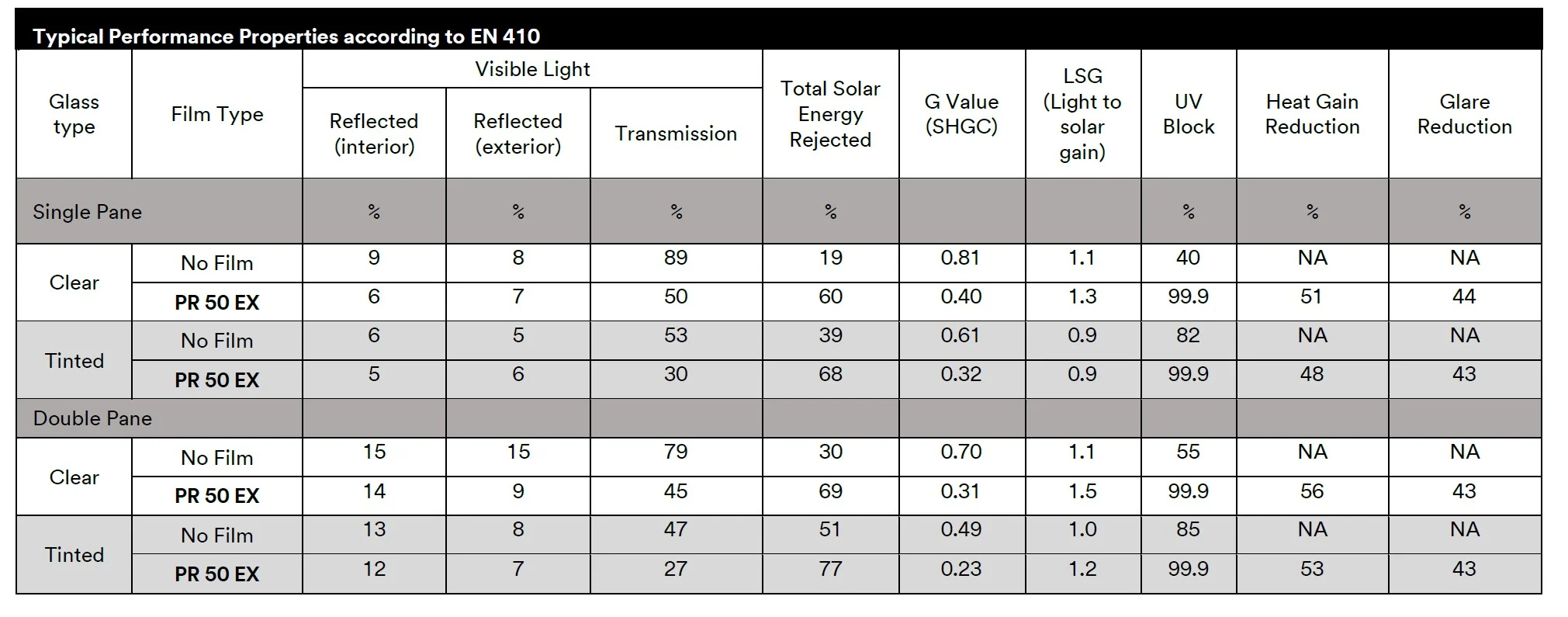
- They include what the glass already does. “Solar energy rejected” counts the heat the bare glass turns away as well as the film’s share. On 3M’s own data sheet for 3M Prestige 50 Exterior, bare single glass already rejects 19% before any film goes on.
Modern double glazing is built to keep heat in. When a film fitted inside the roof reflects the sun’s heat back upwards, much of that heat is trapped in the double glazing and finds its way back into the room. On modern roof glazing our modelling shows the real improvement from an internal film is often about half of its single-glass headline. A reflective film still does a worthwhile job. A clear or neutral film does almost nothing, as the table below shows. To check a data sheet yourself, read making sense of window film performance data; for the physics, see why internal solar control films struggle on modern double glazing.
The film that fails: clear or neutral film inside a modern roof
| Film fitted inside the roof | What the data sheet says (solar energy rejected, single glass) | The improvement you can expect on modern double glazing (less solar heat gain, our modelling) |
|---|---|---|
| Neutral 20 | 67% | 15% |
| Neutral 35 | 55% | 12% |
| Neutral 50 | 42% | 4% |
| Neutral 70 | 29% | under 1% |
| Clear films letting through about 70% of light | 50% | 9% to 12% |
If someone offers you a clear film for the inside of a modern conservatory roof and promises a cool room, walk away.
It’s the radiant heat, not the air
Daylight warms a room gently, and opening a door or a couple of windows usually deals with it. What makes a conservatory unbearable is the sun’s radiant heat, the near-infrared part of sunlight that warms you directly. Step from shade into sun and the air hasn’t changed, but you have. On a May afternoon I measured 29°C in the sun and 19°C in the shade at the same moment. That ten-degree gap is what a good conservatory film is there to close. It is also why the films that reflect the most near-infrared, not simply the darkest films, give the biggest change in comfort.
Roof films reviewed
Love the light? 3M All Seasons 35
Who it’s for: anyone who wants a noticeably cooler conservatory without losing the brightness that made them build one.
What the data says: on 3M’s clear double-glazing reference it cuts solar heat gain by about 54%, cuts glare by about 65%, blocks 99% of UV and lets through about 28% of the light. In winter it also cuts heat loss through that glass by around 11%, which is why 3M put it in the All Seasons range. On low-e roof glass the summer gain is smaller than the reference figure, as with every internal film.
Why it beats the others: it is spectrally selective. It targets the near-infrared heat rather than blocking everything, so it lets through roughly 70% more daylight than Silver 20 while rejecting more radiant heat. It also absorbs less energy than most internal films, which matters on roof glass that is already working hard in the sun.
Downsides: it is the most expensive internal roof film we fit, and the room is still brighter than a Low Reflect Extreme room, so it is not the answer for TV glare.
Verdict: our most-fitted conservatory roof film, and the one we would put on our own roof. Why 3M All Seasons 35 succeeds where other internal films fail.
Can’t see the TV? Low Reflect Extreme
Who it’s for: conservatories used as a TV room, office or playroom with screens, where light itself is the problem.
What the data says: it lets through about 7% of the light and cuts glare by about 93%, with over 99% of UV blocked and about 82% of total solar energy rejected on the manufacturer’s reference glass. To use screens comfortably under a glass roof you usually need to cut glare by more than 90%, otherwise you will be disappointed. This film does.
What’s clever about it: the outside face is a mirror, which is what pushes the heat out. The inside face is far less shiny than a silver film, so the room does not turn into a hall of mirrors when the lights go on.
Downsides: it is dark. If you love the light, you will not love this film.
Verdict: the right film when glare is the complaint. Sunglasses for the roof.
Tight budget? Silver 20
Who it’s for: anyone who wants a cooler conservatory for the least money.
What the data says: through modern double glazing it rejects nearly as much solar energy as All Seasons 35. It gets there differently: by blocking far more light (about 17% gets through on double glazing) rather than by targeting radiant heat. The colour is a little colder and the room darker.
Downsides: less radiant heat rejection than All Seasons 35, a strong mirror on the inside at night, and a dated look to some eyes.
Verdict: sixty-year-old technology that still does a good job. If glare bothers you and budget matters most, it is a sensible choice, not a compromise to be ashamed of.
Polycarbonate roof? A different answer
Polycarbonate roofs need a film made for polycarbonate, fitted on the outside. We use Solar Gard’s Silver 20 for polycarbonate, which cuts glare by about 85% on its reference glass and blocks over 99% of UV. Solar inserts, which slide into the polycarbonate chambers, are the alternative. An internal coating such as Coolkote is good at taming glare but weak at keeping heat out, so we only suggest it when glare is the whole complaint.
The windows people forget: the side glass
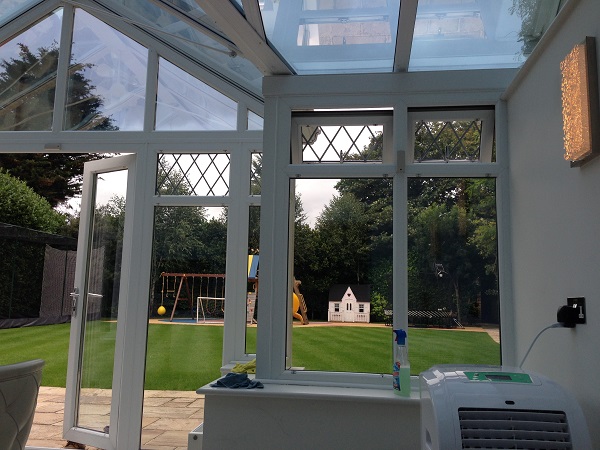
The roof matters most, but the sides are not a footnote. When we modelled a south-facing Edwardian conservatory, roughly 40% of the sun’s heat came through the side glass, and more once the roof had solar-control glass. In high summer it is the east and west windows that gain the most, because the midday sun is high overhead while the morning and evening sun comes in low and sideways. Even north-facing glass catches the sun in June, which rises in the north-east and sets in the north-west.
Side glass is easy and safe to reach from outside, so we fit exterior films there. The roof is not, which is one reason our glass roof films go inside. They stop the heat before it enters the double glazing, which is why they work so much better than internal films on modern glass. You do not have to film every window; pick the ones that suffer.
- 3M Prestige 70 Exterior. About 41% less solar heat gain while keeping about 81% of your daylight, on 3M’s clear double-glazing reference. Metal-free, low reflectivity, very hard to spot on the glass. If you value the view, this is the film. Verdict: when keeping the most light and the clearest view matters most.
- 3M Prestige 50 Exterior. About 56% less solar heat gain, keeping about 57% of your daylight and cutting glare by about 43%, on 3M’s clear double-glazing reference. This is the sweet spot: far more heat control than 3M Prestige 70 Exterior, with a light tint that is hard to tell from indoors. It is now our best seller on side glass. Verdict: the best side film for most conservatories.
- Silver 50 Exterior. Useful heat reduction and a reasonable amount of light at roughly half the installed price of 3M Prestige Exterior, with a little more reflection. Verdict: a genuine recommendation for value, not just the cheap option.
- Internal films on side glass. Reflective ones turn your windows into mirrors at night; neutral ones barely perform on modern glass. Verdict: we rarely recommend either.
Film, blinds, an awning or a new roof?
We fit roof blinds and over-glass awnings as well as film, so we have no reason to push film where it is the wrong answer. Here is how the options compare in practice.
| Option | Heat | Light and view | Upkeep | Typical cost | Choose it when |
|---|---|---|---|---|---|
| Roof film | Good with a reflective film; works all day with nothing to operate | Dims the room a little or a lot depending on the film; view unchanged | None; 10 to 15 year warranties are typical | About £70 to £200 per m² of floor area, so often £1,000 to £2,000 for a roof | You want a permanent fix, keep the view, and the room is used all day |
| Internal roof blinds | Moderate; the heat is already inside the glass | Full control, from open to blackout | Mechanisms, fabric, cleaning | Usually more than film for a whole roof | You want to open and close, or need blackout |
| External awning or blind | The strongest, because it shades the glass before the sun reaches it | Shade when you want it, sun when you don’t | Motors, fabric, weather | The most expensive option | Severe overheating and you want to admit winter sun |
| New solar-control glass roof | Good, built in | Tinted; permanent | None | Which? members reported an average of £6,144 for a roof replacement (April 2026) | The roof is failing anyway |
| Solid roof | Good, but not the best: the tiles soak up the sun’s heat, and most solid roofs include roof lights that still let the sun in. An external dark screen fabric blind does better, stopping the heat before it reaches the glass | You lose the sky | None | Highest | You want a normal room, not a conservatory |
Many of the best results we see combine two of these: a reflective film on the roof for the everyday heat, with blinds or an awning for the handful of days a year when nothing passive is enough.
What film can’t do (we’d rather tell you now)
Will it cope in a heatwave?
Not on the very worst days. Film makes a conservatory usable for many more hours a day and weeks a year, and customers are delighted with the change. But a glass room cannot be made comfortable on a 35°C afternoon by film alone. Ventilation still matters: even a dripping tap fills a bucket, so a roof vent or a couple of open windows stops trapped heat building through the day.
Will it make the room cold in winter?
A conservatory is cold in winter with or without film. Solar film reduces the free warmth from winter sun a little, which you will notice least on a roof film that also cuts heat loss, such as All Seasons 35 (around 11% on 3M’s reference glass). If winter comfort is the bigger problem, a low-e film such as Solar Gard EcoLux on the side glass reflects the room’s warmth back in.
Will it crack my glass?
Film absorbs some of the sun’s energy and warms the glass, so the wrong film on the wrong glass can add stress. Before we recommend anything we check the film against your glass: type, size, coatings, how it is shaded and framed. This is why we ask for photos and sometimes a close look at the glass edge. A reputable installer will do the same; if nobody asks about your glass, be wary.
Will my windows look like mirrors at night?
A reflective film on the inside of side glass will, when it is dark outside and the lights are on. That is why we fit low-reflection exterior films such as 3M Prestige Exterior on side glass. On the roof it matters less, because you are rarely staring at the roof in the evening, and Low Reflect Extreme was chosen for its low inside shine.
Can I fit it myself?
Side windows, perhaps, if you are patient and the panes are small. A roof is a different matter: overhead work on glass you cannot stand on, large sheets of film, and the glass-compatibility question above. Film itself rarely fails; installations do, through dirt under the film, edges cut too tight or corners lifting. We would not recommend DIY on a roof.
How long does it last?
Internal roof films typically carry warranties of around 10 years and often last far longer when properly fitted. Exterior films face the weather, so their warranties are shorter and differ between products; 3M Prestige Exterior has no metal layer to corrode and a long track record. A warranty tells you what the manufacturer will stand behind, not when the film will fail. We confirm the current warranty for your film and glass before you order.
What about self-cleaning glass, lean-tos and lanterns?
Many conservatory roofs have a self-cleaning or easy-clean coating on the outside of the glass, and film will not stick to it. That, and the risk of leaks and falls from working on a fragile roof, is why we fit glass roof films inside and keep exterior films for the side glass. On coated roof lanterns we fit All Seasons 35 inside. On a low-pitch, low-level lean-to roof we recommend only 3M All Seasons 35, fitted inside: the roof sits close above your head and takes the high summer sun almost face-on, so it needs the strongest heat control that still keeps the room bright. See our conservatory roof film page, and work out how much heat your own roof lets in with our conservatory roof heat calculator. Roof lanterns and skylights are covered on our orangery lantern and skylight films page.
Does it stop fading?
Glass stops sunburn, but not all of the sun’s UV. Ordinary glass blocks most of the UVB that burns skin, yet lets through much of the UVA that ages skin and fades fabrics. That is why long-distance lorry drivers can show more sun damage on the side of the face nearest the window, sometimes called trucker’s arm. A well-known case in the New England Journal of Medicine shows a driver whose window side aged visibly faster over more than 25 years at the wheel. A conservatory puts that glass above you as well as beside you. The roof films we fit block 99% or more of UV.
Filming the roof and the side glass together blocks almost all UV and much of the sun’s light, two of the main things that drive fading. Worked out for the films we fit, furnishings in the sun beneath a filmed roof can stay looking newer for up to three to four times longer. Results vary with the fabric, its colour and how much direct sun it gets, and no film stops fading completely.
What customers tell us
Conservatory extension, Gerrards Cross: 3M All Seasons 35 on the roof, 3M Prestige Exterior on the side glass. “Everything from start to finish was so smooth and professional. We are now really looking forward to spending our days in our conservatory extension and can already feel the difference made by the products WindowTreat installed.”
Sky lantern, Amersham: 3M All Seasons 35. “We are very happy with the product and the installation. The service that we received from everyone was excellent and we would definitely recommend WindowTreat to a friend.” Nicola and Ian
Garden room, south-facing: 3M Prestige 40 Exterior. The owner’s thermostat had regularly shown over 27°C; afterwards they reported a 7 to 9°C difference and clear views kept. Read the story.
Before you choose
Work through how to choose conservatory window film, our ten questions in the order that matters, and check the typical conservatory window film cost. Then compare the films on our conservatory roof films and conservatory side window films pages.
About the author
Steve Gargett BSc (Hons) is Managing Director of WindowTreat, a 3M accredited dealer that has been diagnosing and fixing overheating, glare and fading in glazed rooms since 2006. He has a filmed conservatory of his own and a light meter he is not afraid to use. Email info@windowtreat.co.uk.
Your next step
Send us three photos: the roof from inside, the side glass from outside, and the room as you use it. We will tell you which film suits your glass and how you use the room, and we will tell you if film is not the right answer for you. Book a free call using the calendar below.