The short answer: for an external screen on your windows or doors, choose a dark fabric. In the screen fabric on our Harmonia external screens, Black blocks 93% of the sun’s heat and the palest shades block 88%. That sounds close, but it means a pale screen lets in about 12% of the sun’s heat against about 7% for Black: roughly 70% more. Dark fabric also gives you the clearest view out and the best control of glare. It is the opposite of the advice for blinds inside the room, and the reason is simple physics.
The short version
- Why dark wins outside, and loses inside
- Every colour compared: heat, light and view
- Screen or solid fabric for darkening a room
- Choosing the frame colour
- Your questions answered
Why dark fabric keeps a room cooler outside the glass
Sunlight is roughly half visible light and half invisible near infrared, and both turn into heat when they land on you, your floor or your furniture. An external screen works by stopping that energy before it reaches the glass.
A screen fabric does three things with the sun: it lets some through, it reflects some away, and it absorbs the rest. Outside, what matters most is how much gets through, because that is what reaches the glass and your room. Anything the fabric absorbs warms the fabric itself, and the outside air carries that warmth away.
Pale yarns are slightly translucent, so they pass more light through the fabric. Dark yarns stop it. So at the same weave, a dark external screen lets less of the sun’s energy into the room. That is why our team has always recommended dark external fabrics, and why the fabric figures below bear it out.
The fabric maker’s own laboratory measurements make the point. Our Black fabric reflects just 2.6% of the sun, far less than the palest shade at around 25%, yet Black lets the least heat into the room, because only 4.6% of the sun’s energy passes through it, against nearly 14% for the palest. Outside the glass, what gets through decides how warm the room gets.
Inside the room it works the other way. A dark blind behind the glass absorbs the sun and gives that heat straight back to the room, so for internal blinds a pale or metallised fabric is the cooler choice. Our guide to blind fabrics compared covers that side.
Every colour compared
These are the eight colours of the screen fabric we fit on our Harmonia external window screens. All have the same 4% open weave and block 97.5% of UV.
| Colour | Heat blocked | Light through | Best for |
|---|---|---|---|
| Black | 93% | 4.5% | The coolest room, the sharpest view and the least glare |
| Steel | 92% | 6.6% | Near-Black performance in a softer grey |
| Graphite | 91% | 8.6% | Strong heat control with a little more daylight |
| Slate | 91% | 7.0% | Strong heat control, sits well with anthracite frames |
| Taupe | 90% | 6.3% | A warm tone for brick and timber homes |
| Smoke | 89% | 12.2% | More daylight, with a little less heat control |
| Cement | 88% | 9.2% | A light look on pale render |
| Platinum | 88% | 11.0% | The lightest look, with more daylight |
Figures are the fabric maker’s indicative values, calculated to EN 13363-1 with standard double glazing. Your own glass will change the exact numbers, not the order.
The view out and glare
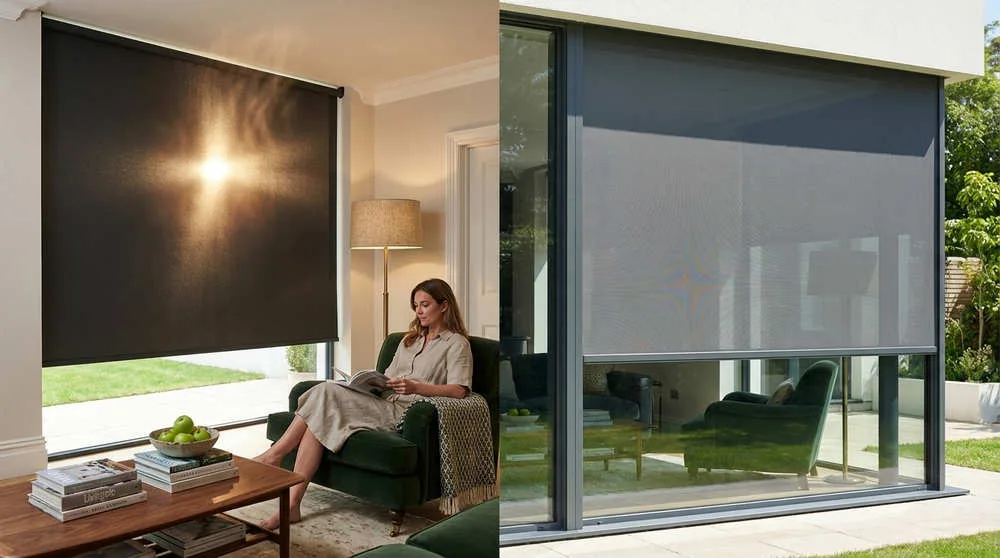
Dark fabric is also the one you see through best. Bright yarns catch the sun and glow, which softens the view, while dark yarns stay quiet so your eye looks straight past them to the garden. Dark screens also give the strongest control of glare on screens and TVs. If you want the view and the cool room, Black, Steel, Graphite and Slate give you both.
Screen or solid fabric for darkening a room?
The mesh screen fabric keeps your view and daylight while it stops the heat. If you want a bedroom or media room dark instead, a solid external fabric does that, and the zip guides lock the fabric edges in so there are no bright strips of light down the sides. Solid fabrics vary: some colours stop all light and some pale ones still let a fair amount through, so we check the exact colour against the darkness you want.
Choosing the frame colour
The cassette and side guides come in White or Anthracite Grey as standard, or any classic RAL colour to match your windows. Frame colour is about looks only. It does not change how cool the room stays, so choose it to suit the house.
Worth knowing
- The figures are the fabric maker’s laboratory values on standard double glazing. They rank the colours reliably; your own glass shifts the exact numbers.
- The figures in this article are for the fabric on our Harmonia screens. On larger or specialist projects we sometimes use other external systems, and we give you their own figures when we do.
- Some gentle rippling or waviness in the fabric of an external screen is normal. It comes from the way the fabric is held in the zip side guides and rolled into the cassette, and it does not affect how well the screen keeps the heat out.
- At night, with the room lit, a mesh screen gives little privacy. A solid fabric does.
- Colours look different on a screen and in your own light, so we bring samples to hold up against your windows before you choose.
Your questions answered
Doesn’t a dark screen get hot?
Yes, the fabric itself warms in the sun. Because it is outside the glass, the moving outside air takes most of that warmth away rather than your room. That is the key difference from a dark blind inside.
Will a dark screen make my room gloomy?
It lets less light in than a pale one, which is part of why it keeps the room cooler, and your eyes adjust so it feels softer rather than dark. When you want full daylight, the screen rolls away into its cassette at the touch of a button.
Which colour stops the most heat?
Black, at 93% in the fabric on our Harmonia screens, followed by Steel at 92%. The palest colours, Cement and Platinum, block 88%.
Can I still see out?
Yes. The mesh fabric has a 4% open weave and dark colours give the clearest view of all.
Your next step
Tell us which room overheats and what you want to keep, the view, the daylight or the darkness, and we will recommend the fabric and colour, then show you samples in your own light.