You invested in a vision: a stunning extension filled with light, seamlessly connecting your home to the garden, but if the reality feels more like an unusable greenhouse in summer or a goldfish bowl at night, you aren’t alone. Here is precisely why that happens and, more importantly, the specific fabric technologies required to fix it.
Key Takeaways
- Standard fabrics fail: Dark fabrics often absorb heat like a radiator, while standard light fabrics create blinding glare; technical fabrics are needed to manage both.
- The invisible threat: UV rays can silently destroy expensive interiors even when the room feels cool, making fabric performance critical for asset protection.
- Privacy vs. View: A single blind is often a compromise; twin systems offer the only “no-compromise” solution for daytime views and night-time privacy.
- Investment over cost: High-performance technical fabrics are a significant investment, but they are often the only way to make a glass-heavy room usable year-round.
Is Your Dream Extension an Unusable Greenhouse?
Honestly, we see this all the time. You’ve built a beautiful space, perhaps with a large roof lantern or wide bi-fold doors—expecting it to be the heart of your home. Instead, for huge chunks of the year, it sits empty.
In summer, the heat builds up until it’s physically uncomfortable to be in there. When the sun drops, the glare is so intense you’re squinting to see the TV or even the person sitting across from you at the dining table. It’s incredibly frustrating to spend that much money on a room you can’t properly enjoy.
The good news is that this isn’t a structural failure; it’s a physics problem. And it is entirely solvable. The solution isn’t just about covering the glass; it’s about choosing the right technology to control the energy passing through it.
The Science: Why Your Room is So Hot (and Full of Glare)
To fix the issue, we have to understand what’s happening. The sun hits your glass with two main types of energy that affect your comfort: visible light (brightness) and infrared light (heat).
When all this energy floods into your room, it gets trapped. This is the classic “greenhouse effect.”
Here is where many homeowners inadvertently make the problem worse. The natural instinct is to think, “It’s too bright, so I need a dark blind.” However, a standard dark fabric acts like a sponge.
It absorbs the solar energy and then radiates it effectively as heat straight into your room. You block the light, but you turn the blind into a radiator.
Conversely, a standard white blind might reflect some heat, but it can glow intensely when the sun hits it, creating a “lightbox” effect that is just as uncomfortable as direct glare.
- For a deeper dive into the mechanics of different materials, read our comparison: Blind fabrics compared: Which ones actually control heat and light best?
- We also break down the specific materials that handle this balance effectively here: Which blind fabrics genuinely handle heat and glare best?
How to Choose the Right Fabric (And Avoid Costly Mistakes)
The “secret” to fixing this is opting for high-performance technical fabrics. Unlike standard materials, these are engineered with a specific job in mind: managing solar energy.
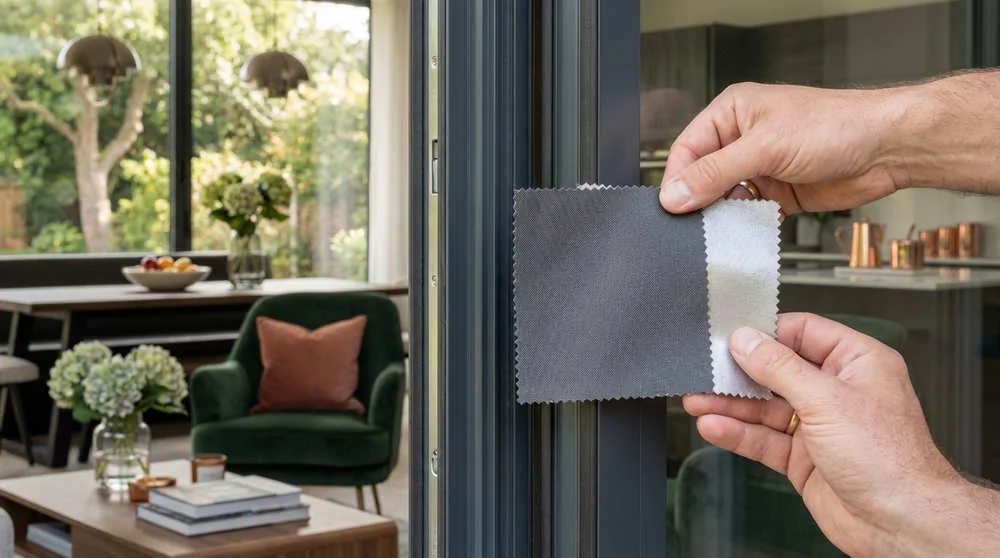
The best of these often feature a reflective backing—essentially a mirror coating on the street-facing side of the fabric. This reflects a huge percentage of that solar heat and UV radiation back through the glass before it enters the room.
This allows you to have a darker, stylish fabric on the inside to reduce glare and match your decor, while the technology on the back does the heavy lifting.
This approach is central to our S.H.A.D.E. framework. We believe shading is an integral part of the architecture, not just a decoration.
We need to be radically transparent here: these technical fabrics are a significant financial investment. They cost notably more than off-the-shelf polyester blinds. However, we frame this as a choice between buying a cheaper product that covers the window but leaves the room unusable, or investing in a technical solution that actually reclaims the square footage you paid for.
The Invisible Threat Silently Damaging Your Home
It isn’t just the heat you can feel. There is a silent destroyer hidden in that sunlight: UV rays.
I remember a specific case that really highlighted this. A homeowner had just installed stunning, expensive Scandinavian wooden flooring throughout their new extension. It was the centrepiece of the room. One afternoon, they watched a single ray of sunlight stretch across the floorboards and felt a sudden, genuine panic. They realised that this “golden lock of light” was actually a story of destruction in the making.
They knew that natural light contains these “agents of destruction”—UV rays—that silently bleach floors, fade expensive sofas, and ruin artwork. A standard blind selected purely for colour might stop the glare, but unless it has specific UV-blocking properties, that damage continues underneath. This is why performance specifications matter more than just aesthetics.
- Understanding value is critical here: Which electric blind fabrics offer the best value for money?
- To ensure you don’t make a regretful purchase, see our guide: How do I avoid choosing the wrong electric blind fabric? (Key considerations)
The “Goldfish Bowl” Problem: Solving Night-Time Privacy
Heat and glare are daytime battles. But what happens when the sun goes down?
This is the “goldfish bowl” effect. You’re sitting in your lovely, illuminated open-plan space, and suddenly the glass turns into a black mirror. You can’t see out, but anyone outside has a perfect, high-definition view of you. It can feel incredibly exposed.
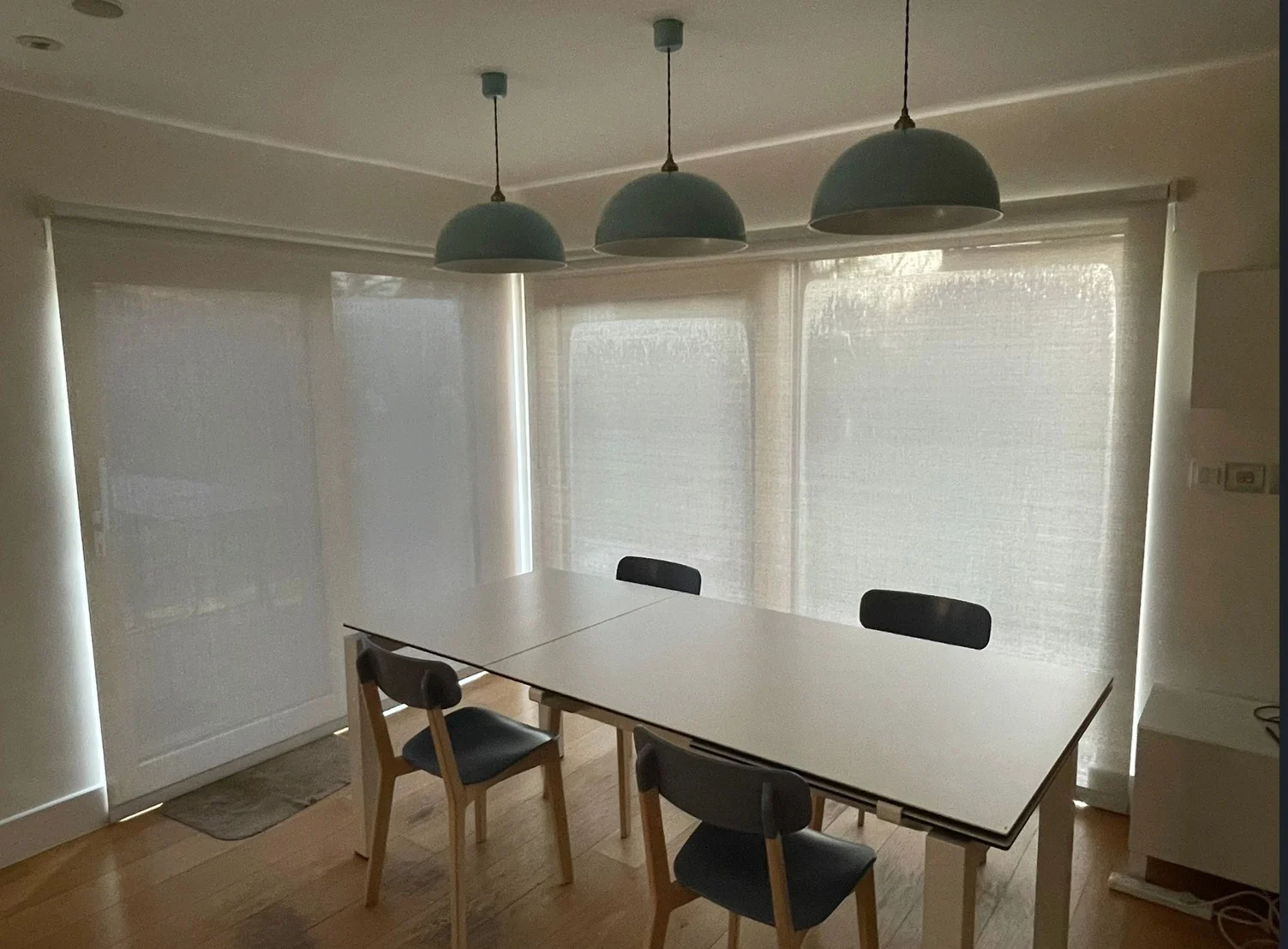
The problem is the compromise. A “screen” fabric (which has tiny holes to let you see the view during the day) becomes transparent at night when the lights are on inside. Conversely, a blackout fabric gives you total privacy at night but blocks your beautiful garden view completely during the day.
- We explore solutions for this specific anxiety here: How do I stop my beautiful glass extension feeling like a goldfish bowl at night?
The No-Compromise Solution: Single vs. Twin Blind Systems
If you want the view during the day and privacy at night, a single blind will always be a compromise. The ultimate answer for total control is a twin blind system (sometimes called day-and-night blinds).
This involves installing two separate blinds, often housed neatly within a single concealed system:
- Blind 1 (Day): A high-performance technical screen fabric. This cuts the heat and glare and blocks UV rays, but still allows you to see your garden.
- Blind 2 (Night): An opaque or blackout fabric that drops down to provide total privacy and a cosy atmosphere in the evening.
It is a higher investment, but it is the only way to get 100% performance 24 hours a day.
- Compare the options to see if this fits your needs: One blind or two? Making sense of single vs twin systems
Enjoy Your Glass Extension, All Year Round
Combining the right engineering with the right fabric is genuinely transformative. We worked with a couple, Duone and Simon, who had built a lovely garden room in Dorset ten years earlier. They had envisioned it as a bright, airy space for family lunches.
The reality was painfully different. The relentless heat and glare made the room so uncomfortable they literally had to wear sunglasses indoors just to see each other across the table. Their dream had slowly faded into a source of frustration.
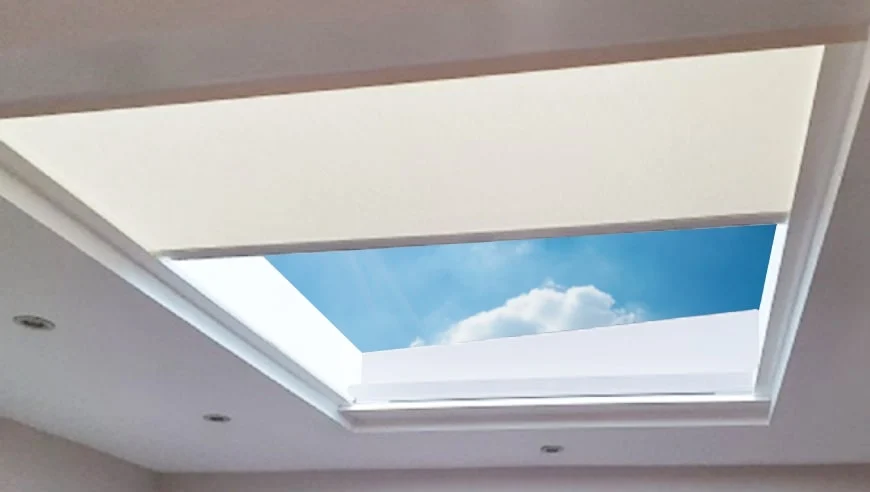
After years of searching, they invested in a specialist roof blind system with us. We used a specific high-performance fabric designed to cut both heat and glare without making the room dark.
The transformation was remarkable. Their garden room finally became the inviting, comfortable space they had planned a decade ago—cherished and usable no matter how brightly the sun was shining.
Your glass extension shouldn’t be a source of stress. By treating the fabric as a piece of technology, not just a colour choice, you can reclaim the stunning space you invested in.
- For a final summary on pulling this all together, read: How do I enjoy my extension with large glass expanses – in every season?
Stop putting up with an uncomfortable room. Call our specialists on 01256 648000 for a friendly chat about your options.
Your next step