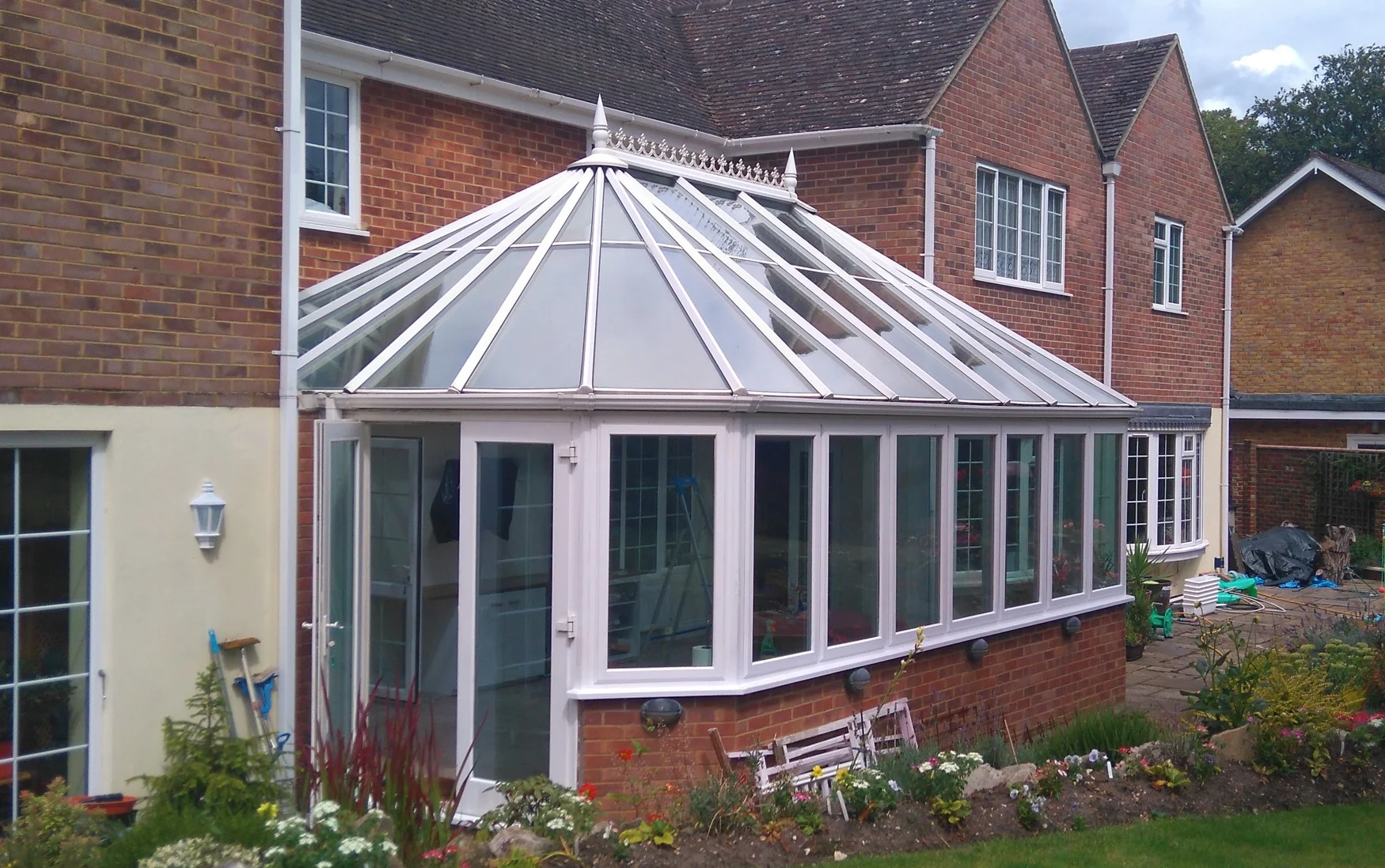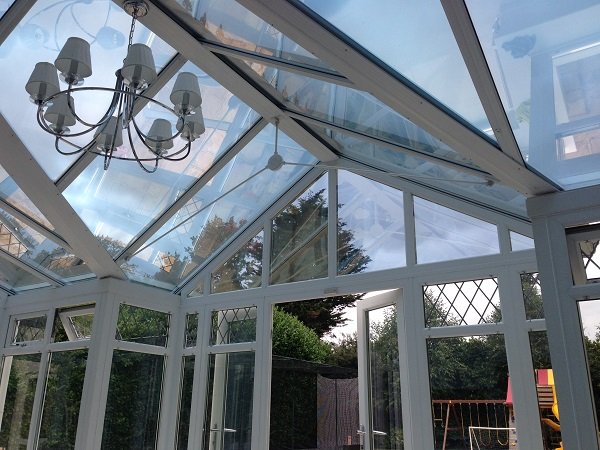
Short answer: on a clear June day, a 10 m² glass conservatory roof facing south lets in about 5.4 kW of solar heat at 1pm, as much as two to three 2 kW fan heaters running at once, and about 45 kWh over the day. Even a shallow roof facing north lets in about 4.2 kW, because a low roof looks up at the sky whichever way it faces.
Use the calculator to work out your own roof, then see the month-by-month table below. The figures are for the heat coming through the glass, which is what makes a conservatory feel like it is cooking you; they are not room temperatures.
Work out your own roof
UK conservatory roof heat calendar
Solar heat coming through 10 m² of shallow (15°) glass roof on a clear day near London: the peak in kW, with the total for the day in kWh underneath. For any other size, scale in proportion: a 20 m² roof lets in twice as much.
| Month | South | East | West | North |
|---|---|---|---|---|
| April | 4.8 kW 36 kWh | 4.2 kW 31 kWh | 4.2 kW 31 kWh | 3.2 kW 25 kWh |
| May | 5.3 kW 43 kWh | 4.8 kW 39 kWh | 4.8 kW 39 kWh | 4.0 kW 36 kWh |
| June | 5.4 kW 45 kWh | 5.0 kW 43 kWh | 5.0 kW 43 kWh | 4.2 kW 40 kWh |
| July | 5.3 kW 43 kWh | 4.8 kW 40 kWh | 4.8 kW 40 kWh | 4.0 kW 36 kWh |
| August | 4.8 kW 36 kWh | 4.2 kW 31 kWh | 4.2 kW 31 kWh | 3.2 kW 26 kWh |
| September | 3.9 kW 26 kWh | 3.2 kW 20 kWh | 3.2 kW 20 kWh | 2.0 kW 13 kWh |
Fit 3M All Seasons 35 inside the roof and every figure in the table falls by about 54%, its reduction in solar heat gain on 3M's double-glazing reference.
What the numbers show
- The heat season is long. A south-facing roof takes in about 4.8 kW at the April peak, nearly 90% of the June figure, and still about 3.9 kW in September.
- Facing matters less than people think on a shallow roof. East and west roofs peak about an hour either side of 1pm at nearly the south figure, and even north-facing shallow roofs let in a lot of heat in summer.
- Low lean-to roofs take the summer sun almost face-on and sit close above your head. That is why, on a low-pitch, low-level lean-to roof, we recommend only 3M All Seasons 35.
How we worked it out
We modelled a clear day on the 21st of each month at latitude 51.5°N using a standard clear-sky model, with 85% of the roof area as glass and the rest as glazing bars. Untreated glass uses a solar factor (g value) of 0.70, the double-glazing reference 3M uses for its figures, with the usual fall-off when the sun strikes the glass at a low angle. Cloud, haze, shading from trees or buildings, and tinted or solar-control roof glass all reduce the real figure, so treat these as the clear-day heat your roof has to deal with. Times are British Summer Time. WindowTreat modelling, November 2026.
Free to use. Journalists, bloggers and other installers are welcome to quote these figures or the table, with a link to this page as the source.
What to do about it
For most glass roofs our pick is 3M All Seasons 35, fitted inside: see our conservatory roof film page for the films we fit, and the results in a Gerrards Cross conservatory and an Amersham sky lantern. Our conservatory window film review covers the films that work and the ones to avoid, and the conservatory roof film cost guide has typical prices. Send us photos of your roof and we will tell you what to expect from yours.