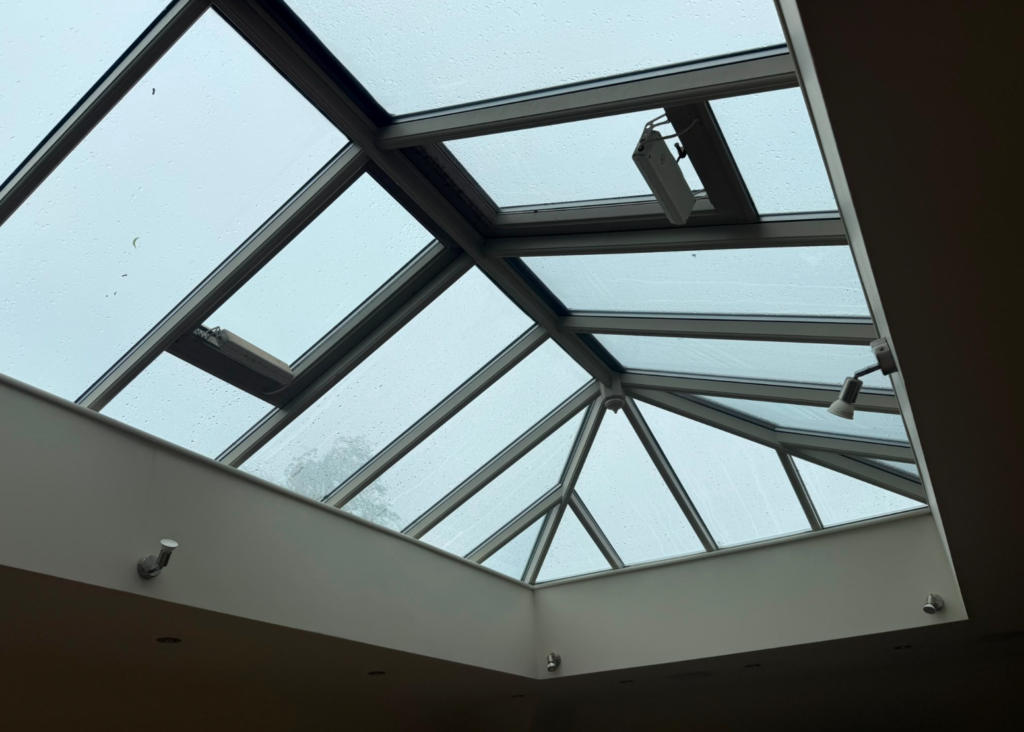
Roof lanterns and skylights bring valuable natural light into a home. However, they can also create excess heat, glare and unmanaged brightness. An interior roof blind helps control these conditions, making carefully designed living spaces more comfortable and usable throughout the year.
Unlike an ordinary window blind, a roof blind operates horizontally beneath the glazing. Therefore, the system must support or tension the fabric across the opening instead of allowing it to hang under its own weight. As the opening becomes larger, the blind’s engineering becomes increasingly important, particularly the system used to tension and control the fabric.
Homeowners can choose from several types of interior roof blind. These include cellular systems such as Honeycomb SKY, constant-tension spring roller blinds such as Venus, and higher-tension torsion-spring systems such as Athena and Hercules XL.
The right choice depends largely on four areas:
- The width and projection of the roof opening
- The expected fabric finish
- The fabric’s ability to control heat and brightness
- The available budget
However, these factors do not work independently. Width and projection affect the tensioning system, fabric options, finished appearance and overall cost. Therefore, the dimensions of the roof opening provide the best place to begin.
The width and projection of the roof opening
Every roof blind starts with two principal measurements. The width runs across the blind, while the projection measures the distance that the blind travels when it closes beneath the glazing.
Both measurements matter. A relatively narrow blind with a long projection can place different demands on a system than a wide blind with a shorter draw. The total fabric area also affects the weight, required tension, box size and finished appearance.
Most importantly, a manufacturer may be able to build a blind to a particular size without guaranteeing that every homeowner will find the fabric finish acceptable. Therefore, we distinguish between what a system can physically cover and the dimensions we recommend for a good result.
Honeycomb SKY cellular roof blinds
Honeycomb SKY uses a cellular, Duette-style fabric rather than a flat roller fabric. This construction creates an intentionally pleated finish and follows a different set of size rules.
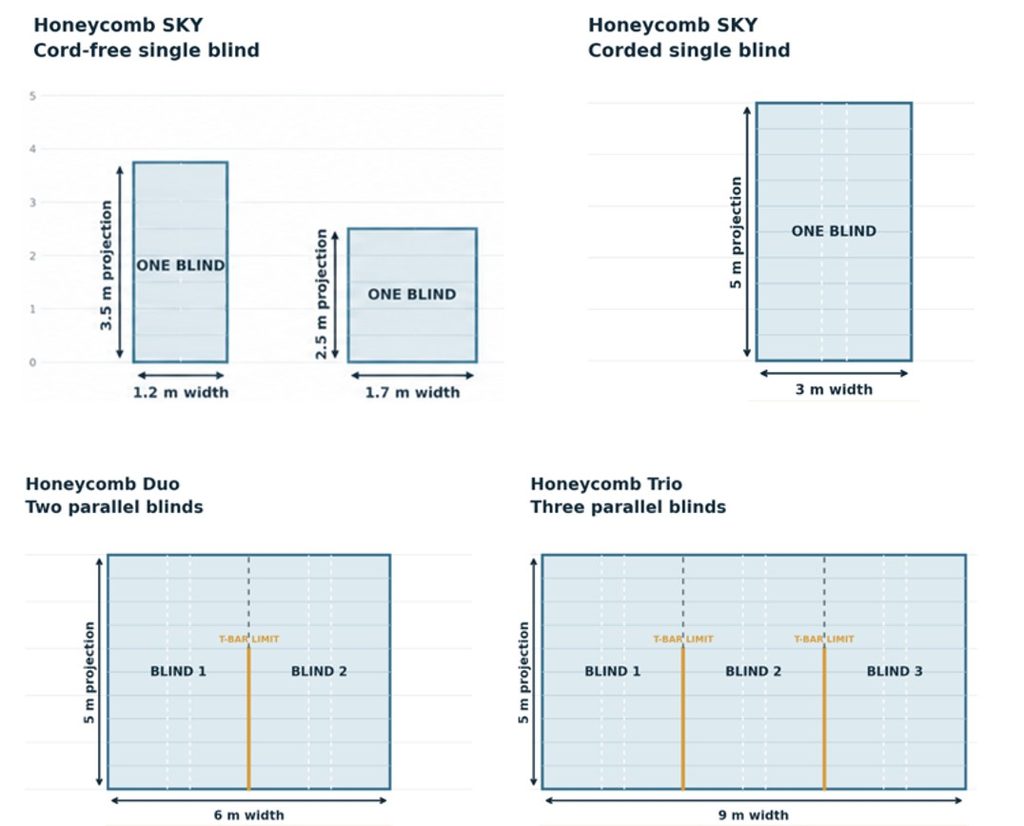
The system can operate without cords across widths of up to approximately 1700mm and projections of up to 2500mm. Longer spans can be reached when narrowing the width. This cord-free format provides the cleanest appearance because no driving cords cross the central area of the fabric.
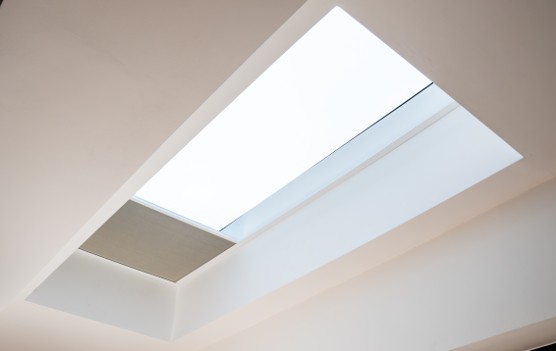
Larger Honeycomb SKY blinds require a series of driving and support cords. A corded single blind can cover openings of up to approximately 3000mm wide by 5000mm projection. For wider roofs, Duo and Trio configurations place two or three blinds in parallel.
These parallel systems can cover substantial roof openings. In addition, T-bars of up to approximately 3000 mm can help manage the junction between blinds and close potential light gaps, subject to the design of the roof.
The cord arrangement changes the appearance of the system. White spooling cords run through the centre of the fabric and work in pairs as part of the extend-and-return mechanism. The pairs sit at intervals across the blind and become visible when the fabric compresses into its stacked position.
Semi-transparent nylon support cords provide additional support between the driving points. These cords also remain visible when the fabric stacks, although they appear less prominent than the white spooling cords.
Therefore, homeowners need to consider more than the maximum dimensions. They should also decide whether the visible cords, required to avoid fabric sag, and multiple-blind junctions suit their expectations for the room.
Venus CTS roof blinds
The Venus uses CONSTON tension springs known as CTS units. Two CTS units sit inside a tension box opposite the headbox and pull the roller fabric across the opening.
In principle, manufacturers can produce CTS systems to large sizes. However, the practical decision should focus on how the fabric finish will look, especially when the blind reaches its fully extended shading position.
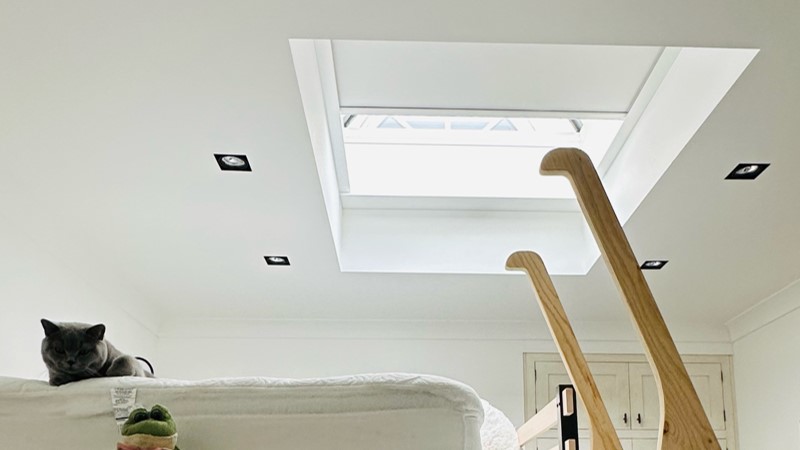
A CTS system gradually loses fabric tension as the blind extends. Consequently, the system provides its weakest tension when the fabric covers the roof glazing and the homeowner can see the largest area of it. Wider or longer blinds can show more waviness, rippling and deflection at this point.
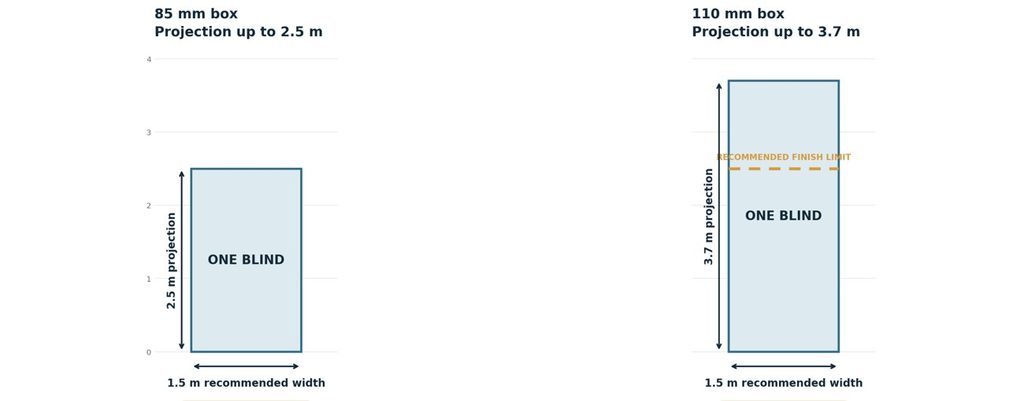
Box capacity also limits the projection. An 85 mm box can accommodate enough fabric for a projection of up to approximately 2,500 mm. Beyond this point, the rolled fabric needs more space. Therefore, the system moves to a 110 mm box, which can accommodate projections of up to approximately 3,700 mm.
Although the larger box creates more capacity, it does not solve the reduction in fabric tension. At these dimensions, homeowners should consider whether a higher-tension torsion-spring system such as the Athena will provide a better finish.
For this reason, we recommend a maximum working size of approximately 1500mm wide by 2500mm projection for a CTS roof blind when the homeowner expects an acceptable domestic roller-fabric finish. A project may exceed these dimensions, but it requires a careful conversation about appearance before manufacture. A CTS roof blind system will always have limitations on fabric finish at any size.
Athena torsion-spring roof blinds
Athena moves into a different level of fabric control. Its torsion-spring technology maintains approximately three times more tension than a typical CTS system. Crucially, the tension remains consistent as the blind travels, rather than reducing as the fabric extends across the roof.
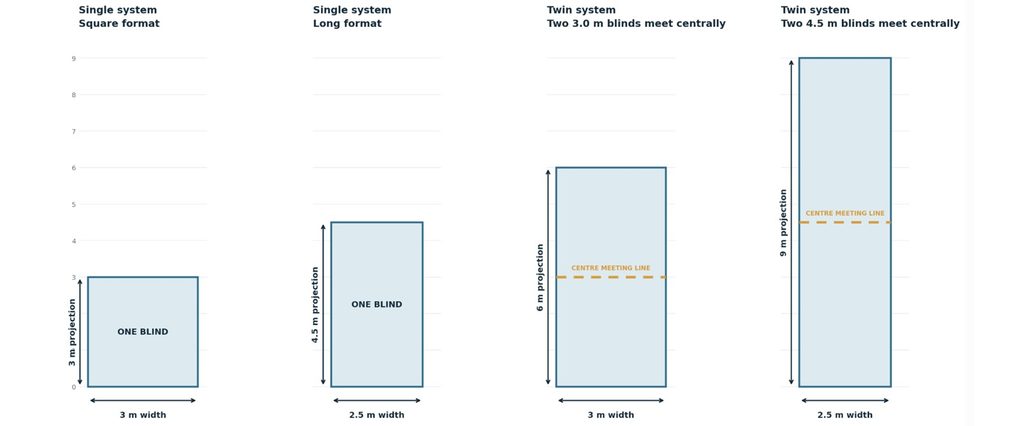
A single Athena blind can cover approximately 3000mm by 3000mm. For narrower but longer roof openings, it can also cover approximately 2500mm wide by 4500mm projection.
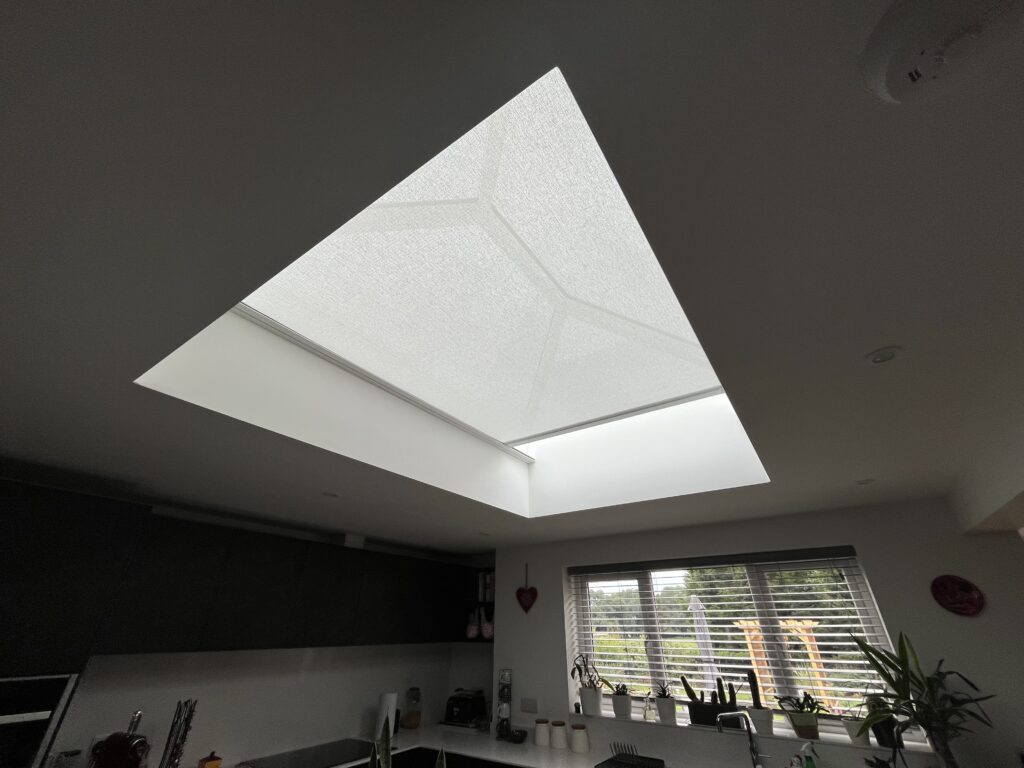
Two three-sided Athena systems can meet in the centre of a roof lantern to cover larger spans. Depending on the proportions, this arrangement can cover approximately 3000mm by 6000mm or 2500mm by 9000mm.
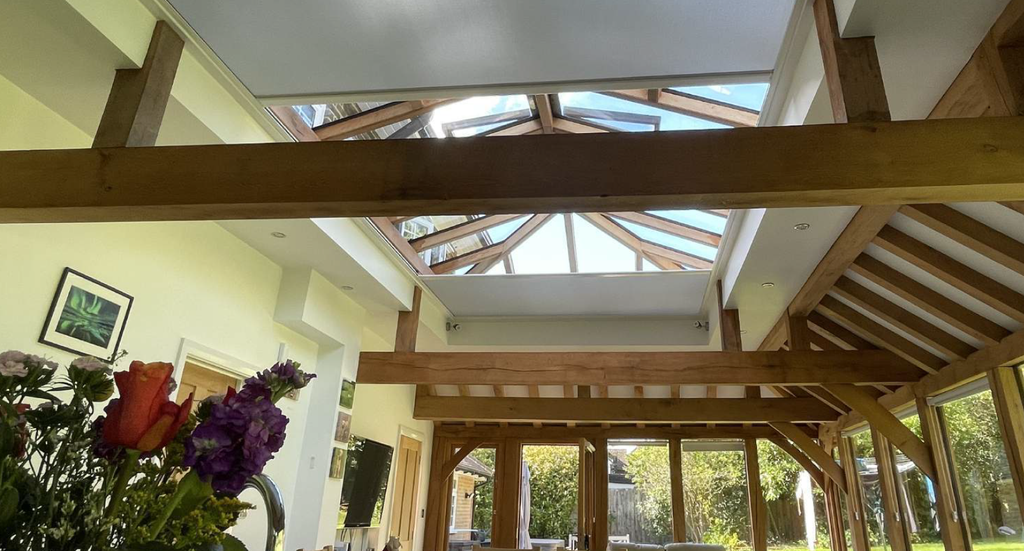
This flexibility makes Athena suitable for small to large roof lanterns and skylights where the homeowner places a high value on fabric finish. This system has the largest portfolio of dimensionally stable fabrics designed to resist its higher fabric tension.
Hercules XL roof blinds
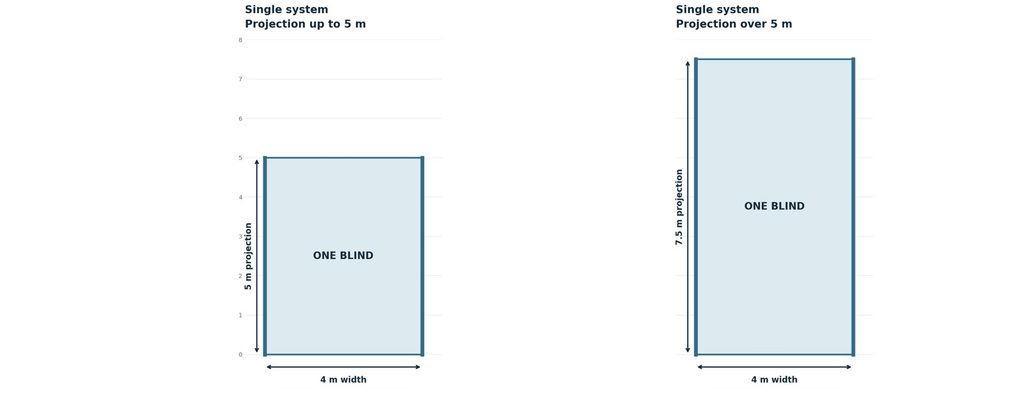
Hercules XL provides the heavy-duty option for exceptionally large roof openings. As standard, a single system can cover approximately 4000mm wide by 7500mm projection.
Its scale makes it a strong choice when a smaller system would require too many individual blinds or create too many junctions across the roof. Hercules XL also uses dimensionally stable fabrics that can withstand the demands of a large, highly tensioned system.
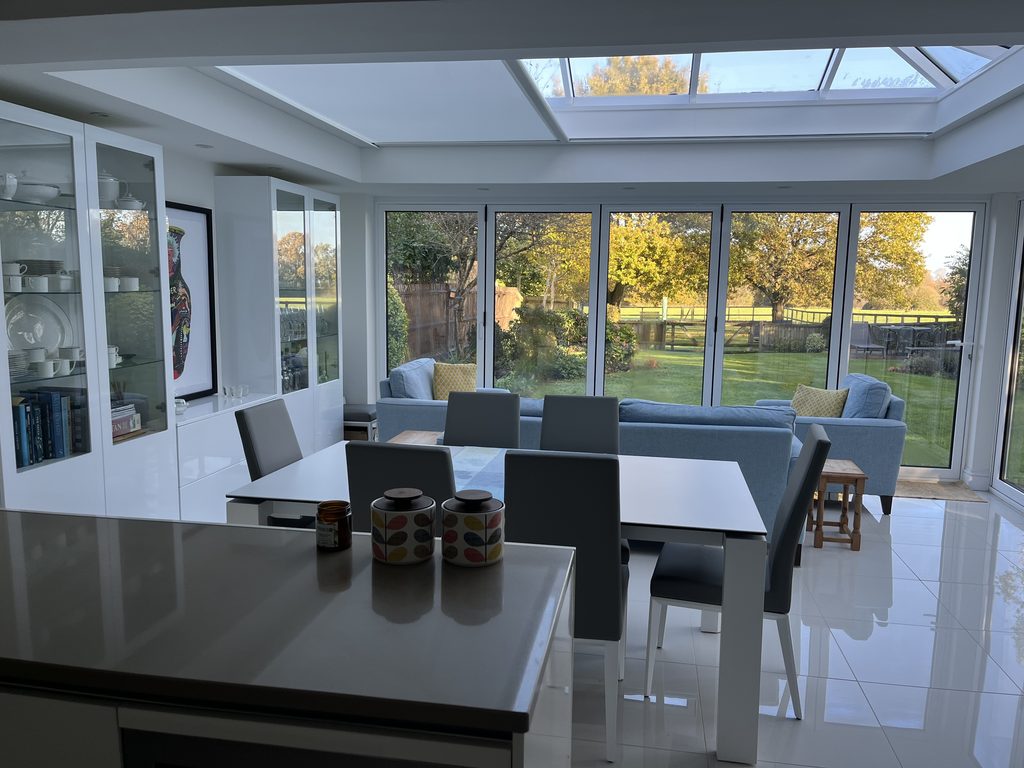
However, its compatible fabric portfolio offers less versatility than the flagship Athena range. Therefore, homeowners need to balance maximum coverage against their preferred fabric appearance and performance.
All dimensions provide an initial guide rather than a final manufacturing specification. The final design must also consider the fabric, installation position, side channels, motor, controls, fixing structure and access.
The expected fabric finish
Once the dimensions establish which systems can cover the opening, the homeowner should decide what they expect the fabric to look like.
This decision often separates an acceptable installation from a disappointing one. Roof blind fabric remains a flexible textile, even when a powerful system tensions it across the opening. Most homeowners want a roof blind that comes as close as possible to the clean appearance of a false ceiling. The choice of system makes a significant difference to the amount of waviness, rippling and sagging visible in the fabric. Most Roof Lantern Blinds Sag. Here’s Why.
A pleated finish with Honeycomb SKY
Honeycomb SKY uses cellular fabric, which gives the blind its distinctive pleated appearance. Homeowners should not compare it directly with the flatter finish of a tensioned roller blind.
Smaller cord-free systems provide the cleanest appearance because they leave the structural opening free from visible cords. This option only suits smaller openings, as cellular fabric cannot withstand the powerful spring tension used in roller blind systems.
For larger openings, Honeycomb SKY uses spooling cords, support cords and, where necessary, multiple parallel blinds because the fabric has a maximum width of 3000mm. These components allow the system to cover larger roof areas, but they also become part of the visible finish.
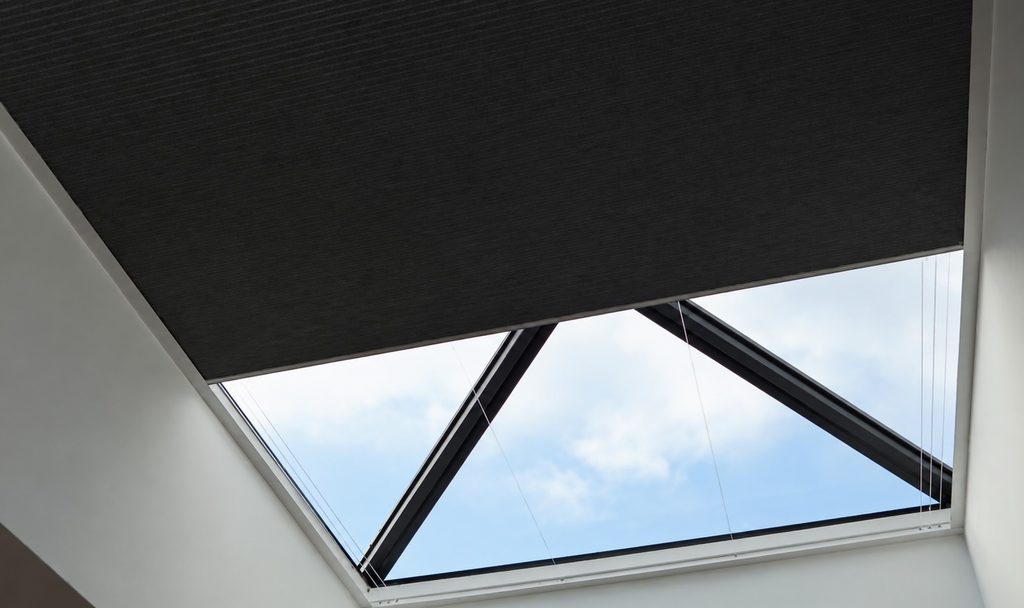
Honeycomb SKY suits homeowners who like the pleated appearance, accept the fabric stack and cord arrangement as part of the design, and need to work within a more modest budget.
A practical roller finish with Venus CTS
The Venus CTS electric roof blind gives homeowners the familiar appearance of roller fabric beneath the glazing. At modest dimensions, it can offer a more cost-effective solution, particularly where the roof requires multiple blinds.
As the blind extends, the system applies less tension to the fabric. This allows greater deflection and surface movement when the blind covers the opening. The CTS mechanism may not pull the zipped fabric edges fully taut, so waviness and rippling can remain visible even on smaller blinds.
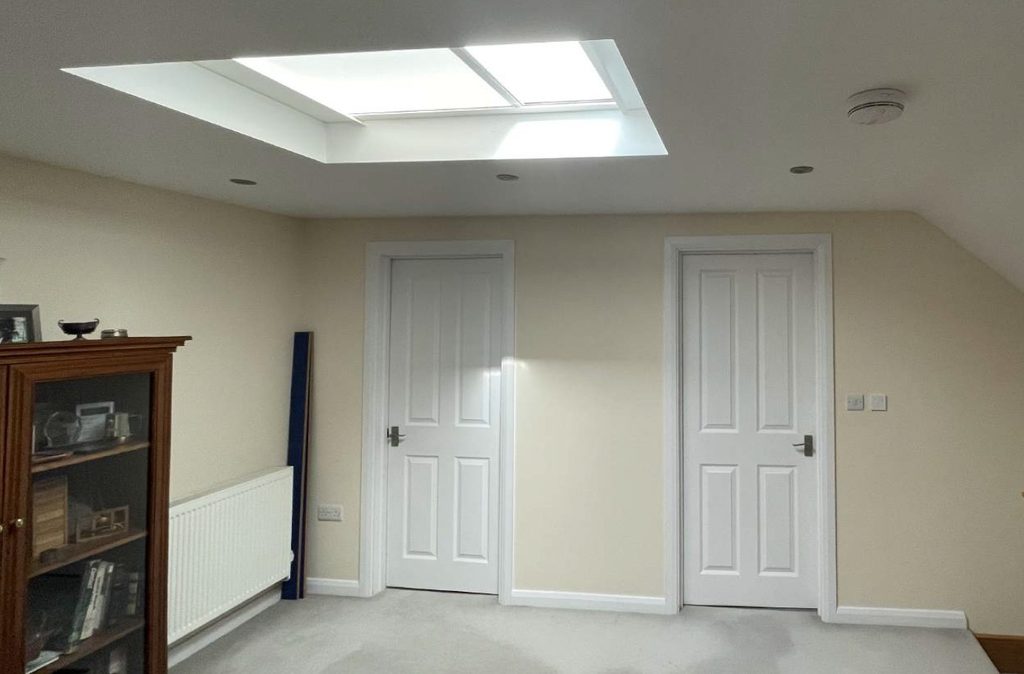
These characteristics do not necessarily indicate a manufacturing fault. They reflect how the CTS system supports flexible fabric across a horizontal opening. Homeowners should understand and accept this appearance before placing an order, especially when considering larger blinds.
For more detail about these natural fabric characteristics, read our guide to why roof blind fabrics sag.
A smoother finish with Athena
Athena applies over three times more fabric tension than a CTS system. This additional force pulls the zipped fabric edges tighter, helping to reduce waviness and rippling. The result is a smoother, more controlled roller-fabric finish, even across larger openings.
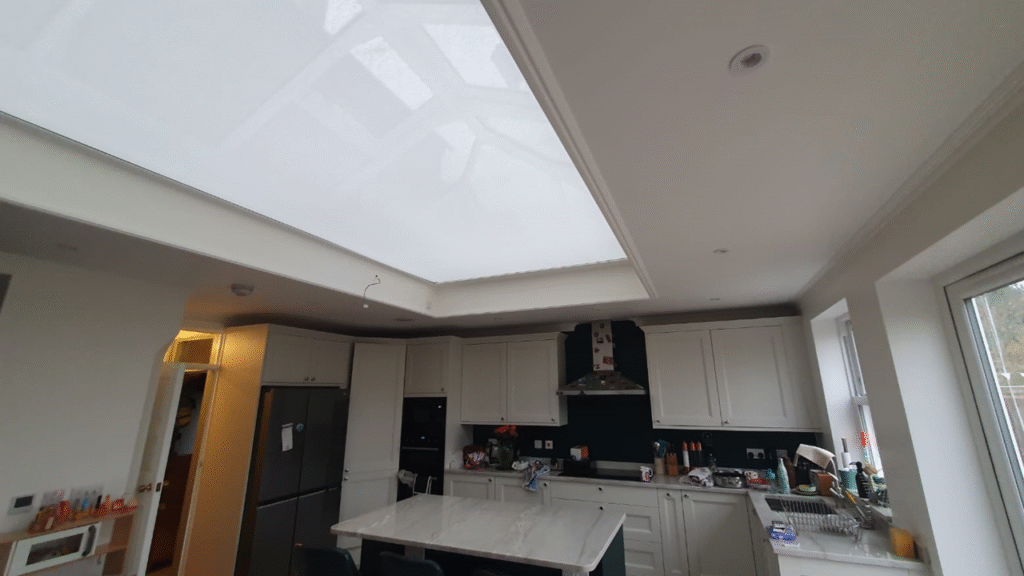
Athena also maintains consistent tension throughout the blind’s travel. It continues to control the fabric when fully extended, preserving the intended finish across the roof opening.
Athena suits projects where the blind will form a prominent part of the interior and the homeowner expects a refined architectural appearance.
Maximum control with Hercules XL
Hercules XL applies the same tensioning principle across much wider openings as a single blind. Its torsion-spring engineering controls a substantial area of fabric where smaller systems would require multiple blinds or may not be suitable.
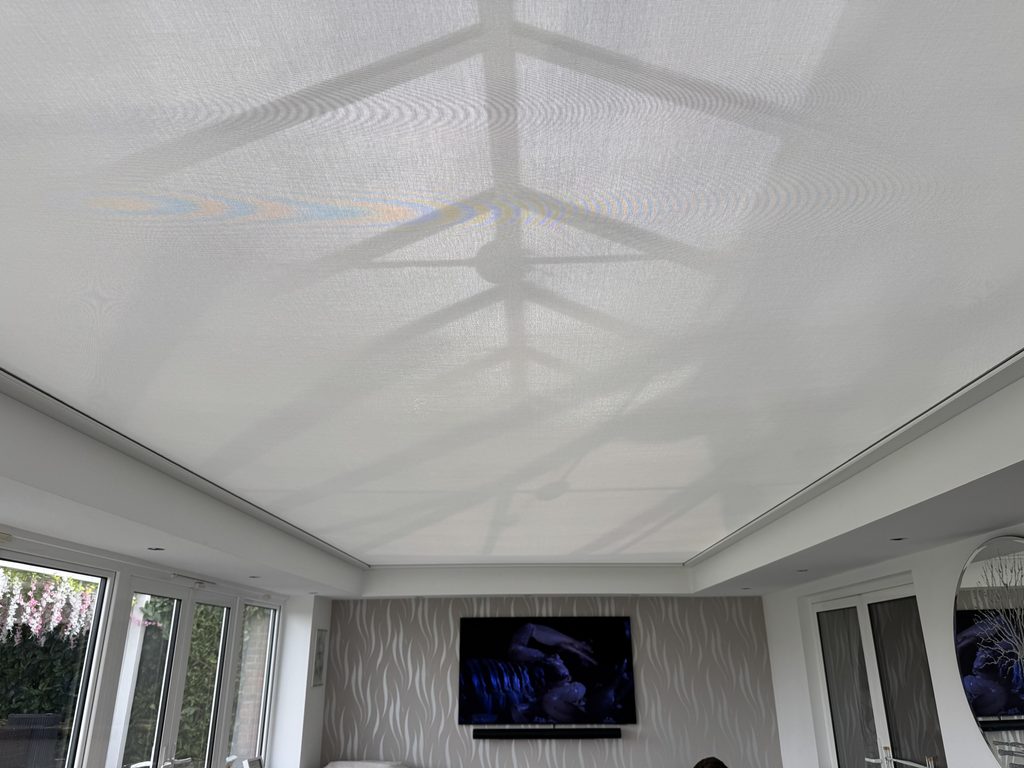
The system applies more than eight times the fabric tension of a CTS system, prioritising scale, strength and fabric control. Some deflection can still occur, particularly with heavier fabrics. At wider sizes, the selected fabric may also require mid-welds, which create visible joins across the blind.
The fabric’s ability to control heat and brightness
The roof blind system determines how well the fabric presents, while the fabric itself plays the central role in improving comfort. Homeowners should therefore choose the system and fabric together.
Performance fabrics offer different qualities and benefits. Some reflect more solar energy back through modern roof glazing, while others excel at controlling glare on screens or reducing the discomfort caused by cold glazing in winter. Every home and living area requires a different balance.
Colour, weave, openness and backing all affect performance and appearance. Each roof blind system also places different demands on the fabric, so the chosen material must remain dimensionally stable when tensioned horizontally across the opening.
Fabric choice for Honeycomb SKY
Honeycomb SKY uses cellular, Duette-style fabrics. The cell structure creates a distinctly different appearance from roller fabric and comes in a broad choice of colours, with either dimout or blackout performance.
The dimout fabric diffuses natural light, improves winter insulation and provides privacy. However, it lacks the solar reflectance needed for effective solar control. Where reducing solar heat gain is the priority, the blackout fabric with its silver internal core offers the stronger solution.
The exposed fabric stack also requires consideration. Dust will collect on the folded material, affecting its appearance and gradually reducing its solar reflectance. Over the first few years, this build-up can diminish even the blackout fabric’s effectiveness as a solar-control solution
Fabric choice for Venus CTS
These fabrics can provide useful heat and brightness control, but they do not require the same degree of dimensional stability as the specialist fabrics developed for high-tension systems. Venus CTS electric roof blinds use a practical but more limited selection from the flagship Athena fabric portfolio.
Fabric weight and construction still matter. The range includes screen fabrics with 1%, 3% and 5% openness factors in different colours, helping homeowners achieve the right balance of heat and light management. It also includes a blackout option.
Fabric choice for The Athena
Athena systems offer the broadest choice of specialised, dimensionally stable fabrics designed to hold their shape under increased tension. Its tested fabric portfolio can address a homeowner’s primary and secondary priorities with one carefully selected fabric, delivering a meaningful improvement in comfort.
If an Athena system falls within the size and configuration limits of your roof lantern or skylight, its extensive performance fabric range is likely to offer the greatest opportunity to improve comfort.
Fabric choice for The Hercules XL
Hercules XL uses only dimensionally stable fabrics designed to withstand the very high loads created across large openings. Its specialist fabric portfolio offers a strong selection, although it is not as versatile as the Athena range.
The available budget
Budget often influences the final choice, but the lowest-priced system does not always provide the best value for a particular roof.
A smaller Honeycomb SKY or Venus blind may provide all the control and finish that a modest opening requires. In contrast, using a CTS system close to or beyond its ideal dimensions may save money initially but leave the homeowner dissatisfied with fabric movement or waviness.
Athena and Hercules XL require a higher investment because they use more substantial engineering, stronger tensioning systems and specialised fabrics. However, that additional investment can produce a smoother finish, cover a larger area and reduce the need to divide the roof into several smaller blinds.
| Roof Blind System | Indicative Dimensions | Expected Fabric Finish | Fabric Performance | Indicative Roof Blind Manufacturing Costs* |
| Honeycomb SKY, cord-free | Up to 1700mm wide × 2500mm | Cellular finish with concertina stack | Limited to Honeycomb Dimout or Blackout | £1300 to £1700 inclusive of VAT |
| Honeycomb SKY, corded | Single blind up to 3000mm × 5000mm, with Duo and Trio options for wider roofs | Pleated finish with concertina stack with visible spooling and support cords | Limited to Honeycomb Dimout or Blackout | £1100 to £3,200 inclusive of VAT |
| Venus CTS | Recommended up to 1500mm × 2500mm | Potential for deflection and waviness | Useful but relatively basic roller-fabric range | £1800 to £2500 inclusive of VAT |
| Single Athena | Up to 3000mm × 3000mm or 2500mm × 4500 mm | Roller finish with three times more fabric tension than CTS | Wide range of specialised, dimensionally stable fabrics | £2850 to £4500 inclusive of VAT |
| Twin Athena | Opposing systems can cover 3000mm × 6000mm or 2500mm × 9000mm | Roller finish with three times more fabric tension than CTS | Wide range of specialised, dimensionally stable fabrics | £4500 to £8000 inclusive of VAT |
| Hercules XL | Up to 4000mm × 7500mm as standard | Heavy-duty dimensionally stable fabric control for large openings. Over 8 times more fabric tension than CTS | A dedicated range of high dimensionally stable fabrics | £4500 to £11,000 inclusive of VAT |
Manufacturing Survey & Installation Costs
A detailed manufacturing survey costs £650.
During this visit, we take the final production measurements, assess the fixing positions and confirm the installation geometry, access requirements and other details needed before the blind enters manufacture.
Installation costs of £1250 for up to two standard tensioned roof blind systems. These systems require millimetre-level accuracy. The headbox, tensioning components and side channels must be carefully positioned and aligned so that the blind operates smoothly and the fabric remains properly controlled. Larger Hercules XL Systems may take much longer due to the amount of fixings required for large sizing.
This is skilled, precise work carried out in a finished home. Our installation team protects the surrounding area, works carefully around your furnishings and leaves the space clean and orderly when the installation is complete.
Unusual access requirements, additional blind systems or necessary preparatory work will be identified and discussed before the order proceeds.
The option of a marketing discount
You can reduce the cost of your electric skylight shading by taking part in our optional marketing scheme. It provides a meaningful discount while helping other homeowners make more confident decisions about improving comfort in their homes.
WindowTreat accepts a smaller margin on selected projects in exchange for:
- Photos and videos of the completed installation, sent to us via WeTransfer
- A scheduled 30-minute video conversation with Steve, our General Manager
- Permission to use agreed parts of the submitted material and recorded conversation in WindowTreat’s marketing
The conversation gives you an opportunity to share your genuine experience of the finished system and any difference it has made to your home.
Which interior electric roof blind should you choose?
Choose Honeycomb SKY when you prefer a cellular, pleated finish and its cord arrangement suits the size of the roof. The smaller cord-free configuration creates the cleanest appearance, while the corded, Duo and Trio formats extend coverage across larger openings. It provides a cost-effective solution, but homeowners should understand the visual limitations of pleated fabrics support cords and fabric stacking, particularly within highly architectural interiors.
Choose Venus CTS when you need a practical roller blind for a modest opening. It can be particularly useful where a project has several smaller roof openings and a limited budget. Keep within the recommended dimensions to avoid disappointment to the finish on the fabric when in the fully extended position. Discover more about this electric roof blind system Venus CTS Electric Roof Blinds: Sizes, Finish, Fabrics, Power and Costs
Choose Athena systems when you want the strongest all-round solution for a roof lantern or skylight. As WindowTreat’s flagship range, Athena offers the broadest selection of tested performance fabrics designed to deliver comfort and a refined appearance within the system’s dimensional parameters. This gives homeowners the greatest opportunity to improve comfort while achieving their preferred interior finish. Discover more about this electric roof blind system Athena Electric Roof Blinds: Sizes, Concealment, Fabrics, Power and Costs
Choose Hercules XL when the opening requires a genuinely heavy-duty system or the homeowner wants a single blind across an exceptionally large area. It excels at controlling large expanses of fabric. Roller roof blinds typically travel at around three metres per minute. On a large roof lantern, two Athena blinds meeting in the centre will deploy or retract faster than a single Hercules XL will. Discover more about this electric roof blind system Hercules XL Electric Roof Blinds: Sizes, Concealment, Fabrics, Power and Costs
Final Thought
The best system must do more than fit the opening. It should produce an acceptable fabric finish, deliver the required heat and light control, complement the interior and remain within a realistic project budget. Athena provides the benchmark solution, while Venus CTS and Honeycomb SKY offer sensible value-engineered alternatives where their dimensions, appearance and performance suit the project.
At this stage, it is worth considering the preferences that will shape your roof blind decision.
Get help choosing your roof blind system
Every roof lantern and skylight presents a different combination of dimensions, fabric requirements and finish expectations.
Book a call back with one of our roof blind specialists using the calander below.
Supporting Links
The Top 9 Priorities To Consider When Understanding Roof Lantern Blinds – WindowTreat
The Top 9 Preferences to Consider When Understanding Roof Lantern Blinds – WindowTreat
Only the Toughest Fabrics Earn a Place in Athena Electric Roof Blind Systems – WindowTreat
Hercules XL Dimensionally Stable Fabric Portfolio for the Largest Roof Lantern Blinds – WindowTreat
Success Story: Sharon’s Electric Roof Blinds Bring Comfort Back to Her Home – WindowTreat
How Claire Transformed Her Orangery with Hercules – WindowTreat