







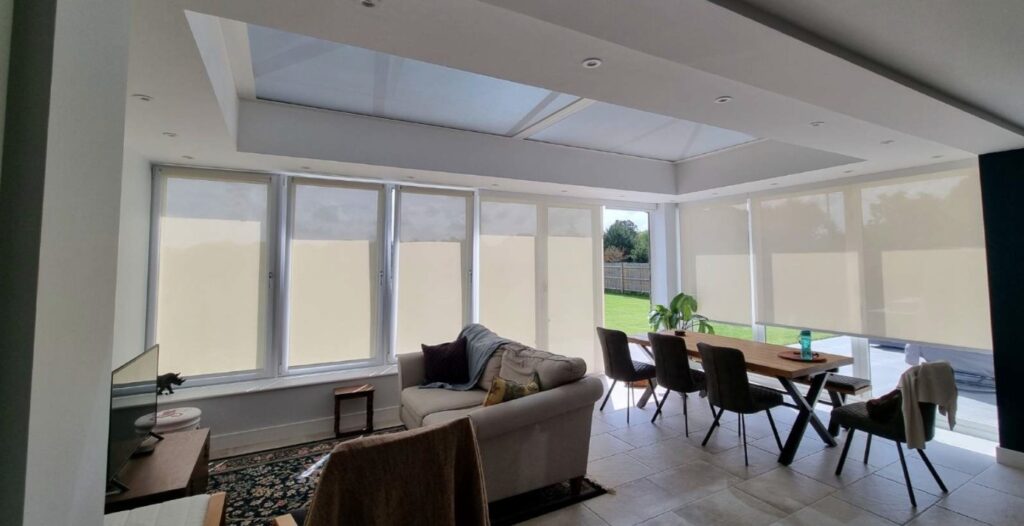
You invested £150,000 or more in a glass extension that promised to transform your home. Instead, it’s too hot in summer, too bright to see a screen, and after dark the whole neighbourhood can see in.
Now you need a solution, without wasting money, creating mess, or choosing something you’ll regret.
This guide covers everything you need to know before investing a single pound. We walk you through realistic pricing, the problems that catch homeowners out, honest comparisons between your options, and crucially, who our specialist solutions are NOT the right fit for.
We don’t just sell electric blinds. We diagnose glazing problems and recommend the right combination of solutions – whether that’s electric blinds 3M window film, electric awnings, or Blindspace concealment systems based on what your space actually needs.
Our goal is to educate you so you can make the best decision. Even if that means you don’t choose us.
Key Insights from This Guide:
- Most homeowners experience shock at the price so we explain exactly what you’re paying for and why
- The single costliest mistake is leaving shading decisions too late in the build process
- A cheap blind on a large roof lantern almost always leads to buying twice
- Electric blinds aren’t always the only answer. Sometimes window film, an external awning, or a combination is the smarter approach
- There are situations where specialist solutions are genuinely not the right fit, and we’re honest about that
- Understanding what drives price up and down puts you back in control of your budget
Quick Reference: Typical Investment Ranges
| Solution Type | Indicative Cost (inc. VAT) |
| Electric Roof Lantern Blind (2m x 3m) | Up to £5,500 |
| Electric Bifold Door Blinds (4m wide) | £3,000 – £5,000 |
| Full Room (2 roof lanterns + 8m bifold) | £12,000 – £17,000 |
| Blindspace® Concealment (roof lantern, supply) | Around £3,500 |
| 3M Window Film (per square metre, installed) | £60 – £200 depending on film type |
| Electric Awning (full-cassette patio or over-glass) | From £3,500 – £7,000+ |
Every project is bespoke. These figures give you a realistic starting point.
What We Mean by “Shading Solutions for Glass Extensions”
We’re not talking about a roller blind from a DIY store or a sheet of tinted film from a hardware shop. We’re talking about engineered shading systems designed for large architectural glazing such as roof lanterns, bifold doors, floor-to-ceiling sliding doors, and expansive conservatory glazing.
At WindowTreat, we work across four specialist product lines, each solving a different part of the glazing comfort puzzle:
Electric Blinds are the core of what we do. These are precision-engineered internal shading systems using high-performance fabrics, robust Somfy motorisation, and tensioning systems designed for large spans. They give you adjustable, on-demand control over heat, glare, and privacy. They’re the right primary solution for most glass extension problems.
3M Window Film works differently. Rather than shading the glass, film upgrades the glass itself permanently improving its thermal performance. Applied directly to the glazing, specialist films can reject up to 97% of infrared heat, block 99% of UV rays all while remaining virtually invisible if necessary. Film is often the right answer for fixed glazing like conservatory side panels, or as a complementary layer alongside blinds for what we call the “belt and braces” approach.
Electric Awnings tackle the problem from the outside. The physics here is compelling: external shading intercepts solar energy before it reaches your glass, making it dramatically more effective at preventing heat build-up than any internal solution alone. Over-glass awnings are particularly relevant for roof glazing that’s being hammered by direct sun, while patio awnings extend your usable outdoor living space.
Blindspace® is a specialist concealment system extruded aluminium housing that recesses into your ceiling or wall during the build phase, allowing electric blinds to disappear completely when retracted. It’s the difference between a visible cassette and a clean, unbroken ceiling line. Blindspace is a separate product that needs to be specified during construction, and it’s the ultimate expression of architectural integration.
Think of it this way: electric blinds give you control. Window film gives the glass itself better performance. Awnings stop heat at the source. And Blindspace makes the whole system invisible.
Most projects benefit from one or two of these. Some need all four. The right answer depends entirely on your space, your problem, and where you are in the build process.
Why Trust This Guide?
WindowTreat specialises in solving heat, glare, and privacy problems caused by large glazing in high-end residential extensions. We’re Trading Standards Approved, SafeContractor accredited, and use Somfy motors with a 5-year warranty. We act as “doctors for glass”, diagnosing the problem before recommending a solution.
What We Will Cover in This Guide:
Use this to jump directly to the section most relevant to your situation, whether you’re still budgeting, already building, or trying to fix an existing problem.
- The core problem – why glass extensions become unusable
- Understanding your options – the four approaches to solving it
- How much is this going to cost?
- What drives price up and down?
- The problems nobody talks about until it’s too late
- Comparing your options – an unbiased breakdown
- Solutions by room type
- The fabric science you need to know
- Smart automation – is it worth it?
- Installation and power
- Blindspace – the concealment system explained
- Running costs and long-term value
- The goldfish bowl problem
- Who specialist shading solutions are NOT for
- How to choose a specialist company
- The S.H.A.D.E. framework
- All articles in this guide
The Core Problem – Why Glass Extensions Become Unusable
Having helped hundreds of homeowners with this exact frustration, the pattern is almost always the same. Someone invests £150,000 or more in a beautiful extension, then discovers parts of it are unusable for months of the year.
Think of it like a performance sports car with no brakes. The glass brings light, views, and connection to the outdoors. But without control, it’s compromised.
This is now so well recognised that UK Building Regulations (Part O) specifically address overheating risk. This means if you’re still in the planning or build phase, designing shading in now isn’t just about comfort – it may be a regulatory requirement you need to address. If your extension is already built without shading designed in, you’re far from alone. Understanding how to enjoy your glass extension in every season starts with accepting that glass alone isn’t enough.
And it’s not always the homeowner’s oversight. We’ve seen stunning designs where common glazing and shading mistakes meant shading was never part of the conversation until it was too late.
The good news? Whether you’re at the planning stage or trying to rescue a finished room, there are effective solutions. The key is matching the right combination to your specific situation.
Understanding Your Options – Four Approaches to Solving the Problem
Before you spend a penny, it helps to understand the landscape. There are four distinct approaches to managing heat, glare, and privacy in a glass extension, and they each work in a fundamentally different way.
Electric Blinds – Adjustable Internal Shading
This is the solution most homeowners think of first, and for good reason. Electric blinds give you on-demand control. You can deploy them when you need shade, retract them when you want the full view. High-performance fabrics can reflect over 80% of solar energy, while dual blind systems let you switch between a sheer screen for daytime glare and a room-darkening layer for night-time privacy.
Electric blinds are the right primary solution for roof lanterns, bifold doors, and sliding doors. They’re adjustable, they work year-round across different conditions, and they’re the most versatile option for most glass extension problems.
3M Window Film – Upgrading the Glass Itself
Window film is a different kind of solution entirely. Instead of adding a physical shade, it permanently changes how your glass performs. Applied directly to the glazing surface, specialist 3M films use multi-layer nanotechnology to reject infrared heat while letting visible light pass through.
Film is particularly effective on fixed glazing such as conservatory side panels, large picture windows, or any glass you can’t easily shade with a blind. It blocks 99% of UV rays (protecting furnishings from fading), reduces glare, and can even improve the thermal insulation of single glazing to perform closer to double. It’s invisible once installed and requires no operation at all.
Where film really comes into its own is as a complement to electric blinds. We often recommend both film to upgrade the base performance of the glass, and blinds for adjustable control on top. It’s a combination very few companies offer because most are either blind specialists or film installers. We do both.
Electric Awnings – Stopping Heat at the Source
Here’s a piece of physics that surprises most homeowners: external shading is significantly more effective than internal shading at preventing heat build-up. The reason is simple as an internal blind manages heat that’s already inside your room. An external awning intercepts it before it ever reaches the glass.
Electric awnings come in two main forms. Patio awnings extend your outdoor living space and provide shade over terrace areas. Over-glass awnings mount directly above roof glazing to shade it from the outside – particularly effective for south-facing roof lanterns that get hammered by direct sun during summer months.
Modern full-cassette awnings are Somfy motorised, retract completely into a sealed aluminium housing to protect the fabric from weather, and can be automated with sun and wind sensors. They’re engineered for UK conditions, not the lightweight garden parasol you might be picturing.
When Helen and Michael in Peckham were struggling with an unbearably hot kitchen under extensive roof glazing, we helped them realise that the most effective approach was tackling the problem from the outside. An external roof blind designed to block over 90% of heat gain transformed their space completely. Even on the hottest days, the room remained bright yet comfortably cool, just as they had originally envisioned.
Blindspace® – Making It All Disappear
Blindspace isn’t a blind. It’s the system that makes your blind invisible.
It’s a specialist concealment system – precision-engineered aluminium housing that recesses into your ceiling or wall cavity during construction. When the blind is retracted, all you see is a clean, unbroken ceiling with a small gap. No visible cassette, no headbox, no hardware. The blind simply appears when you need it and vanishes when you don’t.
Unlike a DIY timber pocket that a builder might fashion, Blindspace features a patented safety hinge cover that sits perfectly flush with the plaster line. It’s designed to house Somfy-motorised roller blinds, including dual systems, and allows full access for servicing through the hinged cover without any damage to your ceiling.
The critical thing to understand about Blindspace is timing. It must be installed during construction, before plasterboarding, as part of the first fix. Retrofitting it into a finished room means cutting into your ceiling, potentially into structural steels, re-plastering, and re-painting – a process that can cost two to three times more than designing it in from the start.
This is precisely why we encourage homeowners to have that initial conversation as early as possible. If you’re still at the design stage, Blindspace is straightforward. If the plaster is dry, we have other elegant options, but the fully concealed look becomes much harder to achieve.
“How Much Is This Going to Cost?” – The Question Everyone Asks First
In our experience specifying systems for large architectural glazing, the initial reaction is almost always the same: shock.
A specialist roof lantern blind can cost as much as the roof lantern itself. That feels wrong, until you understand what you’re paying for. The price reflects precision engineering, not just fabric.
Our honest UK guide to electric blind costs breaks down every factor. For roof lanterns specifically, our roof lantern blind pricing guide explains why these systems sit at the premium end.
Bifold and sliding door blinds present a different challenge. Width rather than gravity. Our bifold and sliding door blind pricing guide walks you through realistic budgets.
Window film sits at a different price point entirely. Depending on the film type and your glazing, installed costs range from around £60 per square metre for standard solar films up to £150–£200 per square metre for premium SolarGard Ecolux insulation film. It’s a significant investment in its own right, but substantially less than blind installation for an equivalent area of glass, and it works 24 hours a day without any operation.
Electric awnings typically start from around £3,500–£4,000 for a quality full-cassette installation, with premium models ranging between £5,500 and £7,000 or more depending on the span and specification. Bioclimatic pergola systems for all-weather outdoor rooms start higher again.
Still feels disproportionate? You wouldn’t question £5,000–£8,000 for a premium kitchen worktop. Our guide on how specialist shading compares to other extension features puts the investment into perspective.
What Drives Price Up and Down?
Concealment is the biggest single cost driver. A blind that disappears into a hidden ceiling pocket requires structural work, specialist Blindspace® components, and coordination with your builder.
Understanding what makes concealed blinds more expensive helps you decide if that investment is right for you. Retrofitting concealment into a finished ceiling can cost two to three times more than designing it in.
Fabric is the other major variable. A standard polyester costs a fraction of a metallised, heat-rejecting technical textile. But only the technical fabric actually solves the heat problem. Our guide to which blind fabrics offer the best value helps you weigh performance against budget.
For window film, the price difference between a basic solar tint and a premium multi-layer nanotechnology film like 3M Prestige is significant – but so is the performance gap. The right film choice depends on your glass type, orientation, and whether heat rejection, insulation, or glare reduction is your primary concern. Getting this wrong risks thermal stress on certain glazing types, which is precisely why professional specification matters.
For awnings, span width is the primary driver. A 3-metre awning costs substantially less than a 6-metre span. Accessories like integrated LED lighting, infrared heaters, and automation sensors add to the investment, though we’d argue a wind sensor isn’t an accessory – it’s essential protection.
Intelligent cost reduction is possible across all products. A visible cassette instead of full concealment, standard fabrics for north-facing windows, or window film on fixed glazing combined with blinds only where you need adjustability – all sensible trade-offs that can bring your project closer to budget.
The Problems Nobody Talks About Until It’s Too Late
In our years helping homeowners, four problems come up again and again. Each one is preventable if you know about it in advance.
The timing regret. For truly concealed blinds, the decision must happen at the design stage. Understanding when to plan electric blinds for your extension is the single most valuable piece of knowledge in this entire guide.
The “buy twice” trap. A cheaper system seems sensible when budgets are stretched. But within months, sagging fabric and poor heat performance lead to deep frustration. We’ve seen homeowners wish they’d known this before buying, and end up paying twice.
The wrong fabric. Choosing by colour alone ignores the physics. A dark fabric absorbs heat and radiates it into your room. Understanding how to avoid choosing the wrong fabric prevents a mistake that’s hard to undo.
The architect oversight. If your architect didn’t plan for blinds, you’re not alone. Shading is frequently overlooked during the design phase. The good news is that elegant retrofit solutions do exist – including surface-mounted blinds with sleek cassettes, battery-powered systems that avoid any wall damage, and window film that can be applied to finished glazing at any stage.
Duone and Simon from Dorset lived with this reality for a full decade. Their garden room was so hot and bright they wore sunglasses indoors. After we installed a high-performance dual blind system, their space was transformed. Their investment wasn’t just in blinds. It was in reclaiming a room they’d lost for ten years.
Comparing Your Options – An Unbiased Breakdown
Here are the key comparisons you’ll need to make.
Internal blinds vs window film. These are not competing solutions – they solve different parts of the problem. Blinds give you adjustable control: deploy them for shade, retract them for full light and views. Film is permanent and can be invisible – it upgrades the glass itself, working around the clock. Film alone won’t give you privacy at night or adjustable light control. Some blinds can improve the thermal performance of the glass. For many homeowners, the smartest approach is both: film on glazing to reduce the base heat load, and blinds on roof lanterns and doors where you need adjustable control or privacy.
Inside vs outside shading. External shading stops heat before it reaches the glass – dramatically more effective for severe overheating. Our inside vs outside shading comparison explains the physics. Electric awnings are the primary external option, particularly for over-glass applications where south-facing roof glazing is creating extreme solar gain. Internal blinds offer more precise control over light and privacy. In the most demanding situations, the answer may be external awning shading combined with internal blinds.
Concealed vs surface-mounted. A concealed blind vanishes into a hidden ceiling pocket using Blindspace®. A surface-mounted blind has a visible but sleek cassette. Our honest comparison of concealed vs surface-mounted helps you decide based on timing and budget, not just aesthetics. If you’re still building, concealment is straightforward. If your room is finished, surface-mounted systems with battery power can be installed with zero mess.
Single vs dual blind. A single blind forces a daily compromise – your view or your comfort. A dual blind system gives you a sheer screen for daytime glare and a room-darkening layer for night-time privacy.
Premium vs budget. The price gap is significant. Our no-nonsense guide to the real difference explains what the extra investment buys in engineering and longevity.
Wondering what you’re actually paying more for with a specialist? Our WindowTreat vs high-street comparison lays out the differences honestly.
Solutions by Room Type
A kitchen has completely different shading needs to a bedroom. Your choices should reflect that.
Kitchens need moisture-resistant, wipeable fabrics and glare control that preserves your garden view. Bedrooms need darkness for sleep.
For homes with wide-span sliding or bifold doors, the engineering challenge is particularly demanding. Our guide to the best blinds for large sliding doors and bifolds covers the technology that prevents sagging across openings up to five metres and beyond.
For conservatories and orangeries with large areas of fixed side glazing, 3M window film can be particularly effective – reducing heat and UV across the entire glass surface without adding any visible hardware, while electric blinds handle the roof panels where adjustable shading is needed most.
And for outdoor living spaces or south-facing terraces, electric awnings create comfortable, shaded areas for entertaining while simultaneously reducing the heat load on adjacent glazing.
The Fabric Science You Need to Know
The fabric is the engine of any electric blind system. Choosing by colour alone is the most common mistake we see.
Solar Reflectance is the hero metric. A fabric with a metallised backing can reflect over 80% of solar energy, keeping your room cool regardless of the colour facing into the room.
Our head to head comparison explains the science in plain English. For homeowners with a severe heat or glare problem, our guide to which fabrics genuinely handle heat and glare best is essential reading.
It’s worth noting that fabric science applies to awnings too. Premium full-cassette awnings use solution-dyed acrylic fabrics – materials engineered to resist fading, rotting, and UV degradation, performing reliably year after year in UK weather conditions. It’s one of the key differences between a specialist awning and a lightweight garden parasol.
Smart Automation. Is It Worth It?
The real value of a smart blind isn’t a remote control. It’s the ability to create automated scenarios – cinema mode, holiday mode, morning sun – where your blinds manage comfort without you lifting a finger.
One of our specialists lives with this technology daily. His blinds close automatically before dusk and open again in the morning. A sun sensor keeps the room comfortable while he’s out. That’s the shift from mechanical blind to intelligent system.
Smart automation extends to awnings too – wind sensors automatically retract an awning when conditions become unsafe, while sun sensors deploy it when shading is needed. It’s hands-off comfort management for both indoors and out.
A customer of ours initially came to us for window film. After we installed it, they were so pleased they invested in smart electric blinds as well. The combined system ended up providing an unexpected benefit – security. The blinds were programmed to close at dusk, and lights came on behind them in sequence, creating a convincing illusion of occupancy when the family was away on holiday. It’s a perfect example of how modern shading systems can work together to deliver benefits far beyond basic light control.
Our honest look at the pros and cons of smart electric blinds covers the genuine benefits, the real costs, and who smart blinds are not for.
Installation and Power
The biggest fear is mess. You’ve just finished a pristine room. The last thing you want is channels chased into your new plasterwork.
Modern battery technology offers a clean alternative. Our guide to powering electric blinds in a finished room without mess explains how high-performance battery motors can be installed with zero wall damage.
Window film installation is completely non-invasive. A professional application involves cleaning the glass, floating the film onto the surface, and squeegeeing it into place. There’s a curing period of up to 30 days as the adhesive fully bonds, but there’s no structural work, no wiring, and no disruption to your room.
Awning installation does require fixing to an external wall, typically above the glazing. For single-storey extensions, this sometimes needs spreader plates to distribute the load safely. A dedicated electrical spur is required for the motor, but this is a straightforward job for a qualified electrician.
Curious about the full blinds process? Our step-by-step installation guide covers what a respectful, professional installation looks like. And for homeowners adding blinds to a completed extension, our honest guide to retrofitting electric blinds sets realistic expectations.
Blindspace® – The Concealment System Explained
Concealment means the blind disappears completely into a hidden ceiling pocket when retracted. It’s the ultimate in architectural integration, and it requires early planning.
Blindspace® is the industry-standard system for achieving this. It’s not a DIY timber pocket fashioned by a builder – it’s a precision-engineered, extruded aluminium housing with a patented safety hinge cover that sits flush with your plastered ceiling. When closed, all you see is a small gap. When open, the blind deploys smoothly below.
What makes Blindspace a distinct product rather than just an installation option is the engineering involved. The housing accommodates single or dual blind systems, allows full motor access through the hinged cover for servicing, and integrates with the skim-coat plaster line so seamlessly that the join is invisible. Standard Blindspace boxes measure 100mm x 100mm for standard roller blinds, with larger 130mm-deep options for dual systems or longer fabric drops.
An architect couple we worked with, Pavla and Piers, designed a secret star-gazing ceiling in their Fulham home. A concealed blackout blind emerges from a hidden recess, keeps the fabric perfectly taut, and vanishes completely to reveal the night sky. That result was only possible because they planned for it during the build.
Worried about reliability? Our guide explains exactly what happens if concealed blinds need attention inside the ceiling. Modern Blindspace® systems are designed for full access through the hinged cover – no damage, no drama.
The timing point bears repeating: Blindspace must be installed before plasterboarding, as part of the first fix. If your build is still at the design or structural stage, specifying Blindspace is straightforward and relatively cost-effective. If the plaster is already dry, retrofitting becomes significantly more invasive and expensive. For finished rooms, a surface-mounted cassette system is typically the more practical choice.
Running Costs and Long-Term Value
A quality electric blind costs approximately 18 pence per year to run. That’s not a typo.
Window film has no running cost at all – once installed, it works passively, permanently, and silently. Premium 3M films carry warranties of up to 10 years for exterior applications and even longer for interior films.
Electric awnings draw minimal power and, with proper care, deliver years of reliable service. Premium full-cassette models protect the fabric from weather when retracted, which is the single biggest factor in long-term awning longevity.
The real long-term cost across all products comes from choosing a cheap system that fails. Our guide to maintenance and running costs explains why initial quality determines everything about your ten-year ownership experience.
The Goldfish Bowl Problem
Those beautiful glass walls that connect you to the garden during the day? At night, they reverse. Your lights turn them into mirrors on the inside and a brightly lit stage for the outside world.
A dual blind system solves this completely. Our guide to stopping your extension feeling like a goldfish bowl explains the sheer-plus-room-darkening approach that gives you privacy without sacrificing your daytime view.
It’s worth knowing that window film can complement this too. Certain films, such as 3M Night Vision, are specifically designed with low internal reflectivity, meaning you can see out more clearly at night than with standard glass. Combined with blinds for full privacy when you want it, this creates a genuinely flexible system.
Who Are Specialist Shading Solutions NOT For?
We’d rather be honest now than waste your time later.
Specialist shading solutions are not the right fit if:
- You have small, standard windows – an off-the-shelf blind from a high-street retailer will do the job perfectly
- Your only priority is the lowest possible price – our systems are engineered for performance and longevity, not for competing on price alone
- You prefer a DIY approach – large architectural blinds, professional window film, and electric awnings all require specialist installation for safety and performance
- You don’t have significant heat, glare, or privacy issues – if your room is comfortable, you don’t need what we offer
- Your budget is under £3,000 for a single electric blind installation. The engineering required for large glazing starts above this threshold
We’re not the right fit for everyone. We’d genuinely prefer to tell you that upfront than set you up for disappointment.
How to Choose a Specialist Company
The best way to judge a specialist is by their process, not their product catalogue.
Do they ask about how you use the space before recommending a product? Do they discuss fabric performance, not just colour? Can they explain the engineering behind their tensioning systems? Do they consider whether film, an awning, or a combination might be a better fit or do they only sell one product?
A true specialist diagnoses first and recommends second. If the first conversation feels like a sales pitch rather than a consultation, that tells you everything.
Our guide to what to look for when choosing a specialist electric blind company gives you five clear questions to ask any company you’re considering.
The S.H.A.D.E. Framework
We developed S.H.A.D.E. Shading designed in, Human-centred, Architectural intent, Directing light, Environmental performance We kept seeing the same thing. Beautiful homes, stunning glazing, but shading treated as an afterthought.
S.H.A.D.E. is a simple principle. Shading is part of architecture, not an accessory. Design it in from day one, and your home lives up to its promise. It applies equally to electric blinds, window film, external awnings, and concealment systems. Any shading decision benefits from being considered early, as part of the design, rather than bolted on afterwards.
Our S.H.A.D.E. guide for homeowners explains what this means for your project. If you’re working with an architect, our S.H.A.D.E. guide for architects provides the technical framework they need.
Frequently Asked Questions
Can I get specialist electric blinds fitted to a room that’s already finished? Yes. Battery-powered systems can be fitted cleanly without chasing walls or re-plastering. The main compromise is that fully concealed Blindspace® systems are difficult to achieve without some structural work. For finished rooms, surface-mounted cassettes or window film are often the most practical starting points.
Will electric blinds make my room completely dark? We prefer the term “room darkening.” Blackout fabrics block light through the material, but light can still find its way around edges. Zip-tensioned systems with side channels get closest to total darkness.
Are electric blinds safe for homes with young children? Yes. Electric blinds eliminate dangling cords entirely, removing a significant safety hazard.
What happens if the motor fails? Somfy motors come with a 5-year warranty and are designed for years of reliable daily use. In concealed installations, Blindspace® access panels allow servicing without damaging your ceiling.
Do I need to involve my architect? For concealed Blindspace® systems, yes and the earlier the better. We can liaise directly with them or your builders. For surface-mounted or battery-powered blinds, or for window film, we can work directly with you.
Can electric blinds integrate with my smart home system? Yes. Systems using Somfy motors integrate with Google Home, Amazon Alexa, and more sophisticated platforms such as Control 4 or Loxone.
Is window film visible once installed? Premium films like the 3M Prestige range are designed for maximum clarity. Most visitors won’t notice it’s there. Some films have a tint that actually improves comfort by reducing glare.
Can awnings withstand UK weather? Premium full-cassette electric awnings are engineered for UK conditions. Wind sensors automatically retract the awning when gusts pick up, and the sealed cassette housing protects the fabric when not in use. They’re a world apart from the manual garden awnings you might have seen.
Your Next Step – From Overwhelmed to Informed
You’ve now covered more ground on this subject than most homeowners ever do. You understand the costs, the problems, the options, and the pitfalls.
If you’re still in the planning stages, the most valuable thing you can do is have an early conversation. It costs nothing and could save you thousands in avoided mistakes. We can assess whether you need electric blinds, window film, external shading, concealment, or a combination – and when in your build timeline each decision needs to happen.
Sometimes the honest answer is “you don’t need us.” We’d rather tell you that upfront.
Bood a Free Call Back – will allow our experts to explore your options with no pressure.
Or simply call 01256 345580 for a friendly chat.
All Articles in This Guide
Understanding Costs
- How much do electric blinds really cost? An honest UK guide A full breakdown of what drives prices, what you’re paying for, and where you fit in the market.
- How much do electric roof lantern blinds cost? Why roof blinds cost more than you expect, and what makes the engineering worth it.
- How much do electric blinds cost for bifold and sliding doors? Realistic pricing for wide-span door blinds, including the dual blind option.
- What makes concealed electric blinds more expensive? Exactly where the extra investment goes when you choose full concealment.
- Which electric blind fabrics offer best value for money? How to match fabric technology to your specific problem without overspending.
- How does specialist shading compare to other extension features? Putting the cost of shading alongside worktops, flooring, and doors.
- What are the real maintenance and running costs? Why running costs are negligible and initial quality determines everything.
Avoiding Common Mistakes
- When is the right time to plan electric blinds? The most important timing decision you’ll make in your entire project.
- What do homeowners wish they’d known? Hard-won lessons from real projects, distilled into two rules.
- How to avoid choosing the wrong electric blind fabric Why function must come before fashion when choosing fabrics.
- What common glazing mistakes do architects make? The comfort-vs-concept gap, and how to bridge it.
- My architect didn’t plan for blinds – is it too late? Honest options when the ideal planning window has passed.
Comparing Your Options
- Concealed or surface-mounted – how to choose The purity vs practicality trade-off explained clearly.
- Single vs twin blind systems Why two blinds often solve the compromise that one cannot.
- Inside vs outside shading – which is best? The physics of stopping heat vs managing it.
- Premium vs budget electric blinds – the real difference What the price gap actually buys you in engineering and longevity.
- WindowTreat vs high-street blinds An open look at what you’re paying more for.
- Blind fabrics compared for heat and light control A straightforward comparison of fabric types with performance data.
- Which fabrics genuinely handle heat and glare best? Why metallised fabrics overcome the dark-vs-light compromise.
Solutions for Specific Spaces
- How to enjoy your glass extension in every season Moving from a room of extremes to year-round comfort.
- Best blinds for large sliding doors and bifolds Why scale demands specialism, and what technology prevents sagging.
- How to stop the goldfish bowl feeling at night The dual blind approach to privacy without penalty.
Installation and Reliability
- How to power electric blinds without wrecking walls Battery solutions that keep your finished room intact.
- The specialist blind installation process explained What to expect from first call to final fitting.
- What to know about retrofitting electric blinds Honest pros, cons, and what’s realistically achievable.
- What happens if concealed blinds break inside the ceiling? Why modern Blindspace® systems are designed for access, not anxiety.
Smart Features and Automation
- Smart electric blinds – the real pros and cons What automation genuinely offers, and who it’s not for.
Choosing the Right Partner
- What to look for in a specialist electric blind company Five questions that separate real specialists from salespeople.
The S.H.A.D.E. Framework
- S.H.A.D.E. explained for homeowners Why shading is part of architecture, not a finishing touch.
- S.H.A.D.E. explained for architects The technical framework for integrating shading from RIBA Stage 2.
Coming Soon: Window Film and External Shading
We’re building out dedicated articles covering 3M window film solutions and electric awnings in the same depth as our electric blinds content. In the meantime, if you have questions about film, awnings, or how they might complement blinds in your project, call 01256 345580 or book a free call back.