








You are likely here because you want the comfort of electric blinds, but you are worried about the physical reality of getting them into your home.
You might be thinking, “Will they damage my newly plastered walls?” or “Is it too late to chase in the cables?”
We understand that fear completely.
Our goal is to educate you so you can make the best decision, even if that means you don’t buy from us.
What is Installation & Power?
In the world of specialist shading, Installation & Power refers to the precise physical integration of the system and the electrical infrastructure required to make it move.
It covers everything from the “first fix” wiring in a new build to the retrofitting of battery motors in a finished room without damaging the decor.
What we will cover in this 2026 Guide:
- The Installation Journey: What to Expect
- Powering Your Blinds: Hardwired vs. Battery
- Retrofitting: Is It Too Late?
- Concealed vs. Surface Mounting Implications
The Installation Journey
A truly professional installation creates peace of mind, not dust.
Many homeowners worry that the final stage of their project will be chaotic.
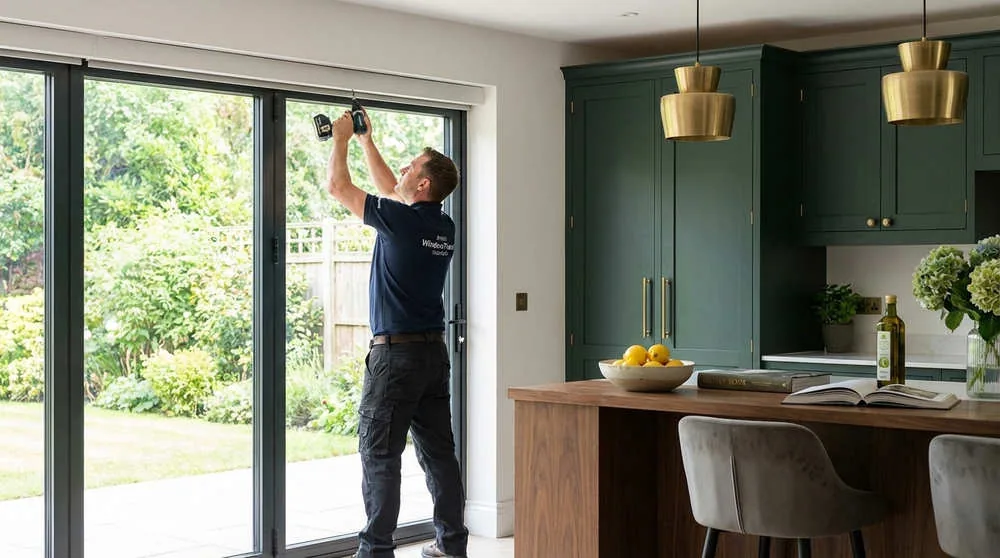
However, a specialist installation process is designed to be quiet, respectful, and meticulously clean.
It begins long before the van arrives, with a detailed survey to understand the nuances of your architecture.
On the day itself, the first priority is protection.
Installers should use heavy-duty coverings for your floors and dust extraction tools that capture debris at the source.
You should expect a comprehensive handover where the team demonstrates exactly how your new system works.
This ensures you are left with a working solution, not a list of questions.
Learn more in our detailed article: What is the actual installation process for specialist blinds, from first call to final fitting?
Powering Your Blinds
The best power source depends entirely on the current stage of your build.
If you are in the early stages of a project, hardwiring is the gold standard.
Running cables to a fused spur during the “first fix” ensures your blinds have a permanent power supply.
However, many homeowners come to us when the room is already finished.
In this scenario, you might fear that you have missed the opportunity or face the nightmare of chasing cables into pristine plaster.
This is where modern technology changes the game.
We champion battery solutions for finished rooms that require zero structural disruption.
These high-performance motors are powerful enough to lift large blinds and typically only need recharging once a year.
A Real-World Example: Duone & Simon
Duone and Simon built a beautiful garden room in Dorset but found it uncomfortably hot.
Ten years after the build, they wanted a solution but were terrified of wires ruining their finished decor.
We installed a high-performance, battery-powered roof blind system.
The installation was clean and discreet, with absolutely no damage to their existing room.
They achieved full automation without a single cable chase, proving you don’t have to compromise on the finish to get the functionality.
Learn more in our detailed article: How do you get power to electric blinds in a finished room without ruining the finish?
Retrofitting: Is It Too Late?
It is almost never too late to install a high-performance shading solution.
You rarely have to choose between ‘perfect’ and ‘nothing.’
It is usually a choice between a pre-planned “invisible” system and a beautifully “elegant” retrofit.
While we always advocate for early planning, a high-quality retrofit can still look stunning.
We use sleek cassettes that can be colour-matched to your window frames, making them look like an intentional part of the design.
Solving Complex Problems: Helen & Michael
Helen and Michael in Peckham faced a massive heat problem in their kitchen extension.
The space was unbearable in summer.
By retrofitting an external blind (The Artemis), they blocked over 90% of the heat before it entered the glass.
This complex installation transformed a beautiful but unusable room into a comfortable living space.
It demonstrates that even if you didn’t plan for it during the build, effective solutions are available that can save your room.
Learn more in our detailed article: What should I know about retrofitting electric blinds? (Pros and cons)
Concealed vs. Surface Mounting
Concealment requires early planning; surface mounting offers flexibility.
If you want your blinds to disappear completely into the ceiling, you must plan for “blind pockets” during the architectural design phase.
This involves structural work that is difficult to replicate once the ceiling is closed.
However, surface mounting is the practical answer for finished homes.
While you will see the headbox, a specialist installation ensures it is minimal and discreet.
The “right” choice is often dictated by your timeline.
If your plaster is dry, a high-quality surface-mounted system is the logical, cost-effective, and non-disruptive path to comfort.
Learn more in our detailed article: What is the actual installation process for specialist blinds, from first call to final fitting?
Frequently Asked Questions about Installation & Power
Q: Can I install electric blinds without an electrician? A: Yes. If you choose a battery-powered system, our installers can fit it without needing to touch your home’s wiring.
Q: Will the installation create a mess in my finished room? A: No. We use professional dust extraction tools and extensive floor protection to ensure your home is left exactly as we found it.
Q: How often do I need to charge battery blinds? A: Modern high-performance batteries typically last around 6 to 12 months on a single charge, depending on usage.
Protecting Your Investment
The physical installation is the final step in bringing your vision to life.
By understanding your power options and the reality of the process, you can move forward without fear of disruption.
We follow the S.H.A.D.E. principle to ensure that the “Architectural Intent” of your home is respected, regardless of when you choose to install.
Do not let the fear of mess stop you from reclaiming your room.
If you are ready to explore the right solution for your home, the next step is simple.
Book your consultation to discuss your project.