Winter sunshine is one of the pleasures of a bright, well-glazed room. So, if that same room becomes uncomfortably hot in summer, it is reasonable to wonder whether solar control window film will solve one problem by creating another.
The short answer is: not usually. Window film reduces some solar heat throughout the year, but it does not remove winter sunshine altogether. More importantly, not all the warmth entering through the glass is warmth your home can use. Once the room is comfortable, additional solar gain simply becomes excess heat to manage, even on a cold day.
This article examines that trade-off properly. It looks at the possible loss of useful winter warmth, the evidence on heating and cooling energy, and why modern glazing and a warming climate are strengthening the case for controlling summer overheating.
Does solar control window film block useful winter sunshine?
It reduces some of the sun’s heat throughout the year, including winter. It still admits daylight and solar energy; how much depends on the film and your glazing. The key question is how much of the warmth being reduced could your room actually use?
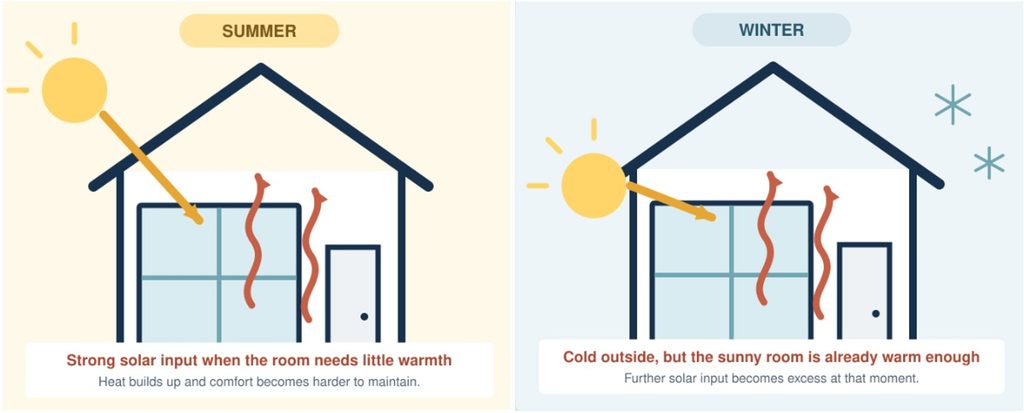
The warmth you feel on a sunny winter afternoon is real. It can make a room more pleasant and reduce the heating needed. Reducing useful solar warmth can mean using more heating on those days. Yet that familiar experience represents only part of the winter.
The days are short. Cloud, neighbouring buildings and the direction of your windows affect how much solar energy reaches the glass. Some warmth can be stored in floors and walls for later, but ordinary rooms cannot carry a sunny afternoon’s heat through a run of cold, dull days.
There is another limit. The room can receive more warmth than it needs. A bright, well-glazed room can become uncomfortable even when it is cold outside. If you find yourself opening a window to release the heat, preserving every bit of that solar gain is doing little for your comfort.
“Free heat is useful when it provides warmth you need. Once there is too much, it just becomes something to manage.”
Winter sunshine can be useful, but once the room has enough warmth, additional solar gain must still be managed
Building energy calculations recognise this distinction between incoming heat and the proportion a home can use. SAP energy assessment methodology
The expert who built houses to collect sunshine, then changed his mind
Building scientist and engineer Joseph Lstiburek once believed strongly in collecting solar heat through windows. In 1980, he built two houses designed around that idea.
They used an approach known as “mass and glass”. Large areas of south-facing glazing admitted sunshine, while masonry inside the houses absorbed and stored the warmth. It was an appealing proposition to use the sun to heat the building, then hold on to that free energy.
His later assessment was remarkably candid. Looking back at those houses in 2022, he described himself as “older and wiser and embarrassed”. The highly insulated, airtight timber-frame houses he built afterwards worked better and cost much less, he explained. Experience had changed his priorities. Lstiburek’s account of the houses he built
That change was already evident in his 2014 article, Zeroing In: Net Zero Houses. Discussing very energy-efficient homes, he warned that pursuing passive solar heating could cause overheating even in winter. His recommendation was to admit less solar heat through the glazing and collect energy with photovoltaic panels instead. Lstiburek, Zeroing In
He was describing very efficient buildings, so his advice needs that context. Nevertheless, his experience exposes the weakness in assuming that more winter solar heat must always be better. A home that retains warmth well can reach the point where it needs less additional heat surprisingly quickly.
Will solar control window film increase winter heating costs?
It can, when the film reduces sunshine that would otherwise provide warmth the room needs. The scale of that trade-off matters. A UK study helps put it in perspective.
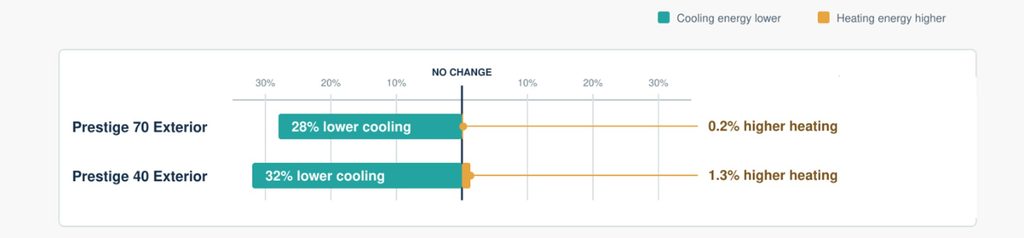
In 2017, researchers modelled adding solar control window film to an existing UK hotel’s clear double glazing. The windows had a U-value of 2.77 W/m²K, a measure of how readily heat escapes. That is appreciably higher heat loss than a well-performing modern window. The simulation used weather based on historical averages, rather than a future, warmer climate.
For that clear double glazing, the annual results were:
Film
Change in cooling energy
Change in heating energy
3M Prestige 70 Exterior
28% lower
0.2% higher
3M Prestige 40 Exterior
32% lower
1.3% higher
Heating and cooling are separate energy totals. These hotel simulations are not predictions for an individual house. Nevertheless, they show substantial cooling reductions alongside very small annual heating increases. Overall modelled energy use also fell. 2017 UK hotel study, Tables 1 and 5
That is reassuring evidence against the assumption that summer protection must bring an equally large winter disadvantage.
Does modern double glazing still need solar control?
It can, especially in rooms that already overheat in sunshine. Modern glazing can improve heat retention much more than it reduces incoming solar heat. Consider this illustrative comparison with the study’s baseline:
Property
Study baseline
Illustrative modern glazing
What changes under matching conditions
U-value: heat loss through the window
2.77
1.4
About 49% less heat loss
g-value: proportion of solar energy admitted
Approximately 0.71
0.63
About 11% less solar heat entering
Study baseline glazing compared to illustrative modern glazing
These are illustrative changes in glazing properties before adding film, not recalculated annual results or a specification shared by all modern windows.
In this example, roughly half as much heat escapes through the window, while almost nine-tenths of the previous solar heat still enters.
That changes what the room needs. With less heat escaping in winter, less additional warmth is needed to maintain its temperature. Yet sunshine can still deliver a substantial heat load. A room that retains warmth well may reach a comfortable temperature sooner, leaving less use for further solar heat. In summer, that continuing solar gain can become a serious comfort problem.
This does not mean the study’s small heating increases can simply be halved. Better glazing also retains useful solar warmth, and the film’s effect depends on the particular glass. A 2024 national laboratory report confirms that the additional solar heat reduction varies between glazing constructions. Recalculating the annual balance would require a new building simulation. NREL window film research
About the glazing comparison
The 49% and 11% calculations illustrate separate changes in heat loss and solar gain; they do not predict annual energy savings. The study reports U = 2.77; 1.4 is an assumed improved whole-window value. A starting g-value of approximately 0.71 is inferred from the study’s rounded film performance data. The 0.63 example comes from a specified Pilkington low-emissivity glass unit. These values do not establish the performance of a particular replacement window or film installation. Study glazing data, Pilkington specification
Warmer winters and hotter summers shift the balance further
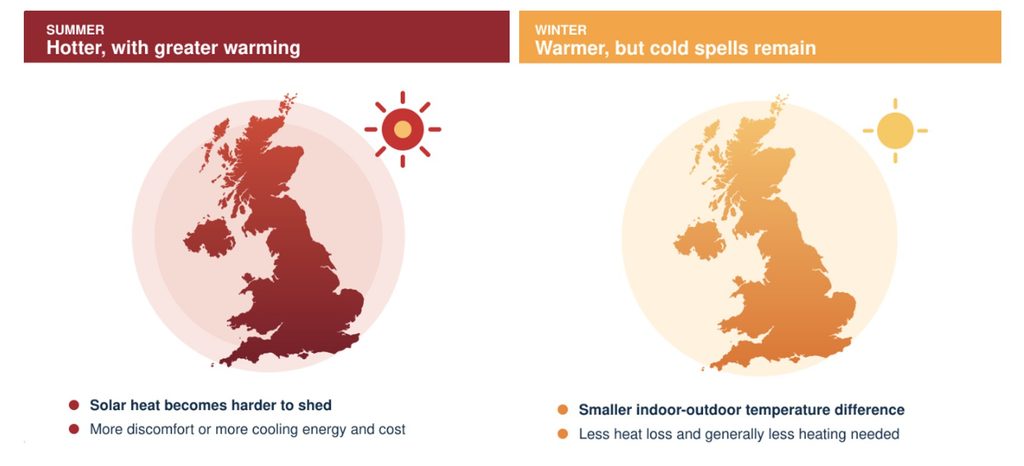
The study also predates the conditions that today’s homes will face over the coming decades. The Met Office projects warmer UK winters and hotter summers, with greater warming in summer than winter. Met Office UK climate projections
Milder winters reduce the temperature difference between indoors and outdoors, so less heat escapes. Combined with lower window U-values, that generally reduces the need for heating and can shorten the periods when extra solar warmth is useful. Cold spells and welcome winter sunshine will remain part of life.
Hotter summers put more pressure on the other side of the balance. Incoming solar heat becomes harder to manage, particularly when warm evenings limit the relief available from ventilation. Homes using air conditioning can face greater cooling energy use and expense. Homes without it face more discomfort.
Projected UK climate predictions and better insulated glazing point in the same broad direction
The likely direction is therefore less need for winter heating and greater need to control summer heat. The precise film savings still depend on the home, but the study’s reassuring result deserves to be read alongside those changing conditions.
For a room that already overheats, better heat retention and a warming climate strengthen the reason to manage excess sunshine. Preserving every possible bit of winter solar warmth should not take priority over making that room comfortable and usable.
How does 3M Prestige work with the seasons?
The choice of film provides further reassurance. 3M Prestige accounts for over 80% of WindowTreat’s residential sales, and its performance changes with the angle at which sunlight meets the glass.
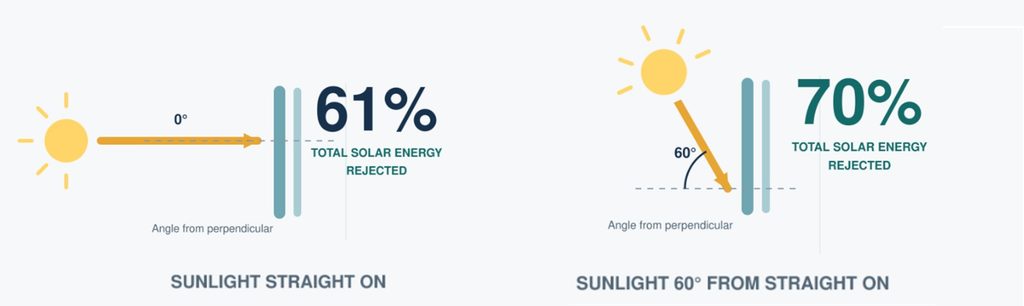
3M Prestige’s heat rejection increases as sunlight arrives more obliquely. Published data for Prestige 70 Exterior on reference clear double glazing show total solar energy rejection increasing from 61% with sunlight arriving straight on to 70% at a 60-degree angle from straight on. An increase of 9%.
3M’s Prestige exterior angular selective solar control film has up to 9% variation depending on altitude of the sun.
On a south-facing vertical window, around midday, the high summer sun meets the glass more obliquely. The lower winter sun approaches more directly. That geometry, together with Prestige’s angular performance, can favour stronger summer protection while admitting a greater proportion of the lower winter sun’s energy.
On suitably oriented windows, 3M Prestige exterior can work with the seasons without you adjusting it. It continues to reduce some winter gain. Roof glazing and east or west-facing windows experience different angles, so their seasonal behaviour needs to be considered separately.
The right grade also matters. We look at the existing glass, the direction of the sunshine and the daylight you want to retain. A lighter film or treatment of selected panes may give the balance you need. You can explore the options in our Prestige Exterior comparison.
For a homeowner’s account of the difference in everyday use, see our garden room solar control case study, which includes customer video feedback about summer comfort.
Will solar control window film make my home darker in winter?
All solar control films reduce visible light to some degree, but the effect varies considerably. A lighter, more neutral film can preserve more daylight and produce less noticeable tint, while a darker film may offer stronger heat and glare reduction.
There are usually two concerns: how the film will look on the glass and how much it will affect the brightness of the room. In practice, both effects are often less noticeable than expected. Our eyes naturally adapt to modest changes in light, so the perceived difference can be smaller than the measured reduction suggests.
We consider how bright the room already is, the appearance and daylight you want to retain, and the level of heat and glare control required. The aim is to achieve the right balance, rather than simply choosing the strongest film.
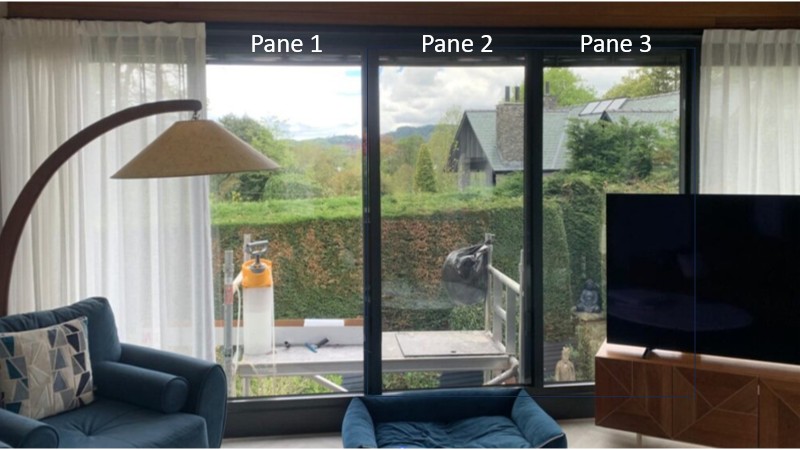
Pane 1 on the left is untreated modern glazing whereas Panes 2 and 3 are treated with 3M Prestige 50 exterior.
Enjoy the sunshine without accepting the overheating
If a room regularly becomes too hot to enjoy, solar control deserves serious consideration. A possible reduction in useful winter warmth is something to account for when choosing the film, rather than a reason to live with the summer problem.
Some homes do make especially good use of winter sunshine. Where summer discomfort is occasional and winter solar heating is important, targeted treatment or adjustable shading may offer a better balance. Film can also form part of a wider solution that includes ventilation and shading elsewhere. For roof glazing, our guide to improving comfort beneath skylights explores the available approaches.
Next Steps
Take the first step towards enjoying your room through more of the year.
Book a free 15-minute call with a WindowTreat specialist using the calender below. Tell us which room overheats, when it happens and what you value about it in winter. We will help you understand whether solar control film is a good fit and what to consider for your existing glazing.
Steve Gargett has been helping people transform their spaces with window film since 2008. With a physics degree and full completion of the Chartered Institute of Management Accountants examinations, he brings a rare blend of technical understanding and financial rigour.
Earlier in his career, Steve held senior financial and project roles within a Fortune 100 company, where he learned the importance of value for money and strong returns on investment. Today, he uses specialist modelling software from the Lawrence Berkeley National Laboratory in California to predict how glazing will perform before and after film installation. Every recommendation is based on independently tested films, giving customers confidence in fact‑based, tailored advice.
He has supported homeowners, architects, and commercial clients across the UK, always focusing on what matters most to each customer and delivering solutions that balance performance, appearance, and long‑term value.
We use cookies to ensure our website works as expected and to improve your experience.
Some cookies help us understand how visitors use our site, and allow us to refine our services. You can accept all cookies, decline non-essential ones, or customise your preferences at any time.
Functional
Always active
These cookies are essential for the website to function properly. They enable core features such as security, network management, and accessibility. The website cannot operate correctly without them.
Preferences
The technical storage or access is necessary for the legitimate purpose of storing preferences that are not requested by the subscriber or user.
Statistics
The technical storage or access that is used exclusively for statistical purposes.The technical storage or access that is used exclusively for anonymous statistical purposes. Without a subpoena, voluntary compliance on the part of your Internet Service Provider, or additional records from a third party, information stored or retrieved for this purpose alone cannot usually be used to identify you.
Marketing
The technical storage or access is required to create user profiles to send advertising, or to track the user on a website or across several websites for similar marketing purposes.
Our receptionist will gladly schedule a consultation for you.
For a more detailed and personalised call, please use the form below. By telling us about your project in advance, our specialists can prepare tailored advice. We will call you back at your chosen time.