You might assume that choosing a high performance window film is the key to improving comfort and solar control, but the process starts much earlier. Expert advice guides the correct match between film and glass type. Choose the wrong film and the installation will not perform as intended, no matter how carefully it is fitted.
Once the specification is correct, the focus shifts to visual quality and installation care. These work together to deliver clarity, durability and a premium finish that lasts for years. This article explains five things that are often muddled together: how a finished installation is inspected, what happens while the film cures, how the edges are judged, what WindowTreat’s workmanship commitment covers, and what the manufacturer’s warranty covers.
The Industry Standard: A Low Bar for Workmanship
The UK reference point is the Glass and Glazing Federation data sheet on visual quality for applied window film. It dates from January 1997 and has not materially changed since. It is an inspection method, and it is worth knowing how it works, because it is what most companies will point to if you question a finish.
- You look at the glass from inside the room, at right angles, from at least 2 metres away.
- You look in natural daylight, not in direct sunlight.
- You judge the main vision area, leaving a 50mm band around the edge to be assessed separately.
- Dirt particles, hairs and fibres, adhesive gels, fingerprints, insects, edge lift, scratches, distortion, creases, air bubbles and small nicks or tears are acceptable only if they are unobtrusive under that test.
- Water haze, water bubbles and water distortion during the curing period are disregarded, because they clear.
Put plainly, the bar is low. A finish passes if you cannot easily see the faults from two metres in soft daylight, and the standard has not been raised since 1997. The trouble is what happens in practice. Two metres and soft daylight are forgiving. A homeowner looks at their own glass from arm’s length, in low evening sun, every day. A commercial installer paid by the square metre has every reason to work to the test and no further.
Retrofitted filmed glass will never match a laboratory lamination, and the standard is right to say so. But the gap between “unobtrusive from two metres” and “clean when you stand at the window” is where craftsmanship lives, and it is the gap WindowTreat works in.
A Culture Built on Speed Rather Than Quality
For decades, installers prioritised speed over craftsmanship. For much of the UK trade the work has been commercial: large runs of office glazing, priced and judged by how many square metres an installer can complete in a day. In that world the inspection test is the finish line, because that is what the pricing rewards. They chased square metre rates. They didn’t chase excellence.
WindowTreat changes that culture. We install high end films for homeowners with precision, care and pride, and we hold every installer to a standard set by what the customer will see, not by what a 1997 data sheet will tolerate. We prioritise quality, not speed, and we treat every installation as a demonstration of expertise.
We keep our installation process far away from the commercial installation culture that dominates window film companies in the UK.
The Reality: 60% Cleaning and 40% Installing
Modern glazing demands a far more disciplined approach. Exterior spectrally selective films are extremely sensitive to contamination, and the gaskets around modern glazing are often loaded with oils, grit, degraded rubber and airborne pollutants. If these contaminants are not removed thoroughly, the film will pull them straight into the adhesive.
This is known as the capillary effect.
The capillary effect occurs when the pressure sensitive adhesive touches a contaminated gasket or frame edge. The adhesive acts like a wick and draws dirt, oils, degraded rubber and micro grit up under the film. This contamination usually appears within the 50mm perimeter band, and it cannot be removed once trapped. It shows up as dark specks, and it increases the risk of the film lifting in time because the bond along the edge is compromised.
This is why, in our experience, exterior spectrally selective films like 3M Prestige exterior need about 60% of the time spent cleaning and 40% installing. If modern gaskets are not cleaned methodically, the capillary effect will expose every shortcut. It is one reason some installation companies steer customers towards interior films such as Climate 35 or 3M Prestige 70 Interior on modern glazing, despite the smaller improvement they give on low-e glass. Interior films avoid exterior contamination entirely, require far less preparation and are not weather dependent.
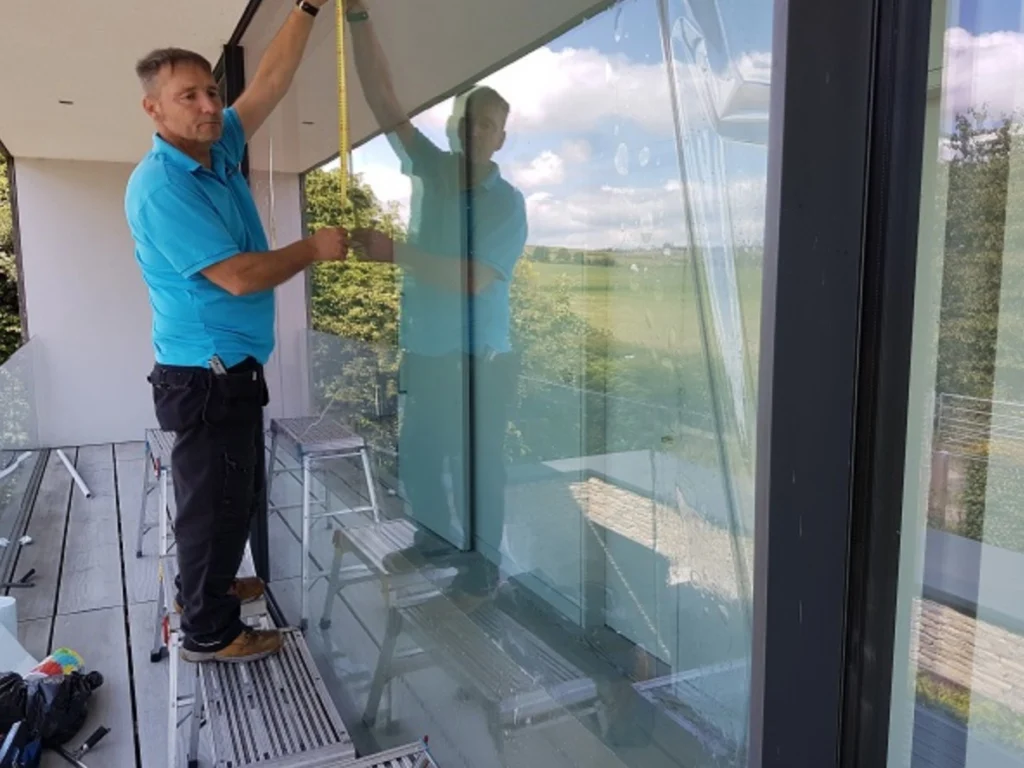
This video demonstrates Mike completing an installation. It shows the meticulous cleaning process, the preparation steps and the careful application techniques that define WindowTreat visual quality standards.
Static, Airborne Contaminants and Back Rolling Techniques
During installation, the clear backing liner is peeled away and the adhesive instantly becomes a static magnet. Any airborne pollutants or debris sitting on the frames will be pulled straight toward the film.
Expert techniques such as back rolling help minimise this effect, as demonstrated by Mike in the video. By rolling the film down the glazing rather than lifting it through the air, the adhesive is exposed in a more controlled and cleaner environment.
Even so, no technique can compensate for poor cleaning. If the glass and frame are not prepared methodically, the visual quality will be compromised before the film even touches the surface.
The Edges: Where a Good Installation Shows
The GGF data sheet treats the 50mm band around the edge of each pane separately, and allows a small number of particles there where the condition of the frame makes a higher standard unattainable. That allowance exists for tired commercial frames. On a home with modern glazing, WindowTreat treats the band to the same standard as the rest of the pane, because the band is where capillary contamination shows and where edge lift starts.
A deliberate edge gap is not a fault. Film is cut back from the frame, normally by 1 to 4mm, so water can be squeegeed out and the film never touches the gasket. Film that overlaps the gasket is the installation fault, because it is the start of peeling. On darker films we keep the gap towards the smaller end so the light line at the edge stays discreet.
Panes wider than a roll of film also need a join, and where it sits matters just as much: see how we plan film joins on large sliding doors.
What to Expect While the Film Cures
A freshly installed film is not finished on the day. The adhesive reaches its final strength over the following days, and the small amount of water left behind the film works its way out over the following weeks. 3M’s guidance for Prestige Exterior is final adhesion after about 8 to 10 days at around 18°C in dry conditions. The GGF data sheet gives a typical visual cure of around 30 days for films up to 100 microns thick, and longer in cold or damp weather.
During that period a slight haze, small water pockets or faint distortion are normal and clear on their own. They are not inspected as defects and they are not something to press or pierce. Dark specks, hairs, fibres, creases and air bubbles are different: they do not clear, and they are what a careful installation avoids in the first place.
Slower, More Careful and More Reliable
WindowTreat installers take longer and complete fewer installations per day, and this is exactly why the results are consistently better.
Installers spend a significant amount of time preparing the glass and frames. They scrape the glass clean, work behind the gaskets to remove hidden debris, and wipe the gaskets repeatedly with lint free tissue to remove contamination. They overlap squeegee strokes with methodical precision, using both hands for pressure to drive the water out from behind the film. No air bubbles are left. They do not rush to get home early, and they take the time to clean the film and tidy the work area. Most importantly, they do not work to the minimum a 1997 data sheet will accept.
Shortcuts are easy. Quality is not.
Workmanship Commitment and Warranty: Two Different Promises
Two promises protect a WindowTreat installation, and it helps to know which is which.
The manufacturer’s product warranty covers the film itself. For the 3M Prestige Exterior Series this is 10 years on vertical and near-vertical glazing and 7 years on sloped and horizontal glazing, subject to 3M’s conditions and registration. It covers the product, not the way it was fitted. If a film fails and the manufacturer finds the cause was the installation, the warranty does not apply.
WindowTreat’s workmanship commitment covers that gap. If 3M or Solargard investigates a failure and finds a workmanship issue, WindowTreat replaces the film on the affected windows, for as long as the manufacturer’s product warranty runs, on residential installations. Access equipment such as scaffolding or lifts is excluded, and so are films no longer manufactured.
A warranty is a promise, not a lifespan. WindowTreat and manufacturer experience is that a well specified, well installed 3M Prestige Exterior film has a life expectancy of 20 years or more, well beyond its warranty period. That longevity depends on the care taken during fitting, which is why the two promises belong together: the manufacturer stands behind the film, and WindowTreat stands behind the installation.
The full wording of the workmanship commitment is below.
The Takeaway
Visual quality is not a luxury. It is the foundation of performance, longevity and homeowner satisfaction. Expert advice ensures the right film for modern glazing. High quality film delivers the performance. Careful installation protects visual clarity and long term durability. The industry’s inspection test is a reasonable floor; WindowTreat treats it as a floor, not a target.
We have built a culture where cleaning comes first and installers take pride in taking more time to achieve a higher standard. The approach costs more, but the extra time is cheap insurance against a film that has to come off and go on again.
Supporting Links
Best Solar Control Films for Modern Glazing: 3M Prestige Exterior Compared – WindowTreat
Making Sense of Window Film Performance Data – WindowTreat
Why Internal Solar Control Films Struggle on Modern Double Glazing – WindowTreat
Heatwaves, Solar Gain and Smarter Cooling Strategies – WindowTreat
Understanding Solar Heat Gain: My Professional Guide to a Home with Heavy Glazing – WindowTreat
Explore this topic
Completed customer projects
- Success Story Window Film Mark
- Cooling a New Build with Heat Rejecting 3M Window Films
- Stewart’s Garden Room Transformation: From 27°C Alerts to All‑Day Comfort with 3M Prestige 40 Exterior
Your next step
See the window films for your home we fit; we quote from your photos