New window film looks hazy for the first few days, with small water blisters and sometimes finger-shaped lines under it. That is fitting water, and it dries out on its own: typically within about 30 days for solar control, privacy and low-e films, 60 days for safety film, and longer in cold or damp weather. A crease, a scratch, film touching the frame or lifting at an edge is different: those are things to tell us about straight away. This page shows what each thing looks like, how the Glass and Glazing Federation says film should be judged (from 2 metres, in daylight, looking through the window), and how to send us two photos of anything that bothers you.
What you will see, and what it means
The interactive guide above draws each of these. Here they are in plain text.
| What you see | What it is | What to do |
|---|---|---|
| Water pockets or blisters | Soft-edged, cloudy blisters of fitting water, often in groups. They shrink week by week and can seem to grow or join up in the first week before they shrink. One wider than a 5p coin (about 18 mm), or not roughly round, may not dry out on its own. | Give it time if it is smaller than a 5p; send a photo if it is bigger or an odd shape |
| Spears and fingers | Thin, tapering fingers of trapped water, about 1 to 15 cm long, usually running in from an edge. They dry out like pockets. | Give it time; send a photo if they are still there after the drying time |
| Haze or a milky look | Fitting water across the pane in the first days. It lifts as the water goes. | Give it time |
| Slight waviness or distortion | Water under the film while it dries. | Give it time |
| A small speck | A single dust particle you find close up and lose from 2 metres. | Expected with applied film |
| A hair or fibre | One fine fibre, only found close up. A group of them is a different matter. | Expected if you lose it from 2 metres; a cluster is one to tell us about |
| Light line at the edge | A fine pale line in the 1 to 4 mm gap at the frame, more visible with dark films. | Expected with applied film |
| A straight join | On panes bigger than the roll. Straight, parallel to the frame, with a gap of 1 mm or less. | Expected with applied film |
| Reflections look different | Metallised films (silver films, 3M Night Vision) change how the glass reflects. The GGF says this is not a defect. | Expected with applied film |
| Specks bunched together | Several particles in one patch, or a cluster you keep noticing from 2 metres. | Get in touch |
| An insect | A small fly or thrip trapped under the film and visible from the room. | Get in touch |
| Air bubble | Sharp-edged and clear, like a bubble in a spirit level, and it has not changed size. There is no water in it to dry out. | Get in touch |
| Crease or fold | A sharp line or kink in the film itself. | Get in touch straight away |
| Scratch, nick or tear | A fine bright line, a notch at an edge, or a tear. | Get in touch straight away |
| Smear or adhesive mark | A cloudy patch, streak or sticky mark still there after the drying time. | Get in touch once the film has dried |
| Fingerprint | A print under the film, visible from the room. | Get in touch |
| Edge lifting | Film peeling or curling away from the glass at an edge or corner. | Get in touch straight away |
| Film on the frame | Film pressed against the frame or gasket with no gap. The GGF calls this an installation fault. | Get in touch straight away |
How long new window film takes to dry
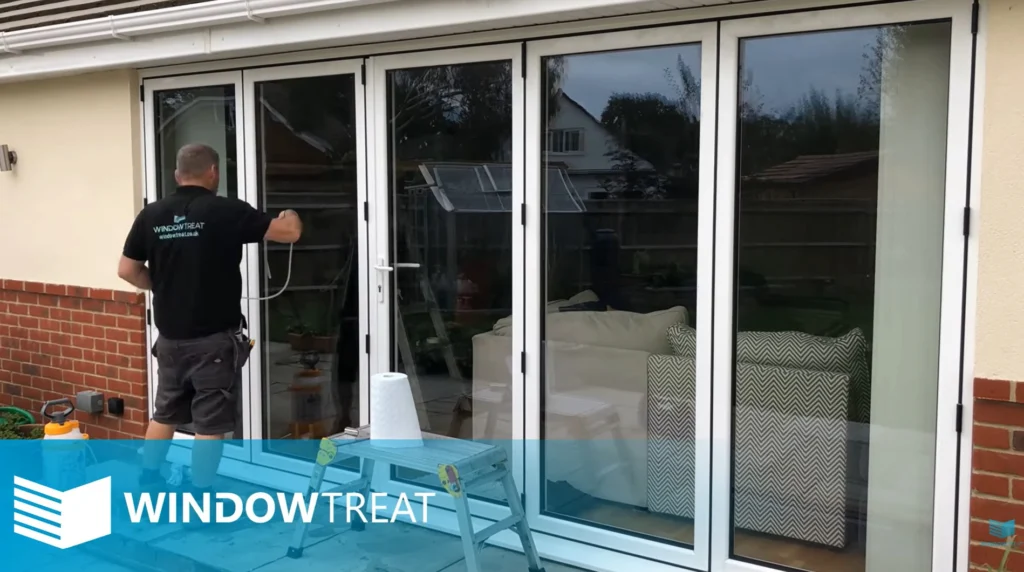
Film is fitted wet. We float it onto the glass on a slip solution, position it, then squeegee the water out. A thin layer of moisture always stays behind and dries out through the film over the following weeks. The GGF gives these typical times for the film to reach its normal appearance:
| Film thickness | Typical films | Typical drying time (GGF) |
|---|---|---|
| Up to 100 microns | Solar control, privacy, low-e, anti-glare | 30 days |
| 100 to 200 microns | Safety film | 60 days |
| 200 to 300 microns | Heavier safety film | 100 days |
| 300 to 425 microns | Heaviest security film | 140 days |
The GGF says cold, damp or shaded conditions extend these times, without giving a figure. In our experience of UK fitting, a north-facing window fitted between November and February can take around half as long again. That is our estimate, not a number from the standard. 3M notes that some individual water pockets take longer than 30 days. Please do not clean the windows for the first 30 days, while the adhesive is still building its grip, and please do not press or prick water pockets.
How to check your film
There are two useful ways to look at a window. Close up, you find and measure a blemish. From 2 metres, in daylight, you see whether it matters when you look through the window as you normally would. The GGF’s test for applied film asks whether anything is visually disturbing under these conditions:
- Look twice: the day after fitting for fitting faults (creases, tears, film touching the frame), and again once the film has dried for anything else.
- Clean the glass on both sides first. Dust on the outside often looks like a speck under the film.
- Stand inside, at least 2 metres back, roughly square on to the window.
- Use natural daylight, not bright direct sunshine and not a torch.
- Look through the glass at the view and ask whether anything catches your eye.
The 50 mm band next to the frame is checked the same way, but where an old or rough frame sheds debris during fitting the GGF accepts a small number of particles there. We work the edge band to the same standard as the main view wherever the frame allows. For comparison, the glass industry judges glass itself from 3 metres, and small blemishes in glass pass as long as they are not obvious or bunched together.
When to get in touch
Straight away, at any time:
- A crease, fold or sharp line in the film
- A scratch, nick or tear
- Film touching or pressed against the frame or gasket
- Film lifting or peeling at an edge or corner
- Part of a pane left uncovered, or a join that is not straight
- A visible gap at a join (more than about 1 mm)
Once the film has dried (about 30 days, longer in winter):
- Anything in the main view that catches your eye from 2 metres in daylight
- Specks, hairs or insects bunched together, or a cluster you keep noticing
- A clear, sharp-edged bubble that has not changed size
- A water pocket wider than a 5p coin (about 18 mm), or not roughly round, at any point
- Haze, streaks, smears or spears still there after the drying time
- Adhesive marks or a sticky residue you can see
- Fingerprints under the film
If you keep noticing something that this page says is expected, send a photo anyway. We would rather look.
How to show us: two photos
- Close up, with a tape measure next to the blemish. This tells us what it is and how big it is. A torch or low sun is fine for this one.
- From 2 metres, from where you normally sit or stand, with the whole window in the picture, in daylight. This tells us what it is like to live with.
Send both on WhatsApp to 01256 648000, with which window it is and when you first noticed it. We look at them the same way we check our own work and reply with what we think it is and what happens next.
Our part
We check every pane before we leave, from 2 metres in daylight, and we work the edge band to the same standard as the main view wherever the frame allows. We will message you the day after fitting and again about a month on, when the film should be dry, to ask how it looks. You do not have to wait for that: if anything on this page is bothering you at any point, send the two photos. If it needs time, we will say so and check back. If it is not right, we will come back and put it right.
Where this comes from
| Source | How to look | Edges | Drying time | What passes |
|---|---|---|---|---|
| GGF Datasheet 5.18.3, Visual Quality for applied film, April 2020 | Looking through the film at right angles, at least 2 m, natural daylight not direct sun; exterior film from either side | 50 mm band assessed with the frame in mind; edge gap normally 1 to 4 mm, under 2 mm for dark films; film touching the frame is an installation fault | 30, 60, 100 or 140 days by thickness; longer in cold, damp or shaded conditions | Dirt, hairs and fibres, gels, fingerprints, insects, air bubbles, haze, scratches, distortion, creases, edge lift, nicks and tears, acceptable only if not visually disturbing; changed reflections are not a defect |
| IWFA Architectural Visual Inspection Guideline, 2020 | As GGF, from the room side | As GGF; adapted from GGF material with permission | 30, 60, 90 or 140 days | Same list; the word used is “unobtrusive” |
| 3M Visual Guidelines and Care and Cleaning, 2022 | At least 6 ft (about 2 m), mainly at right angles, daylight not direct sun, glass clean both sides | Some contamination near edges is hard to avoid and expected | Final inspection around 30 days; longer in cool, humid conditions and for thick or metallised films | Good fitting keeps contamination from being obtrusive; exterior fits may mean accepting some specks |
| Solar Gard visual inspection bulletin | At least 2 m, right angles, daylight | As GGF | Full cure typically about 30 days, depending on film and climate | Contamination minimised and not obtrusive in normal viewing |
| GGF visual quality standard for glass | From inside, about 3 m back, daylight not direct sun | Outer 50 mm excluded | Not applicable | Small blemishes in the glass itself pass if not obvious and not bunched together |
GGF Datasheet 5.18.3 (April 2020) is published by the Glass and Glazing Federation for its members. Public copies of the other sources: IWFA guideline; 3M visual guidelines. For the standard in full, and why it is written the way it is, see Visual Quality in Window Film Installations.
Questions we are often asked
Will the bubbles go? Water pockets, haze and finger-shaped lines go on their own as the fitting water dries out, typically within 30 days for most films and longer for thick films and in winter. An air bubble (sharp-edged, clear, not changing size) does not, so tell us.
Can I clean the film? Not for the first 30 days. After that, use a soft cloth or paper towel and a normal glass cleaner, with no scrapers, abrasives or heavy pressure. For exterior film see how to clean and care for 3M Prestige Exterior window film.
Why is there a gap between the film and the frame? A gap of 1 to 4 mm lets the fitting water out and keeps the film off the frame and gasket. Film pressed against the frame can lift and peel, which the GGF calls an installation fault. The gap can show as a faint lighter line, more so with dark films.
Why does my window reflect more than before? Metallised films, including silver films and 3M Night Vision, change how the glass reflects. The GGF says this is a natural result of the coating, not a defect.
Thinking about window film for your own glazing and want to talk it through first? Book a free call.