The short answer: the glass is rarely the whole answer. The homes that are hardest to break into stack three layers: something that puts a burglar off (cameras, lights, a house that looks lived in), something that raises the alarm the moment the glass is hit (shock sensors on a loud alarm), and something that slows them down while the alarm does its work (anchored security film or security glass). Get all three working together and a burglar is left standing outside a lit, filmed, screaming house, still trying to get through the glass.
The short version
- How burglars really get in, and when
- Layer 1: put them off: cameras, lights, a lived-in look
- Layer 2: raise the alarm: shock sensors on a loud alarm
- Layer 3: slow them down: security film or security glass
- Every option side by side
- Your questions answered
Who this is for. You have a ground-floor bay, a back door, bifolds or a big pane that worries you, and you want to know what actually works, in what order, and what it costs. Written by Steve Gargett, who trained 280 police counter terrorism security advisers in making glazing safe, working with the National Counter Terrorism Security Office.
How burglars really get in
- Mostly after dark. An analysis of the Crime Survey for England and Wales for the year to March 2024 found about 59% of domestic burglaries happened in the dark. That is why autumn and winter evenings are when security matters most.
- Doors first, then windows. The same analysis found about 1 in 6 burglars got in through a window, and 1 in 10 through a window that was already open or could be pushed open.
- So start with the free fix. Lock windows and doors every time, and keep keys away from the letterbox. Everything below works far better on a house that is locked.
Layer 1: put them off before they start
- Outside lights on a sensor. A study by Loughborough University and UCL of Crime Survey data found external lights and good door locks among the most effective single security measures, and combinations of measures did better still.
- A visible camera covering the glass and the approach. It deters and it identifies. If it sees past your boundary (the pavement or a neighbour’s garden), data protection rules apply to you, so angle it carefully and use privacy masking.
- A house that looks lived in. Closed blinds all week say “nobody’s home”. Electric blinds that open and close on a varied schedule, alongside lights on timers, make an empty house look occupied while you’re away. It’s one of the most useful things an electric blind can do, and it protects your furnishings from the sun at the same time. See our smart home automation and controls.
Layer 2: raise the alarm the moment the glass is hit
Most alarms go off once someone is inside. With a glazed opening you want the alarm going off while they are still outside, attacking the glass. That’s what shock sensors do.
- Shock (vibration) sensors on each sash or door leaf. Small detectors on the frame that recognise the pattern of a hammer, bar or shoulder, while ignoring wind and traffic. They trigger before entry. Ask for them to be set as instant zones (no entry delay) and tuned on site: badly set sensors either miss attacks or cause false alarms.
- Acoustic glass-break detectors. They listen for the sound of breaking glass across a room, so one can back up several windows.
- A loud siren outside and inside, with a strobe. Noise and light are what make someone give up and run.
- A camera inside the room. It shows on your phone straight away whether an alarm is real, and records anyone who gets in. Set privacy zones or switch it off when you’re home.
- Monitoring, if you want someone to respond. A bells-only alarm relies on neighbours. For a police response, the alarm must be monitored and installed by a police-recognised installer to the right British Standards (PD 6662 and BS 8243). Ask for Grade 2 equipment as a minimum.
Why this matters for glass. Security film and security glass are designed to buy time. A shock sensor makes sure that time is spent with the alarm already sounding. We don’t install alarms or CCTV ourselves, but we’re happy to talk your alarm installer through how the glass and the sensors work together.
Layer 3: slow them down at the glass
Ordinary glass gives way in seconds. These three options turn a pane into a barrier that takes noisy, sustained effort to get through.
1. 3M security film, fixed so the glass stays in the frame
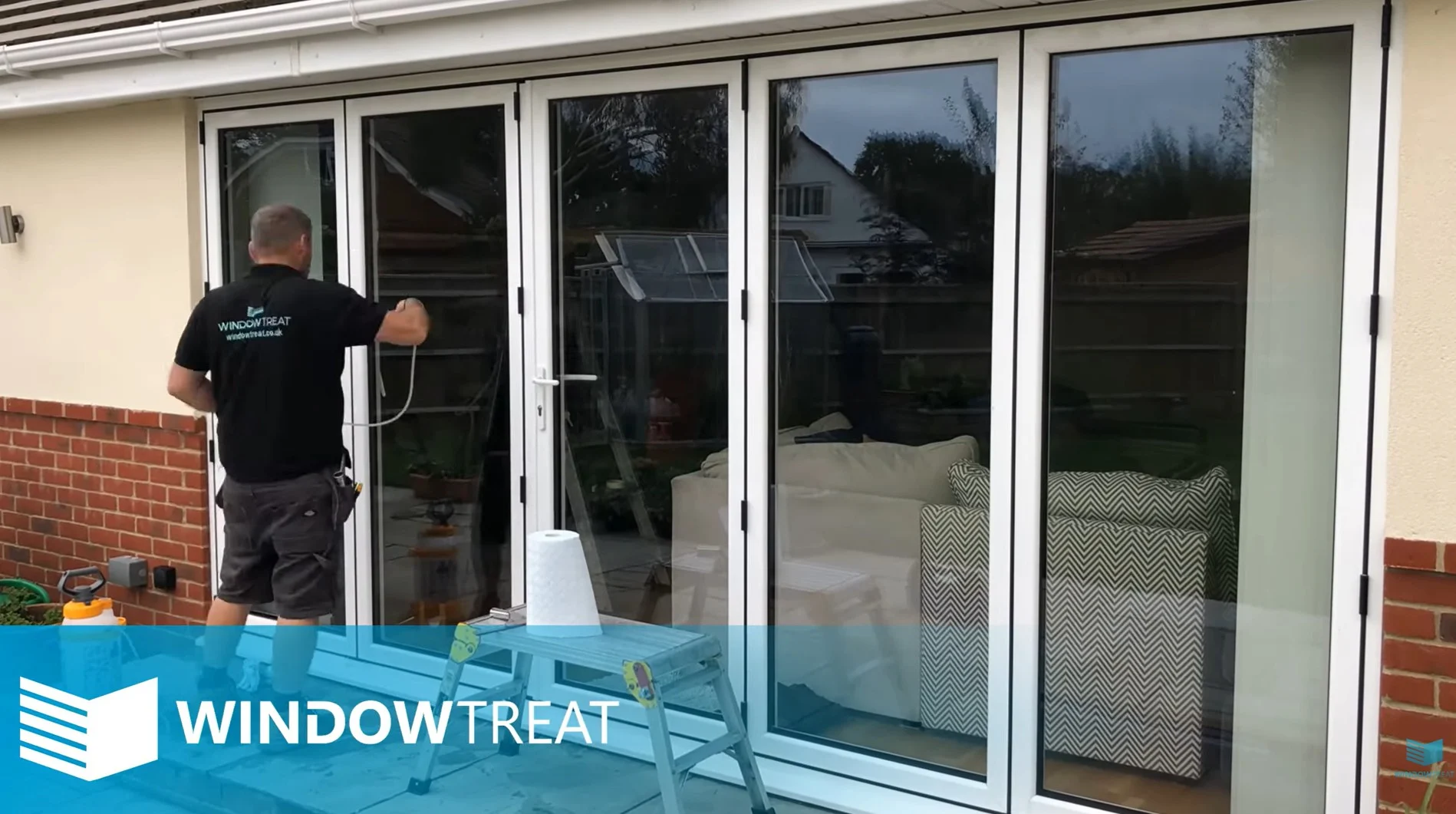
A clear film on the inside of the glass that holds broken pieces together, so a pane can’t simply be knocked out. We fit two 3M films: 3M Scotchshield Ultra S800, a multi-layer film certified impact resistant to EN 12600, with a 15-year 3M warranty; and 3M Safety S140, which reached EN 356 class P2A on 4 mm float glass, with a 10-year 3M warranty. It fits in a day, keeps your existing windows, and nobody can see it’s there.
The fixing is what makes it work. Toughened glass, which most modern doors and low panes use, breaks into small cubes. Film on the surface alone could let the whole filmed sheet be pushed out of the frame in one piece. So we fix the film to the frame in one of two ways:
- Under the beading. We take the beading off, film right to the edge of the glass unit and refit the beading, so the beading holds the filmed glass in the frame.
- Anchored to the frame. Where the beading can’t come off cleanly, we bond the film edge to the frame with 3M Impact Protection Attachment or an equivalent structural silicone, so the broken pane stays held in place under attack.
More detail on the films and fitting: 3M security window films.
2. New sealed units with a proper security laminate
Your frames stay; a glazier replaces the glass units with ones that have a genuine security laminate. The interlayer is what counts: ask for 1.5 mm or more. A standard 0.4 mm laminate is often sold as “security glass” but does far less against a determined attack. New units also bring fresh seals and modern low-E coatings, so they insulate better.
3. Glass-clad polycarbonate
The top of the range for homes: a polycarbonate core faced with glass, from the same family of materials as bullet-resistant glazing. It’s the strongest option and the most expensive, made by fewer manufacturers, with longer lead times. Ask the glazier for the EN 356 test certificate for the exact build they are quoting.
Every option side by side
| Option | What it does | Relative cost | Works best with |
|---|---|---|---|
| Locks and habits | Stops the easy entries through open or unlocked windows and doors | Free to low | Everything else on this list |
| Outside lights on a sensor | Puts burglars off and lights them up for cameras | Low | An outside camera |
| Cameras outside and inside | Deters, identifies, and lets you check an alarm from your phone | Low to medium | Lighting and an alarm |
| Electric blinds on a varied schedule | Makes an empty house look lived in; also protects furnishings from sun | Medium | Lights on timers |
| Shock sensors on a loud alarm | Raises the alarm while the glass is being attacked, before entry | Low to medium | Security film or security glass |
| 3M security film, fixed to the frame | Holds broken glass in place and slows entry; keeps your existing units | Medium, fitted in a day | Shock sensors |
| Security laminate units (1.5 mm interlayer) | Security built into new glass; better insulation too | Medium to high | Shock sensors |
| Glass-clad polycarbonate units | The strongest glass option for homes | Highest | Shock sensors and monitoring |
Relative costs are a guide for a typical ground-floor bay or set of doors. We’ll price security film for your windows on a free call.
Our recommendation
For most homes: lock up, add outside lighting and a visible camera, put shock sensors on the vulnerable glass, and fit 3M security film fixed to the frame. That gives you all three layers for far less than new security glass, without a glazier or any change to how your windows look. If your units are near the end of their life, or you want the very strongest glass, new security units are the better long-term investment, and the sensors and cameras still apply.
Worth knowing
- Glass is one part of a secure window. Film strengthens the glass; a secure window also needs sound frames and good locks. Tested secure windows (PAS 24) are tested as a whole window.
- Security film is not bulletproof or fire-rated. It holds broken glass together and slows a manual attack.
- Check which glass you have. A small kitemark in the corner of a pane usually means toughened glass. Send us a photo and we’ll tell you how the film needs to be fixed.
Your questions answered
What is the best way to stop someone breaking in through a window?
Combine layers: lock it, light it, put a camera on it, add a shock sensor linked to a loud alarm, and strengthen the glass with security film fixed to the frame or with security glass. Each layer covers the others’ gaps.
Do window vibration sensors work?
Yes, when they are set up properly. A shock sensor recognises the pattern of an attack on the frame or glass and sets the alarm off before anyone gets in. Ask your installer to tune each one on site and set it as an instant zone.
Is security film worth it on toughened glass?
Yes, if it’s fixed to the frame. On toughened glass we either film under the beading so the beading holds the filmed glass in, or bond the film to the frame with 3M Impact Protection Attachment or an equivalent. Film on the surface alone isn’t enough on toughened glass.
Should I get security film or security glass?
Film costs far less, fits in a day and keeps your existing units. New security glass costs more but renews your insulation and lasts as long as the new units. If your double glazing is getting old, new units may be the better investment; if it’s in good order, film is usually the better value.
Can CCTV point at the street?
You can, but once a camera captures images beyond your own boundary, data protection rules apply to you. Angle cameras to cover your property and use privacy masking for the rest.
Where do you fit security film?
Across most of England, and further afield for bigger projects. Send us a photo of the windows or doors that worry you.
Next step
Tell us which windows and doors worry you and send a photo of the glass. We’ll tell you which film and fixing method suits it, how it fits with your alarm, and what it will cost.
Read next: 3M security window films.