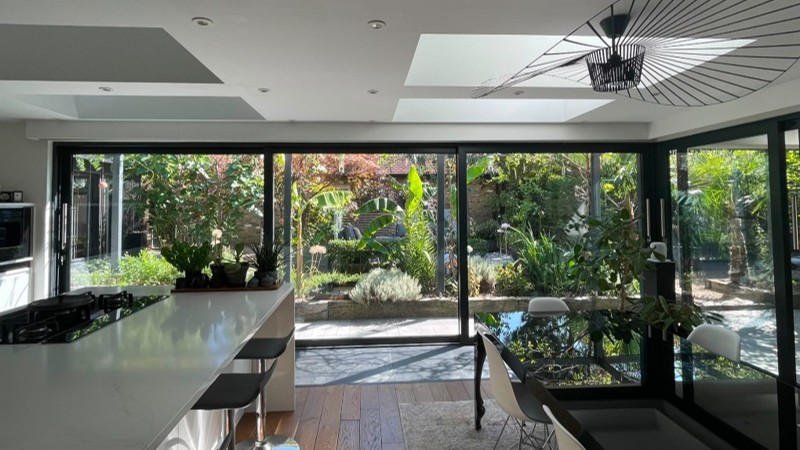
Modern homes often use skylights to pull daylight deep into living spaces. This design choice creates bright and uplifting rooms. However, it also introduces new comfort challenges. As summer arrives, the space beneath the skylights can become uncomfortably hot. When night falls, the dark voids above can feel exposed. During winter, the room can lose its sense of cosiness. These changes prompt homeowners to ask how they can improve home comfort when they live beneath skylights.
To answer this, the article explores how to enhance comfort beneath skylights through automated shading and solar control films. It outlines clear performance expectations with transparent costings so homeowners can make confident and informed decisions.
Understanding the options to reduce heat
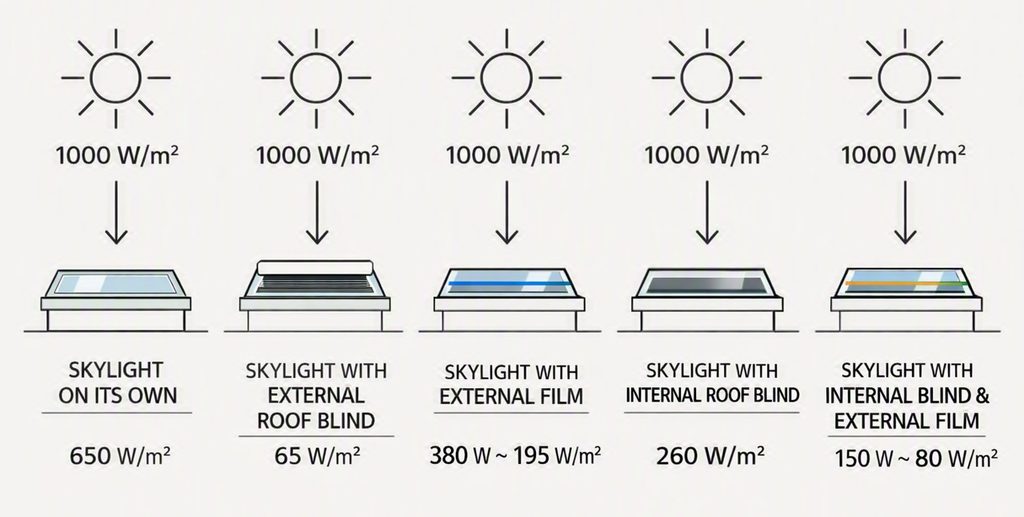
Modern skylights usually have a g value of 0.65. This means 65% of the sun’s energy enters the home through the glazing. During summer, irradiance often reaches 1000 W per square metre, so around 650 W per square metre passes through the glass. To understand what this feels like, imagine a 1m x 1.5m skylight. That area alone brings almost the same heat as a one kilowatt heater running in the room. As the number of skylights increases, or the glazed area becomes larger, the heat intensifies.
To reduce this heat, you need to lower the g value of the glazing by considering different solutions. These include automated external shading, internal shading and solar control films. Each option changes how much solar energy (Watts per square metre) enters the home with the aim of creating a more comfortable environment beneath the skylights.
Which Solutions Remove Most Heat On Modern Glazing
When you want to remove as much heat as possible, the first principle is simple.
You achieve far better results when you stop heat before it enters the glazing system. Modern insulated glass uses low emissivity coatings that slow winter heat loss. These coatings also make it harder for internal solutions to push solar energy back out. As a result, external roof blinds usually outperform internal blinds, even when the internal fabrics have very high solar reflectance. External films also tend to outperform internal films, even when they appear lighter or less reflective.
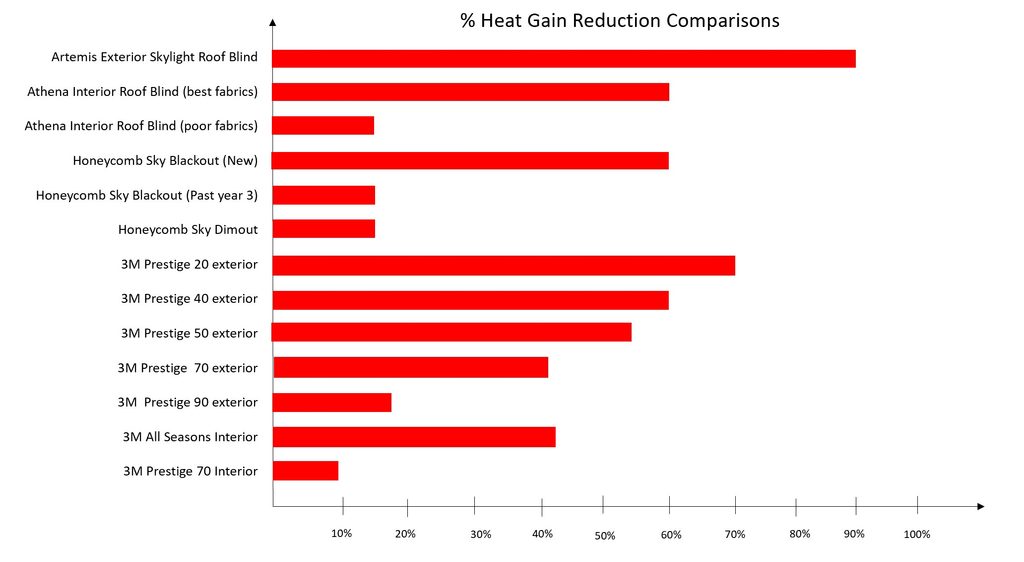
Choosing the right solution may involve more than chasing the highest heat rejection. Homeowners often have other comfort priorities such as light levels, privacy, acoustics, and draft management. These factors influence the final decision. The best approach is to find the right balance whilst staying focused on selecting an overall solution that effectively reduces heat gain.
Skylight With External Roof Blind
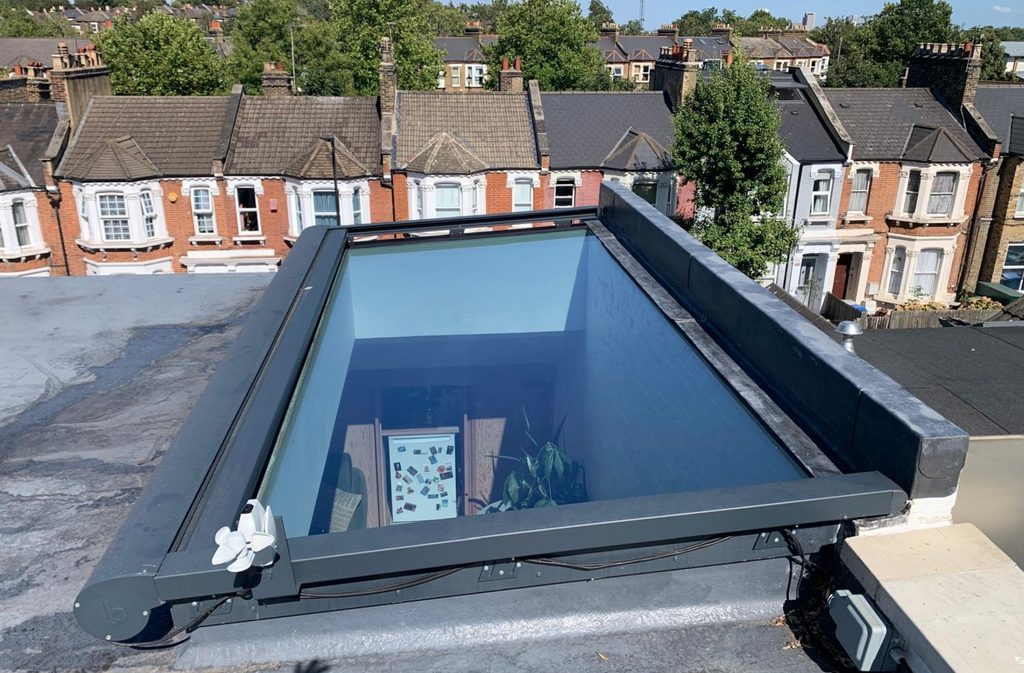
An external roof blind delivers the strongest reduction in summer heat because it stops solar energy before it reaches the glass. This approach keeps the original g value high, so the home still benefits from passive winter heat gain. As a result, external shading becomes the most effective option for maximising comfort on large, modern skylights.
The tensioned fabric travels cleanly across the glass in any direction along the pitch, and in some cases the blind can span more than one skylight. As you consider this option, it helps to understand how it behaves in real conditions. The blind retracts automatically when wind speeds rise, which protects the system but reduces shading during those potentially sunny moments. Some homeowners pair the blind with solar film to soften the impact of these retractions.
If summer heat is your only concern, an external blind remains a leading choice.
Skylight With External Solar Film
An external solar film can reduce significant amounts of heat on a skylight, as long as the glass does not have a self cleaning coating. Self cleaning coatings reject exterior films, which forces homeowners to choose internal options such as 3M All Seasons.
When the glass is suitable, external installation allows the use of the 3M Prestige Exterior, which stands out because it carries a manufacturer’s warranty even on skylights with pitches below 20 degrees, including horizontal units. Most metallised films cannot offer this.
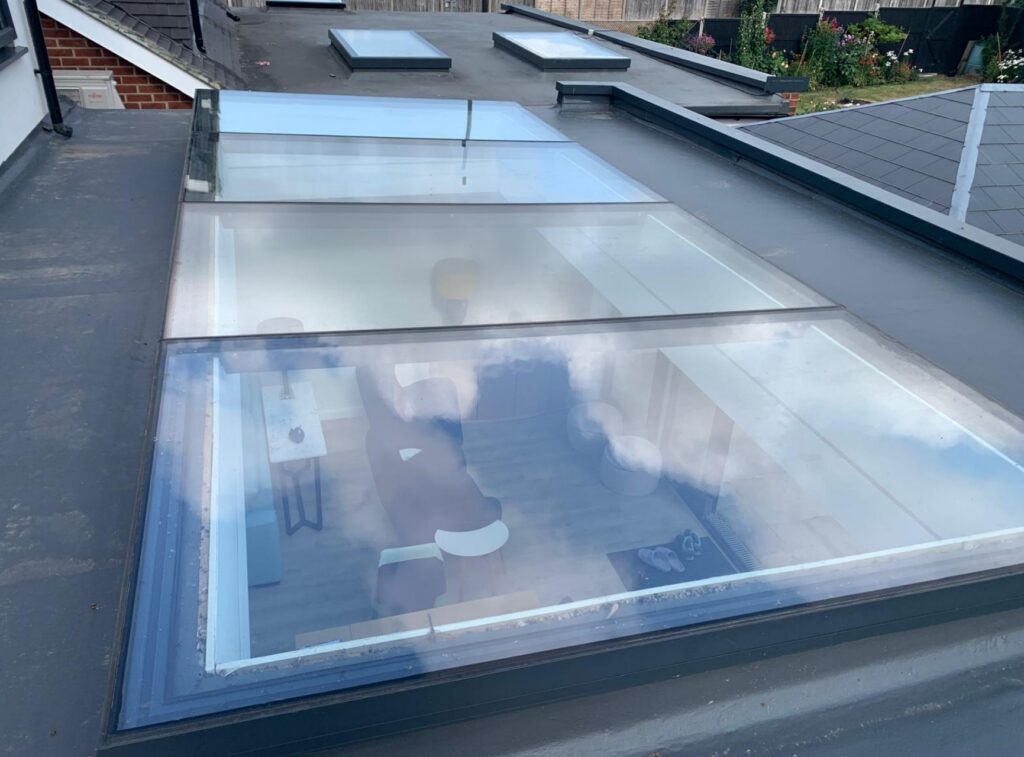
External films operate as an always‑on technology. They permanently lower the g value of the glazing, which reduces summer heat but also reduces passive winter heat gain. 3M Prestige exterior removes larger quantities of near infrared energy, which is responsible for much of the discomfort beneath skylights. If you are comfortable reducing some visible light, you can achieve even lower g values and stronger heat rejection.
Getting the right ratio of heat gain reduction to visible light becomes a key consideration
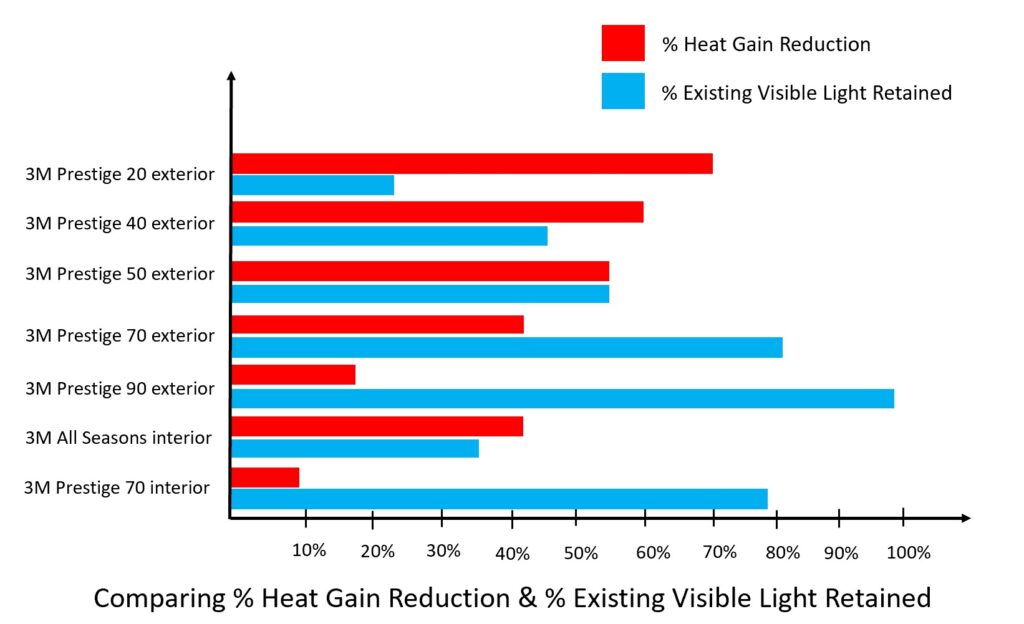
This whole area is a minefield to homeowners, so making sense of the window film performance data is important to ensure you understand how a film really performs on your modern glazed skylights.
Skylight With Internal Roof Blind
Internal roof blinds can improve comfort beneath skylights, but their performance depends heavily on fabric choice. High solar reflectance (Rs%) is essential because the blind must push solar energy back through modern insulated glazing. Even the most reflective internal fabrics will not match the heat rejection of external shading, yet they remain reliable because they are not affected by weather.
As you explore this option, it helps to consider the additional comfort benefits. As well as tackling heat gain, internal blinds can
- manage drafts
- soften dark voids at night
- improve light control including blackout
- support acoustic comfort.
They can provide an all‑year‑round solution, but only if you choose a fabric with strong solar reflectance.
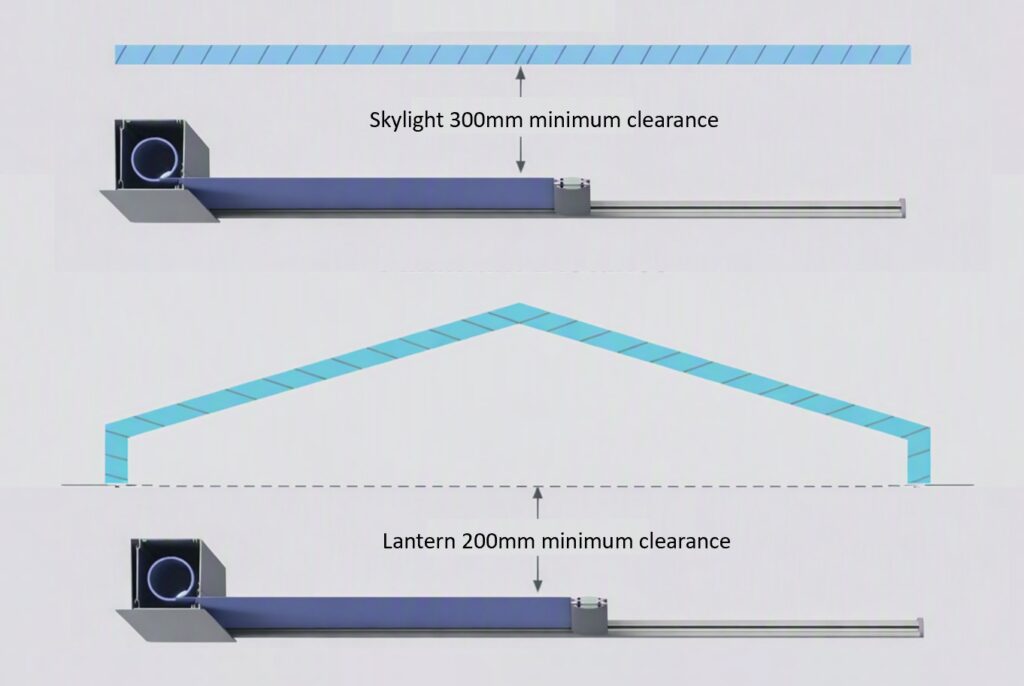
Positioning also matters. Dimensionally stable zipped fabrics can become unstable over 70 degrees centigrade, so they need space to breathe. Placing the blind around 300mm below the glass helps the fabric manage heat safely. Roof lanterns you can afford to shorten this distance.
Honeycomb fabrics breathe more easily because they are not zipped at the edges, although the adhesive between the cells can soften too under high temperatures causing the fabric to sag. They generally required cords when wider than 1500mm.
In practice, only blackout honeycomb fabrics offer any heat reflectance. Even then beware as the performance will diminish as dust settles on the fabric with time. Systems such as the Athena use aluminium cassette boxes to protect the dimensionally stable roller fabrics from dust build‑up and can be cord free at widths of 3 metres wide or more. A clean false‑ceiling effect is created but only if the roof blind system has enough tension. Discover how to avoid a sagging roof blind.
Note the Athena has over 3 times more fabric tension than CTS (Contant Tension Spring) roof blind systems.
Skylight With Internal Blind and External Solar Film
A combined internal blind and external solar film is often chosen when balanced comfort is required. Through this approach, heat is reduced before it reaches the glazing, and the internal blind then lowers it further. As a result, performance is brought closer to what an external roof blind would achieve.
In addition, the everyday benefits of an internal blind can be maintained. Night‑time cosiness is improved, glare is managed, privacy is supported and acoustic comfort is enhanced. At the same time, the external film provides continuous heat control throughout the day. When both elements are used together, a more stable and comfortable environment is created in both summer and winter.
Real Life Example Exploring The Numbers
A real life example helps show how each solution changes comfort beneath skylights. First, the total glazed area is measured. Then, summer irradiance is applied and the resulting heat load is calculated. Through this process, the impact of each shading option becomes clear.
Next, the baseline heat gain is compared with the reduced values achieved through external shading, external solar films, internal blinds and combined approaches. By reviewing these numbers side by side, homeowners can see how each solution performs in real conditions, together with transparent costs and make confident informed decisions.
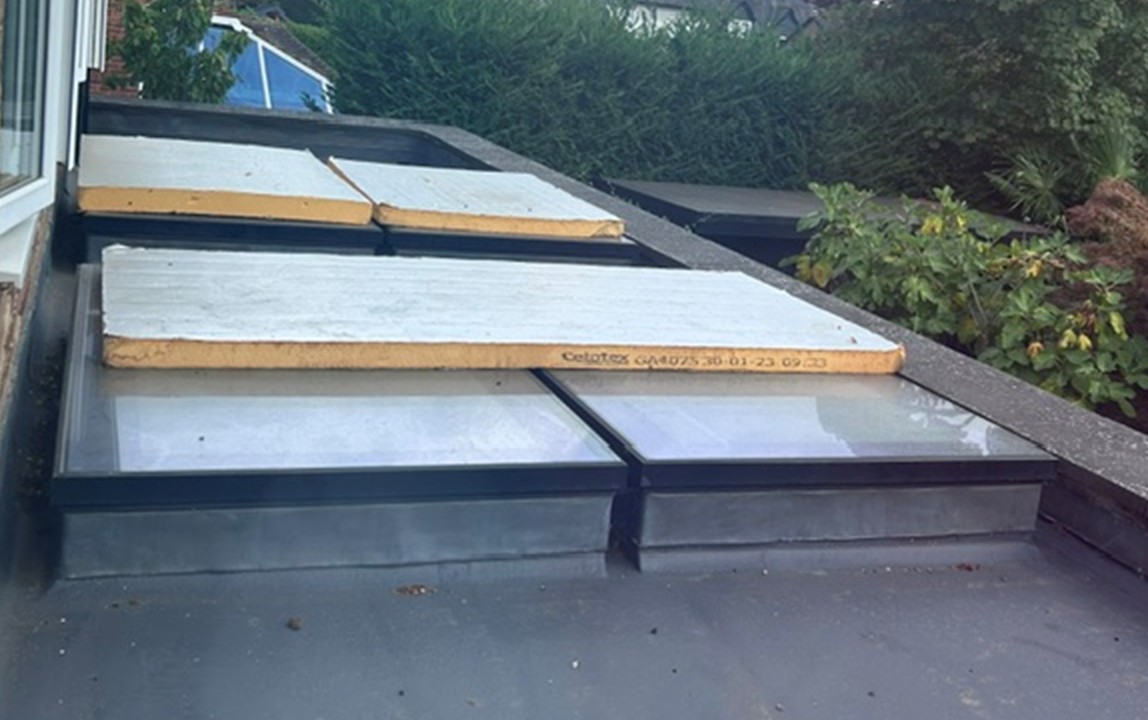
- 4no Skylights 900mm x 1800mm Internal & 1300mm x 2200mm External
- Approximately 6.5m2 of glazing
- Peak Irradiance 1000W/m2
- Skylight G-value 0.65
- Solar Energy 650W/m2
- Total Load on 4no Skylights 6.5m2 x 650W/m2 = 4225W = 4.23kW
- Equivalent to over 4no 1kW heaters in your home in the summer
| Solar Energy W/m2 | % Heat Reduction | Load on 4no Skylights | |
| Skylight Alone | 650 | N/A | 4.24kW |
| External Roof Blind | 65 | 90% | 0.42kW |
| External Solar Film (3M Prestige 70 exterior) | 380 | 41% | 2.5kW |
| External Solar Film (3M Prestige 20 exterior) | 195 | 70% | 1.27kW |
| Internal Roof Blind | 260 | 60% | 1.7kW |
| Internal Roof Blind With Exterior Film (PR70X) | 150 | 77% | 0.97kW |
| Internal Roof Blind With Exterior Film (PR20X) | 80 | 88% | 0.5kW |
Breaking Down Automating Shading Costs
- Manufacturing Survey for automated shading systems £650 inclusive of VAT
- Installation Costs £1250 inclusive of VAT per day
- Artemis Skylight Exterior Blinds 2 days installation (1-3 small roof blinds per day)
- Athena Tensioned Interior Blinds 3 days installation (1-2 small roof blinds per day)
- Honeycomb Sky Interior Blinds 2 days installation (1-4 small roof blinds per day)
| £ Systems Cost | £ Solar Panel Upgrades | £ Survey Cost | Days Required For Installation | £ Installation Costs | £ Totals | £ Optional Marketing Discounts | |
| 2no Artemis external blinds (each covering two skylights) | 8950 | N/A | 650 | 1 | 1250 | 10,850 | (600) |
| 4no Artemis external blinds (illustrative) | 15,700 | N/A | 650 | 2 | 2500 | 17,600 | (1200) |
| 4no Athena Internal Tensioned Roof Blinds | 12,200 | 1300 | 650 | 2 | 2500 | From 15,350 | (1200) |
| 4no CTS Internal Roof Blinds | 10,400 | 1300 | 650 | 2 | 2500 | From 13550 | (1200) |
| 4no Honeycomb Sky Internal Roof Blinds | 6500 | Included | 650 | 1 | 1250 | 8400 | (1200) |
| 4no 3M Prestige Exterior Solar Films | 3450 | N/A | N/A | 1 | Included | 3450 | (300) |
Analysing the Costs
When you look at the numbers, Athena internal tensioned roof blinds combined with exterior 3M Prestige film can closely match the performance of the Artemis external roof blind. The overall investment remains similar, yet each solution offers distinct advantages. In this real life example, two larger Artemis roof blinds can replace four individual ones because of the skylight positioning. This change reduces system costs and shortens installation time.
Athena stands out as the gold standard for internal systems thanks to its wide portfolio of high‑performance fabrics and superior tensioning. However, costs can be reduced by choosing CTS roof blind systems or Honeycomb SKY systems. Even using film alone provides discreet protection, and the level of solution selected to manage solar heat gain ultimately depends on budget.
The Option of Marketing Discounts
You can reduce the cost of your electric skylight shading by taking part in our marketing scheme. They are optional but if you take part, you receive a meaningful discount while helping other homeowners make informed decisions about improving comfort in their own homes.
We lower a small amount of margin on these high‑performance systems in return for real photos, videos and genuine homeowner feedback that helps future customers understand how the solutions perform in everyday use.
The process is simple. You send a set of photos and videos of your installation via WeTransfer followed by a 30‑minute scheduled video conversation with Steve, our General Manager.
We record a short section of your feedback so future homeowners can hear directly from someone who has already improved their home comfort. Steve says this is the favourite part of his job. He loves discussing your finished project and hearing how much more comfortable your home feels. Your experience gives future homeowners clarity and confidence when researching similar challenges.
Customer Video Feedback Example
The example video below was part of George’s optional marketing scheme discount.
His relaxed feedback helps future homeowners understand how these systems perform in real homes. It is not pinewood‑studio quality. Instead, it is a natural discussion directed by Steve our general manager, guiding viewers through the project and the comfort improvements achieved.
George talks about the internal Athena Roof Blind installed to his large skylight. This kind of honest, real‑world feedback gives future homeowners confidence when researching similar challenges. Visit Georges full success story
Final Thoughts
This article shows how each skylight solution plays a different role in managing heat and comfort. External shading delivers the strongest performance, internal blinds improve everyday comfort and solar films provide continuous, discreet protection.
Artemis external roof blinds set the benchmark for summer heat control. Athena internal blinds paired with 3M Prestige film move close to that level while adding year‑round comfort. CTS systems, Honeycomb SKY systems and film‑only options offer practical alternatives when budget or simplicity guide the decision.
By understanding how each option behaves and by reviewing the numbers, homeowners can choose a solution that fits their space, comfort goals and investment level. The right choice creates a cooler, calmer and more enjoyable living environment throughout the year.
Supporting Links
Success Story: How External Shading Made Helen Fall In Love With Her Home Again – WindowTreat
Skylight Heat Gain Reduction – A Clear Guide To Performance and Cost – WindowTreat
The Six Pillars of Occupant Comfort – WindowTreat
Electric Power Requirements For Premium Interior Roof Blinds – WindowTreat
Success Story: Sharon’s Electric Roof Blinds Bring Comfort Back to Her Home – WindowTreat
Making Sense of Window Film Performance Data – WindowTreat
Best Solar Control Films for Modern Glazing: 3M Prestige Exterior Compared – WindowTreat
Heatwaves, Solar Gain and Smarter Cooling Strategies – WindowTreat
https://shadeit.wpengine.com/wp-content/uploads/2018/03/Overheating-in-September.pdf